








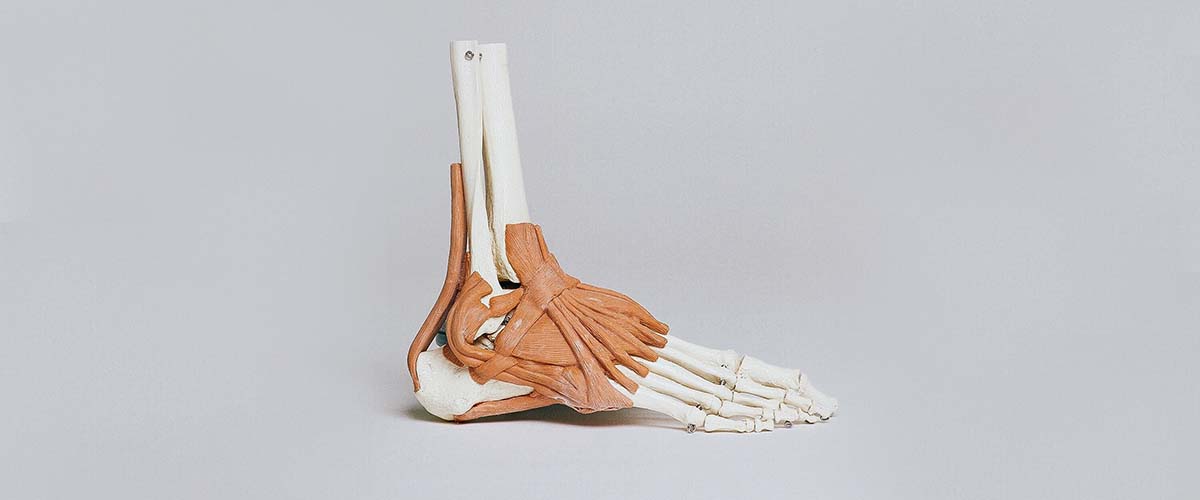
Ankle arthroscopy is minimally invasive surgery in which a small camera and instruments are placed into the ankle through two or three small incisions. It lets the surgeon see and treat problems inside the joint with less pain and a faster recovery than open surgery. It is used for impingement, cartilage lesions, loose bodies, inflamed tissue and, in selected patients, ankle fusion.1,2 It is a safe procedure: across nearly 8,000 ankle arthroscopies, major complications occurred in only 0.2%.3
- Outpatient surgery through small incisions
- Treats impingement, cartilage lesions, loose bodies, scar tissue and synovitis1
- Often combined with ligament stabilization for chronic instability14,16
- Arthroscopic fusion heals more reliably than open fusion11,12
- Major complications are rare (0.2%)3
What ankle arthroscopy treats
- Anterior ankle impingement: removing bone spurs and scar tissue, with good satisfaction and low complication rates.6,7 Patients with soft-tissue impingement often return to sport in about 6 weeks.8
- Osteochondral lesions of the talus: cleaning out and stimulating repair of cartilage defects; smaller lesions do better.9,10
- Loose bodies, synovitis and adhesions1
- Chronic ankle instability: checking and treating problems inside the joint before stabilization.14 At arthroscopy before ligament reconstruction, 77.6% had synovitis and 34.3% had talar cartilage injury.15
- Ankle arthritis: debridement for earlier disease, and arthroscopic fusion for end-stage arthritis.11
- Ankle fractures: arthroscopy during fracture fixation found joint problems in 84.2% of patients.21
- Posterior ankle problems: os trigonum, posterior impingement and FHL tendon problems, via posterior arthroscopy.2 Professional footballers returned to training in about 34 days.23
Arthroscopic ligament stabilization
For chronic instability, the lateral ligaments can be repaired arthroscopically (arthroscopic Brostrom). Compared with open repair, results were similar for stability,16,17 with fewer wound complications16 and, in one large analysis, less pain and faster return to work.18 Another analysis found slightly better scores with open repair,19 so the choice is individualized. After anatomic stabilization, 95% of patients returned to sport and 83% to their pre-injury level, at about 12.5 weeks.20
Arthroscopic ankle fusion
For end-stage arthritis without major deformity, fusion can be done arthroscopically. Compared with open fusion, it had a higher fusion rate, less blood loss and a shorter hospital stay;11 union occurred in 98% vs 83% in one series,12 with better 1- and 2-year scores.13
How it’s done
- Usually outpatient, under general or regional anesthesia
- Two or three small incisions at the front (or back) of the ankle
- The joint is examined fully, and the problem is treated with small instruments
- Gentle distraction may be used to see the joint
In-office needle arthroscopy is a newer option for selected problems such as impingement,24 though evidence is still limited.25
Risks
Ankle arthroscopy is safe; across 7,942 procedures, major complications occurred in 0.2%, most often a blood clot, and most complications were minor.3 Possible complications include irritation of the small skin nerves near the incisions, portal-site drainage or infection, and, very rarely, a blood-vessel injury after removing large spurs.4,5
Recovery
- Most patients go home the same day.
- For debridement or spur removal: walking in a boot or shoe within days, with early motion, and return to sport often in about 6 weeks.8
- For cartilage procedures, ligament repair or fusion, a period of protected weight-bearing and a longer rehab.
Dr. Dold reviews your recovery plan based on the procedure.
Frequently asked questions
Is ankle arthroscopy a big operation?
No. It is done through small incisions, usually as an outpatient, with less pain and faster recovery than open surgery.
How long until I can walk after ankle arthroscopy?
For simple debridement, many people walk in a boot or shoe within days. Cartilage repair, ligament repair or fusion requires a longer protected period.
What can’t be fixed arthroscopically?
Large deformities, some fractures and certain reconstructions still need open surgery. Dr. Dold will explain which approach fits your problem.
What are the risks?
Serious complications are rare (about 0.2%). The most common issues are minor, such as numbness near an incision.
Will I need physical therapy?
Usually yes, to restore motion, strength and balance, especially after ligament or cartilage procedures.
Research cited on this page
- Sandmeier RH, Renström PA. Ankle arthroscopy. Scand J Med Sci Sports. 1995;5(2):64-70. PubMed
Ankle arthroscopy is used to remove loose bodies, treat cartilage defects, relieve impingement, release adhesions and perform fusion. - Smyth NA, Zwiers R, Wiegerinck JI, et al. Posterior hindfoot arthroscopy: a review. Am J Sports Med. 2014;42(1):225-34. PubMed
Posterior (back-of-ankle) arthroscopy treats os trigonum, FHL and other posterior problems. - Arshad Z, Aslam A, Al Shdefat S, et al. Complications following ankle arthroscopy. Bone Joint J. 2023;105-B(3):239-246. PubMed
Across 7,942 ankle arthroscopies, major complications occurred in 0.2%; most complications were minor. - Barber FA, Click J, Britt BT. Complications of ankle arthroscopy. Foot Ankle. 1990;10(5):263-6. PubMed
An early series found complications occurred more often than previously reported. - Yammine K, Kheir N, Daher J, et al. Pseudoaneurysm following ankle arthroscopy: a systematic review of case series. Eur J Orthop Surg Traumatol. 2019;29(3):689-696. PubMed
Rarely, a pseudoaneurysm can follow ankle arthroscopy, especially after removing large anterior spurs. - Zwiers R, Wiegerinck JI, Murawski CD, et al. Arthroscopic Treatment for Anterior Ankle Impingement: A Systematic Review of the Current Literature. Arthroscopy. 2015;31(8):1585-96. PubMed
Arthroscopic treatment of anterior impingement gives good satisfaction with low complication rates. - Tol JL, Verheyen CP, van Dijk CN. Arthroscopic treatment of anterior impingement in the ankle. J Bone Joint Surg Br. 2001;83(1):9-13. PubMed
Arthroscopic spur removal gave good or excellent results in 77% with early arthritis. - Ferkel RD, Karzel RP, Del Pizzo W, et al. Arthroscopic treatment of anterolateral impingement of the ankle. Am J Sports Med. 1991;19(5):440-6. PubMed
Arthroscopic debridement of anterolateral impingement allowed return to sport at about 6 weeks. - Ramponi L, Yasui Y, Murawski CD, et al. Lesion Size Is a Predictor of Clinical Outcomes After Bone Marrow Stimulation for Osteochondral Lesions of the Talus: A Systematic Review. Am J Sports Med. 2017;45(7):1698-1705. PubMed
After arthroscopic marrow stimulation for talar cartilage lesions, outcomes depended on lesion size. - Choi WJ, Park KK, Kim BS, et al. Osteochondral lesion of the talus: is there a critical defect size for poor outcome?. Am J Sports Med. 2009;37(10):1974-80. PubMed
Lesions under 150 mm² did well after arthroscopic marrow stimulation, while larger ones often failed. - Mok TN, He Q, Panneerselavam S, et al. Open versus arthroscopic ankle arthrodesis: a systematic review and meta-analysis. J Orthop Surg Res. 2020;15(1):187. PubMed
Arthroscopic ankle fusion had a higher fusion rate, less blood loss and shorter hospital stay than open fusion. - Quayle J, Shafafy R, Khan MA, et al. Arthroscopic versus open ankle arthrodesis. Foot Ankle Surg. 2018;24(2):137-142. PubMed
Union occurred in 98% of arthroscopic vs 83% of open ankle fusions. - Townshend D, Di Silvestro M, Krause F, et al. Arthroscopic versus open ankle arthrodesis: a multicenter comparative case series. J Bone Joint Surg Am. 2013;95(2):98-102. PubMed
Arthroscopic fusion gave better 1- and 2-year scores and shorter stays than open fusion. - Ferkel E, Nguyen S, Kwong C. Chronic Lateral Ankle Instability: Surgical Management. Clin Sports Med. 2020;39(4):829-843. PubMed
Arthroscopy is recommended to address problems inside the joint before ankle stabilization surgery. - Chen H, Zhang T, Qu J, et al. Treatment of chronic lateral ankle instability by double-band anatomical reconstruction of the anterior talofibular ligament’s fibular enthesis. Zhong Nan Da Xue Xue Bao Yi Xue Ban. 2021;46(12):1354-1362. PubMed
At arthroscopy before ligament reconstruction for instability, 77.6% had synovitis and 34.3% had talar cartilage injury. - Moorthy V, Sayampanathan AA, Yeo NEM, et al. Clinical Outcomes of Open Versus Arthroscopic Broström Procedure for Lateral Ankle Instability: A Meta-analysis. J Foot Ankle Surg. 2021;60(3):577-584. PubMed
Arthroscopic and open Brostrom repairs had similar stability, with fewer wound complications arthroscopically. - Song YJ, Hua YH. Similar Outcomes at Early Term After Arthroscopic or Open Repair of Chronic Ankle Instability: A Systematic Review and Meta-Analysis. J Foot Ankle Surg. 2019;58(2):312-319. PubMed
Arthroscopic and open repair of chronic ankle instability gave equivalent early outcomes. - Cho T, Jones C, Chaudry S, et al. Meta-analysis of surgical approaches to lateral ankle instability: Open Broström versus arthroscopic Broström versus lasso-loop repair. J Orthop. 2026;74:323-331. PubMed
Across 21 studies, arthroscopic Brostrom repair had lower pain, higher scores and faster return to work than open repair. - Rajnish RK, Yadav SK, Chandel A, et al. Outcomes of Open Versus Arthroscopic Anterior Talofibular Ligament Repair: An Updated Systematic Review and Meta-analysis. Indian J Orthop. 2026;60(1):57-73. PubMed
Another meta-analysis found slightly higher scores and less knot-related pain with open repair. - Li Y, Su T, Hu Y, et al. Return to Sport After Anatomic Lateral Ankle Stabilization Surgery for Chronic Ankle Instability: A Systematic Review and Meta-analysis. Am J Sports Med. 2024;52(2):555-566. PubMed
After anatomic lateral ankle stabilization, 95% returned to sport and 83% to their pre-injury level, at about 12.5 weeks. - Howard S, Hoang V, Sagers K, et al. Identifying Intra-Articular Pathology With Arthroscopy Prior to Open Ankle Fracture Fixation. Arthrosc Sports Med Rehabil. 2021;3(1):e177-e181. PubMed
Arthroscopy at the time of ankle fracture surgery identified joint problems in 84.2% of patients. - Zhang G, Chen N, Ji L, et al. Arthroscopically assisted versus open reduction internal fixation for ankle fractures: a systematic review and meta-analysis. J Orthop Surg Res. 2023;18(1):118. PubMed
Arthroscopically assisted and open ankle fracture fixation gave comparable pain relief and function. - Calder JD, Sexton SA, Pearce CJ. Return to training and playing after posterior ankle arthroscopy for posterior impingement in elite professional soccer. Am J Sports Med. 2010;38(1):120-4. PubMed
After posterior ankle arthroscopy, professional footballers returned to training in about 34 days. - Colasanti CA, Mercer NP, Garcia JV, et al. In-Office Needle Arthroscopy for the Treatment of Anterior Ankle Impingement Yields High Patient Satisfaction With High Rates of Return to Work and Sport. Arthroscopy. 2022;38(4):1302-1311. PubMed
In-office needle arthroscopy for anterior impingement reduced pain with high return to work and sport. - Burt J, Smith V, Gee CW, et al. The role of outpatient needle arthroscopy in the diagnosis and management of musculoskeletal complaints: A systematic review of the Arthrex NanoScope. Knee. 2023;42:246-257. PubMed
Needle arthroscopy shows promise, but evidence is still limited.
Medically reviewed by Andrew P. Dold, MD, FAOA, FAAOS, FACS, FRCSC. Last reviewed October 2026. This page is general information, not medical advice. Your own diagnosis and treatment plan depend on your exam and imaging.