








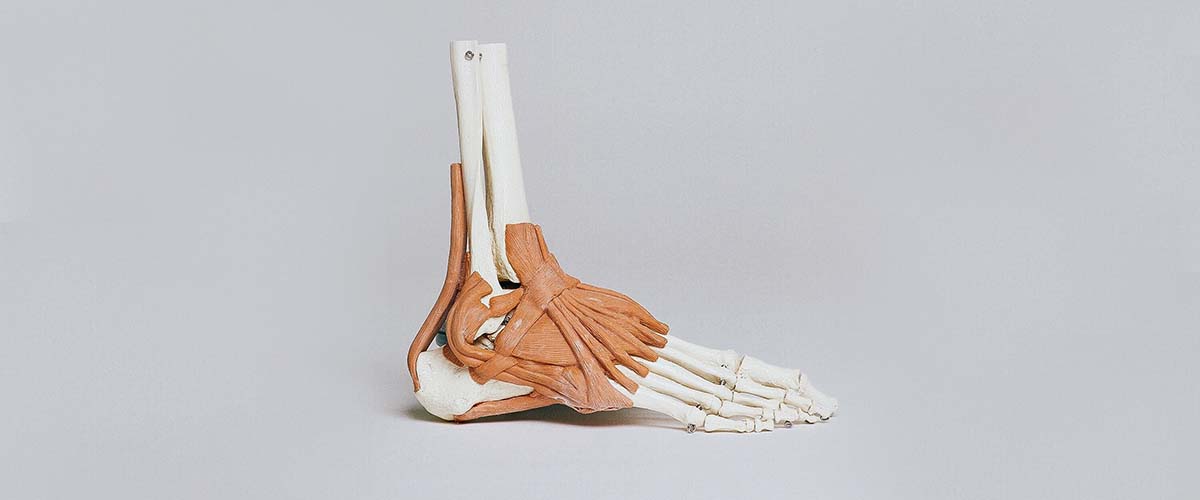
Achilles tendonitis, more accurately called Achilles tendinopathy, is pain and stiffness in the Achilles tendon caused by overload. It is one of the most common running injuries.1,2 The tendon is not usually “inflamed”; it becomes thickened and painful as it struggles to keep up with the load placed on it. The research is clear that the right exercise program is the foundation of treatment, and most people recover without surgery.
- Pain and stiffness in the back of the heel or a few inches above it, worst in the morning or at the start of activity
- Two types: midportion (in the tendon itself) and insertional (where it attaches to the heel)
- Progressive calf-strengthening exercise is the first-line treatment11,12
- Shoes, heel lifts and activity changes reduce tendon load38,39
- Surgery is for the minority who do not improve with several months of good rehab
Who gets Achilles tendinopathy?
It is common in runners and in people who play sports with jumping and quick changes of direction, but it also affects less active, middle-aged adults. Possible risk factors include a sudden increase in training, reduced calf strength, alcohol use and certain antibiotics.3 Fluoroquinolone antibiotics (for example ciprofloxacin and levofloxacin) are linked to tendon problems, especially in older adults and people also taking steroids.4,5
Midportion vs insertional
| Midportion | Insertional | |
|---|---|---|
| Where it hurts | 2 to 6 cm above the heel; the tendon may feel thickened | Where the tendon attaches to the back of the heel bone |
| Associated findings | Sometimes a thickened plantaris tendon alongside42 | Heel bump (Haglund deformity), bone spur or calcification |
| Exercise approach | Heavy calf loading, including heel drops off a step15,17 | Loading without dropping the heel below the step, to avoid compressing the tendon21 |
Diagnosis
The diagnosis is clinical: where the pain is and tenderness when pressing the tendon are the most reliable signs.7 Ultrasound or MRI can confirm the diagnosis, show how much of the tendon is involved and rule out a partial tear.8 A sudden “pop” with weakness suggests a ruptured Achilles, which needs prompt evaluation.
Exercise: the foundation of treatment
Clinical practice guidelines recommend exercise as first-line care.9,10 In network meta-analyses, active treatment did better than waiting it out, and no add-on treatment was convincingly better than exercise alone.11,12
- Eccentric heel drops (Alfredson program): the most studied program,13,15 with improvement still present at five years.18
- Heavy slow resistance training: equally effective as eccentric training, with higher patient satisfaction.17
- You can often keep running: continuing sport while keeping pain within an acceptable level during and after activity did not slow recovery.20
- Insertional tendinopathy: avoid dropping the heel below the step and avoid stretching into the painful position; low-compression loading did better.21,22,24
Exercise is most effective when it is progressed and supervised; a home program on its own often falls short.19
Shoes, heel lifts and orthoses
Temporary heel lifts, rocker-sole shoes and arch-support orthoses reduce load on the tendon,38,39 which can help calm symptoms while the exercise program builds capacity.
Shockwave therapy and injections
Shockwave therapy has better support for insertional tendinopathy, especially combined with exercise,23,24 than for midportion tendinopathy, where trials are mixed.25,26,27
Injections are add-ons, not substitutes for exercise. In a randomized trial, PRP was not better than saline when both groups exercised,28 and a Cochrane review found insufficient evidence to support routine injections.30 One trial found a carefully placed, ultrasound-guided steroid injection next to (not into) the tendon, combined with exercise, helped midportion symptoms,31 but steroid is used selectively because of tendon risks. High-volume injections, blood injections and nitroglycerin patches have not shown lasting benefit.32,33,34,35,36,37
When is surgery needed?
Surgery is considered when symptoms persist despite about 6 months of well-done rehabilitation. Options depend on the type:
- Midportion: minimally invasive release or debridement, and removal of a thickened plantaris tendon when it is involved. Minimally invasive and open approaches had similar success, with fewer complications after minimally invasive surgery.40,41,42
- Insertional: removal of the heel bump (Haglund deformity), bone spur and damaged tendon, with reattachment of the tendon when needed. Results are good, and the operation is matched to the extent of tendon damage.43,44,45,46 A flexor hallucis longus tendon transfer can reinforce a badly degenerated tendon.47
- Tight calf: gastrocnemius recession lengthens the calf muscle and has helped patients with a tight calf who did not improve with rehab.48,49
Outlook
The long-term outlook is generally favorable: in an 8-year study most patients did well, although symptoms appeared in the other Achilles in 41%.6 Keeping up calf strengthening after recovery helps protect both tendons.
Frequently asked questions
Should I stop running with Achilles tendonitis?
Not always. Many people can keep running at a reduced level if pain stays mild during and after activity and settles by the next morning. Your exercise program is the key part of treatment.
Is Achilles tendonitis the same as a torn Achilles?
No. Tendinopathy is an overuse problem that builds over time. A rupture is a sudden tear, usually with a pop and weakness, and needs prompt evaluation.
Do injections help Achilles tendonitis?
Injections are only add-ons. PRP was not better than saline in a randomized trial, and steroid injections carry tendon risks, so exercise remains the foundation.
How long does recovery take?
Most people improve over 3 to 6 months of consistent loading exercise. Some take longer, especially with insertional tendinopathy.
When is surgery needed?
Only if symptoms persist despite about 6 months of well-done rehabilitation. The operation depends on whether the problem is in the midportion or at the heel.
Research cited on this page
- Lopes AD, Hespanhol Júnior LC, Yeung SS, et al. What are the main running-related musculoskeletal injuries? A Systematic Review. Sports Med. 2012;42(10):891-905. PubMed
Achilles tendinopathy is one of the most common running-related injuries. - Francis P, Whatman C, Sheerin K, et al. The Proportion of Lower Limb Running Injuries by Gender, Anatomical Location and Specific Pathology: A Systematic Review. J Sports Sci Med. 2019;18(1):21-31. PubMed
In runners, Achilles tendinopathy accounted for about 10% of specific injuries. - van der Vlist AC, Breda SJ, Oei EHG, et al. Clinical risk factors for Achilles tendinopathy: a systematic review. Br J Sports Med. 2019;53(21):1352-1361. PubMed
Nine possible risk factors were identified; ofloxacin use, alcohol and reduced calf (plantar flexor) strength may be modifiable. - Stephenson AL, Wu W, Cortes D, et al. Tendon Injury and Fluoroquinolone Use: A Systematic Review. Drug Saf. 2013;36(9):709-21. PubMed
Fluoroquinolone antibiotics were associated with an increased risk of tendon injury, including rupture; the risk is higher with steroids. - Alves C, Mendes D, Marques FB. Fluoroquinolones and the risk of tendon injury: a systematic review and meta-analysis. Eur J Clin Pharmacol. 2019;75(10):1431-1443. PubMed
Confirmed the tendon risk with fluoroquinolones; older age and steroid use add to the risk. - Paavola M, Kannus P, Paakkala T, et al. Long-term prognosis of patients with achilles tendinopathy. An observational 8-year follow-up study. Am J Sports Med. 2000;28(5):634-42. PubMed
Over 8 years, the long-term outlook for Achilles tendinopathy was favorable, but 41% developed symptoms in the other Achilles. - Hutchison AM, Evans R, Bodger O, et al. What is the best clinical test for Achilles tendinopathy?. Foot Ankle Surg. 2013;19(2):112-7. PubMed
Pain location and tenderness on pressing the tendon were the most reliable and accurate clinical tests. - Rabello LM, van den Akker-Scheek I, Brink MS, et al. Association Between Clinical and Imaging Outcomes After Therapeutic Loading Exercise in Patients Diagnosed With Achilles or Patellar Tendinopathy at Short- and Long-Term Follow-up: A Systematic Review. Clin J Sport Med. 2020;30(4):390-403. PubMed
Clinical improvement tends to go along with improvement on imaging. - Chimenti RL, Neville C, Houck J, et al. Achilles Pain, Stiffness, and Muscle Power Deficits: Midportion Achilles Tendinopathy Revision – 2024. J Orthop Sports Phys Ther. 2024;54(12):CPG1-CPG32. PubMed
The American Physical Therapy Association clinical practice guideline on midportion Achilles tendinopathy (2024 revision). - Martin RL, Chimenti R, Cuddeford T, et al. Achilles Pain, Stiffness, and Muscle Power Deficits: Midportion Achilles Tendinopathy Revision 2018. J Orthop Sports Phys Ther. 2018;48(5):A1-A38. PubMed
The previous (2018) APTA clinical practice guideline. - van der Vlist AC, Winters M, Weir A, et al. Which treatment is most effective for patients with Achilles tendinopathy? A living systematic review with network meta-analysis of 29 randomised controlled trials. Br J Sports Med. 2021;55(5):249-256. PubMed
All active treatments did better than wait-and-see at 3 months, with no clinically relevant differences between them; a calf exercise program is a sensible first step. - Challoumas D, Crosbie G, O’Neill S, et al. Effectiveness of Exercise Treatments with or without Adjuncts for Common Lower Limb Tendinopathies: A Living Systematic Review and Network Meta-analysis. Sports Med Open. 2023;9(1):71. PubMed
No add-on treatment, alone or with exercise, was convincingly better than exercise alone, which should remain first-line. - Jarin I, Bäcker HC, Vosseller JT. Meta-analysis of Noninsertional Achilles Tendinopathy. Foot Ankle Int. 2020;41(6):744-754. PubMed
Eccentric exercise is the most studied and supported non-operative treatment for non-insertional Achilles tendinopathy. - Wilson F, Walshe M, O’Dwyer T, et al. Exercise, orthoses and splinting for treating Achilles tendinopathy: a systematic review with meta-analysis. Br J Sports Med. 2018;52(24):1564-1574. PubMed
Exercise is conditionally recommended; eccentric exercise was not clearly better than splinting. - Habets B, van Cingel RE. Eccentric exercise training in chronic mid-portion Achilles tendinopathy: a systematic review on different protocols. Scand J Med Sci Sports. 2015;25(1):3-15. PubMed
The Alfredson eccentric program helps, and other exercise programs achieved similar results. - Malliaras P, Barton CJ, Reeves ND, et al. Achilles and patellar tendinopathy loading programmes : a systematic review comparing clinical outcomes and identifying potential mechanisms for effectiveness. Sports Med. 2013;43(4):267-86. PubMed
There is little evidence that the eccentric part of exercise must be isolated; other loading programs also work. - Beyer R, Kongsgaard M, Hougs Kjær B, et al. Heavy Slow Resistance Versus Eccentric Training as Treatment for Achilles Tendinopathy: A Randomized Controlled Trial. Am J Sports Med. 2015;43(7):1704-11. PubMed
Heavy slow resistance training and eccentric training gave equally good, lasting results; heavy slow resistance had higher patient satisfaction. - van der Plas A, de Jonge S, de Vos RJ, et al. A 5-year follow-up study of Alfredson’s heel-drop exercise programme in chronic midportion Achilles tendinopathy. Br J Sports Med. 2012;46(3):214-8. PubMed
Five years after the Alfredson program, scores improved significantly, though almost half had needed other treatments. - Ram R, Meeuwisse W, Patel C, et al. The limited effectiveness of a home-based eccentric training for treatment of Achilles tendinopathy. Clin Invest Med. 2013;36(4):E197-206. PubMed
A home-based eccentric program alone often fell short of patient expectations. - Silbernagel KG, Thomeé R, Eriksson BI, et al. Continued sports activity, using a pain-monitoring model, during rehabilitation in patients with Achilles tendinopathy: a randomized controlled study. Am J Sports Med. 2007;35(6):897-906. PubMed
Continuing running and jumping during treatment, guided by a pain-monitoring model, had no negative effect. - Pringels L, Capelleman R, Van den Abeele A, et al. Effectiveness of reducing tendon compression in the rehabilitation of insertional Achilles tendinopathy: a randomised clinical trial. Br J Sports Med. 2025;59(9):640-650. PubMed
For insertional tendinopathy, rehab that reduced tendon compression worked better than high-compression rehab at 12 and 24 weeks. - Ko VM, Cao M, Qiu J, et al. Comparative short-term effectiveness of non-surgical treatments for insertional Achilles tendinopathy: a systematic review and network meta-analysis. BMC Musculoskelet Disord. 2023;24(1):102. PubMed
For insertional tendinopathy, eccentric exercise plus soft-tissue therapy gave the strongest short-term pain control. - Zhi X, Liu X, Han J, et al. Nonoperative treatment of insertional Achilles tendinopathy: a systematic review. J Orthop Surg Res. 2021;16(1):233. PubMed
For insertional tendinopathy, evidence favors shockwave therapy or shockwave plus eccentric exercise. - Jarin IJ, Bäcker HC, Vosseller JT. Functional Outcomes of Insertional Achilles Tendinopathy Treatment: A Systematic Review. JBJS Rev. 2021;9(6). PubMed
For insertional tendinopathy, eccentric exercise and low-energy shockwave therapy have the most evidence for initial treatment. - Charles R, Fang L, Zhu R, et al. The effectiveness of shockwave therapy on patellar tendinopathy, Achilles tendinopathy, and plantar fasciitis: a systematic review and meta-analysis. Front Immunol. 2023;14:1193835. PubMed
For midportion Achilles tendinopathy, shockwave therapy had a negligible effect (low- to moderate-quality evidence). - Gatz M, Schweda S, Betsch M, et al. Line- and Point-Focused Extracorporeal Shock Wave Therapy for Achilles Tendinopathy: A Placebo-Controlled RCT Study. Sports Health. 2021;13(5):511-518. PubMed
In a randomized trial, shockwave therapy was not better than placebo shockwave for symptoms. - Katolický J, Nedělka T, Bashford G, et al. Ultrasound-based evaluation of changes in tendon macro- and micromorphology following exercise and ESWT in mid-portion Achilles tendinopathy: A randomized clinical trial with a 26-week follow-up. J Sci Med Sport. 2026;29(10):1115-1124. PubMed
Progressive resistance training, with or without focused shockwave, led to meaningful improvement; shockwave may speed tendon remodeling. - de Vos RJ, Weir A, van Schie HT, et al. Platelet-rich plasma injection for chronic Achilles tendinopathy: a randomized controlled trial. JAMA. 2010;303(2):144-9. PubMed
In a randomized trial, a PRP injection was not better than a saline injection when both groups did eccentric exercises. - Masiello F, Pati I, Veropalumbo E, et al. Ultrasound-guided injection of platelet-rich plasma for tendinopathies: a systematic review and meta-analysis. Blood Transfus. 2023;21(2):119-136. PubMed
Ultrasound-guided PRP reduced pain in tendinopathies at 1 to 6 months, but certainty of evidence was low. - Kearney RS, Parsons N, Metcalfe D, et al. Injection therapies for Achilles tendinopathy. Cochrane Database Syst Rev. 2015;2015(5):CD010960. PubMed
Cochrane review: insufficient evidence to support routine injection therapies for Achilles tendinopathy. - Johannsen F, Olesen JL, Øhlenschläger TF, et al. Effect of Ultrasonography-Guided Corticosteroid Injection vs Placebo Added to Exercise Therapy for Achilles Tendinopathy: A Randomized Clinical Trial. JAMA Netw Open. 2022;5(7):e2219661. PubMed
An ultrasound-guided steroid injection plus exercise did better than a placebo injection plus exercise. - Hassan R, Poku D, Miah N, et al. High-volume injections in Achilles tendinopathy: a systematic review. Br Med Bull. 2024;152(1):35-47. PubMed
High-volume injections improved short-term pain and function, without differences at later follow-up. - van der Vlist AC, van Oosterom RF, van Veldhoven PLJ, et al. Effectiveness of a high volume injection as treatment for chronic Achilles tendinopathy: randomised controlled trial. BMJ. 2020;370:m3027. PubMed
In a randomized trial, a high-volume injection without steroid added no benefit to usual care. - van Oosten CCM, van der Vlist AC, van Veldhoven PLJ, et al. Do High-Volume Injections Affect the Ultrasonographic Neovascularization in Chronic Achilles Tendinopathy? A Randomized Placebo-Controlled Clinical Trial. Clin J Sport Med. 2022;32(5):451-457. PubMed
High-volume injection did not change blood flow in the tendon, challenging its rationale. - Bell KJ, Fulcher ML, Rowlands DS, et al. Impact of autologous blood injections in treatment of mid-portion Achilles tendinopathy: double blind randomised controlled trial. BMJ. 2013;346:f2310. PubMed
Autologous blood injections added no benefit to eccentric exercise. - Kane TP, Ismail M, Calder JD. Topical glyceryl trinitrate and noninsertional Achilles tendinopathy: a clinical and cellular investigation. Am J Sports Med. 2008;36(6):1160-3. PubMed
Nitroglycerin (GTN) patches did not show a clinical benefit. - Maffulli N, Papalia R, D’Adamio S, et al. Pharmacological interventions for the treatment of Achilles tendinopathy: a systematic review of randomized controlled trials. Br Med Bull. 2015;113(1):101-15. PubMed
No drug treatment was clearly preferable to eccentric loading. - Sobhani S, Zwerver J, van den Heuvel E, et al. Rocker shoes reduce Achilles tendon load in running and walking in patients with chronic Achilles tendinopathy. J Sci Med Sport. 2015;18(2):133-8. PubMed
Rocker-sole shoes reduced load on the Achilles during walking and running. - Lee KKW, Ling SKK, Yung PSH. Controlled trial to compare the Achilles tendon load during running in flatfeet participants using a customized arch support orthoses vs an orthotic heel lift. BMC Musculoskelet Disord. 2019;20(1):535. PubMed
Heel lifts and arch-support orthoses reduced peak Achilles load in runners with flat feet. - Lohrer H, David S, Nauck T. Surgical treatment for achilles tendinopathy – a systematic review. BMC Musculoskelet Disord. 2016;17:207. PubMed
Minimally invasive and open surgery had similar success and satisfaction, with a tendency to more complications after open surgery. - Baltes TPA, Zwiers R, Wiegerinck JI, et al. Surgical treatment for midportion Achilles tendinopathy: a systematic review. Knee Surg Sports Traumatol Arthrosc. 2017;25(6):1817-1838. PubMed
Many surgical techniques are used for midportion tendinopathy; none were compared with non-surgical treatment. - Spang C, Alfredson H, Docking SI, et al. The plantaris tendon: a narrative review focusing on anatomical features and clinical importance. Bone Joint J. 2016;98-B(10):1312-1319. PubMed
A thickened plantaris tendon can contribute to midportion pain, and its removal has been curative in some patients. - Moen R, Hagenbucher JR, Shinabarger AB. Surgical Treatment of Insertional Achilles Tendinopathy: A Systematic Review. J Am Podiatr Med Assoc. 2020;110(5). PubMed
For insertional tendinopathy, no single operation clearly outperformed the others; surgery should match the extent of tendon damage. - Thompson JM, Nguyen K, Ahluwalia J, et al. Surgical Takedown Approaches to Insertional Achilles Tendinopathy: A Systematic Review. J Foot Ankle Surg. 2021;60(6):1217-1221. PubMed
After insertional surgery, rupture rates were low (about 1 to 3%), with fewer complications when the tendon was not completely detached. - Yuen WLP, Tan PT, Kon KKC. Surgical Treatment of Haglund’s Deformity: A Systematic Review and Meta-Analysis. Cureus. 2022;14(7):e27500. PubMed
Open and endoscopic surgery for Haglund deformity both improved function and satisfaction; endoscopic surgery had fewer complications. - Guedes A, de Mattos ESR, Barreto ESR, et al. Open vs Endoscopic Surgical Treatment for Haglund Deformity: A Systematic Review, Meta-analysis, and Meta-regression. Foot Ankle Orthop. 2026;11(2):24730114261435962. PubMed
Comparative studies did not show a clear advantage of open or endoscopic Haglund surgery. - Howell MA, Catanzariti AR. Flexor Hallucis Longus Tendon Transfer for Calcific Insertional Achilles Tendinopathy. Clin Podiatr Med Surg. 2016;33(1):113-23. PubMed
Flexor hallucis longus tendon transfer is an option for severe calcific insertional tendinopathy. - Arshad Z, Al Shdefat S, Iqbal AM, et al. Gastrocnemius release is an effective management option for Achilles tendinopathy: a systematic review. Knee Surg Sports Traumatol Arthrosc. 2022;30(12):4189-4197. PubMed
Gastrocnemius release is an effective option for Achilles tendinopathy in patients with a tight calf who did not improve with non-surgical care. - Cychosz CC, Phisitkul P, Belatti DA, et al. Gastrocnemius recession for foot and ankle conditions in adults: Evidence-based recommendations. Foot Ankle Surg. 2015;21(2):77-85. PubMed
Growing evidence supports isolated gastrocnemius recession for several foot and ankle conditions.
Medically reviewed by Andrew P. Dold, MD, FAOA, FAAOS, FACS, FRCSC. Last reviewed October 2026. This page is general information, not medical advice. Your own diagnosis and treatment plan depend on your exam and imaging.