









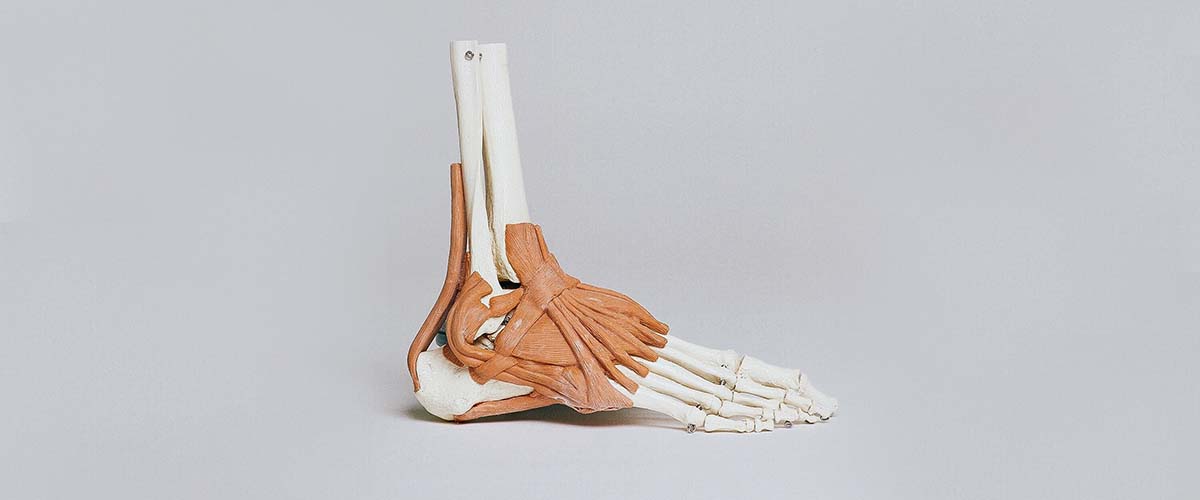
Metatarsalgia means pain under the ball of the foot, around the heads of the long metatarsal bones. It is a symptom rather than a single diagnosis: the cause may be overload from foot shape, a tight calf, a bunion, a plantar plate tear, a stress fracture or a nerve problem.1,3 Finding the specific cause is what makes treatment work.2
- Aching or burning under the ball of the foot, often like walking on a pebble
- Usually the second or third metatarsal head
- Metatarsal pads, cushioned or custom insoles and rocker soles reduce pressure10,12,16
- Plantar plate tears and a tight calf are common, treatable causes19,30
- Surgery (Weil or minimally invasive osteotomy) when non-surgical care fails26
Common causes
- Overload of a metatarsal: a relatively long second metatarsal or one that sits lower than its neighbors. A long second metatarsal strongly predicted metatarsalgia.4,5,6
- Bunions and big-toe problems that shift weight to the smaller metatarsals,5 including transfer metatarsalgia after bunion surgery.7,8 See bunions.
- Plantar plate tears and instability of the second toe joint.19
- A tight calf (gastrocnemius), which increases forefoot pressure.1
- Stress fractures and bone stress reactions.3 See foot fractures.
- Morton’s neuroma between the third and fourth toes.3 See Morton’s neuroma.
- Freiberg disease: collapse of a metatarsal head, usually the second.33
- Joint inflammation (synovitis), arthritis, thinning of the fat pad and high-heeled or thin-soled shoes
Symptoms
- Aching, sharp or burning pain under the ball of the foot
- Feeling like walking on a pebble or a folded sock
- Pain worse when barefoot, on hard floors, or in heels
- Callus under one metatarsal head
- With plantar plate tears: swelling at the base of the second toe, which may drift or lift
Diagnosis
Dr. Dold pinpoints where it hurts, tests the stability of each toe joint, checks for a tight calf and bunion, and evaluates where the pain occurs during walking. Standing X-rays measure metatarsal length and alignment and look for stress fractures or Freiberg disease.2,4 Ultrasound and MRI can show plantar plate tears, neuromas and bone stress.3,20
Non-surgical treatment
Non-surgical care is the first step:1
- Metatarsal pads placed just behind the painful metatarsal heads reduced peak pressure by about 32%.10
- Insoles: in randomized trials, custom-moulded insoles lowered pain12 and well-designed ready-made insoles helped most patients.13 Cushioned insoles and pads reduce forefoot pressure,11,15 and custom orthoses reduced forefoot pain in most studies.14
- Shoes: a stiff, rocker-sole shoe with a cushioned insert reduced metatarsal head pressure by about 50%.16 Avoiding high heels and thin soles helps.
- Calf stretching for a tight gastrocnemius1
- Callus care and, for joint inflammation, a cortisone injection with a rocker-sole shoe; 93% of inflamed toe joints became pain-free or improved in one series.17
For plantar plate tears with an unstable toe, taping and stiff shoes help, but non-surgical treatment usually gives only temporary relief.18
Plantar plate repair
The plantar plate is a strong ligament under each toe joint. When it tears, usually at the second toe, the toe becomes unstable and the ball of the foot hurts.19 Repairing the plantar plate improved pain and function predictably out to 2 years,21 with 80% good to excellent satisfaction at 12 months.22 Adding plantar plate repair to a shortening osteotomy improved results compared with the osteotomy alone.23
Metatarsal osteotomy
When a long or prominent metatarsal is overloaded, shortening or elevating it redistributes pressure:
- Weil osteotomy: a reliable open technique.1 A floating toe afterward is common but did not affect satisfaction,25 and a triple Weil variation reduced floating toe when more shortening was needed.24
- Minimally invasive distal metatarsal osteotomy (DMMO): done through tiny incisions. It was as safe and effective as the Weil osteotomy,26 improved scores at about 5 years,28 and reduced pressure under the painful metatarsal heads,29 though prolonged swelling and floating toe are common.27
Calf release (gastrocnemius recession)
A tight calf increases pressure under the forefoot. Releasing the tight gastrocnemius tendon gave substantial pain relief and high satisfaction in isolated metatarsalgia, with low complication rates,30 and 69.2% of patients were completely satisfied in one series.31 Some patients notice reduced push-off power.32 It is often combined with forefoot procedures.30
Freiberg disease
Freiberg disease is treated first by unloading the metatarsal with pads, stiff shoes or a boot.33,34 If pain persists, surgery may include a dorsal wedge osteotomy to rotate healthier cartilage into the joint, grafting, or joint debridement.33
Recovery
- Non-surgical: most people improve over weeks to a few months with pads, insoles and shoe changes.
- After osteotomy or plantar plate repair: walking in a post-operative shoe, with swelling that can last several months.
- After calf release: early walking in a boot and a stretching program.
Dr. Dold reviews your expected timeline based on your procedure.
Frequently asked questions
What is the most common cause of metatarsalgia?
Overload of the second or third metatarsal head is most common, often related to foot shape, a bunion, a tight calf or a plantar plate tear. Identifying the specific cause guides treatment.
Do metatarsal pads really work?
Yes, when placed correctly just behind the painful metatarsal heads. Pads and cushioned or custom insoles reduce pressure and pain in most people.
What’s the difference between metatarsalgia and Morton’s neuroma?
Metatarsalgia is pain under the metatarsal heads. Morton’s neuroma is a thickened nerve between the toes, usually the third and fourth, causing burning, tingling or numbness into the toes. They can coexist.
What is a plantar plate tear?
A tear of the ligament under a toe joint, usually the second toe. It causes pain under the ball of the foot and can let the toe drift or lift. Early cases are treated with taping and stiff shoes; persistent instability often needs repair.
When is surgery needed?
When several months of pads, insoles and shoe changes haven’t helped, or when there is a plantar plate tear, a tight calf or a deformity that needs correcting.
Research cited on this page
- Besse JL. Metatarsalgia. Orthop Traumatol Surg Res. 2017;103(1S):S29-S39. PubMed
First-line treatment is conservative (stretching, footwear, insoles, callus care); gastrocnemius recession, plantar plate repair and the Weil osteotomy are surgical options. - Charen DA, Markowitz JS, Cheung ZB, et al. Overview of Metatarsalgia. Orthopedics. 2019;42(1):e138-e143. PubMed
Timing of pain during gait, a careful exam and weight-bearing X-rays are key to finding the cause of metatarsalgia. - Hodes A, Umans H. Metatarsalgia. Radiol Clin North Am. 2018;56(6):877-892. PubMed
Common causes include bone stress reaction or fracture, interdigital neuroma and plantar plate tears. - Maceira E, Monteagudo M. Mechanical Basis of Metatarsalgia. Foot Ankle Clin. 2019;24(4):571-584. PubMed
Different types of metatarsalgia relate to metatarsal length and tilt, which guides treatment. - Togei K, Shima H, Hirai Y, et al. Relationship Between the Relative Length of the Second Metatarsal and Occurrence of Metatarsalgia in Patients With Hallux Valgus. Foot Ankle Int. 2025;46(2):217-226. PubMed
Bunion severity and a relatively long second metatarsal independently predicted metatarsalgia. - Karagoz B, Bayrak HC, Dincer DE. The relationship between preoperative relative second metatarsal length and postoperative transfer metatarsalgia following hallux valgus surgery. Acta Orthop Traumatol Turc. 2025;59(6):387-393. PubMed
A relatively long second metatarsal strongly predicted transfer metatarsalgia (odds ratio about 5). - Maceira E, Monteagudo M. Transfer metatarsalgia post hallux valgus surgery. Foot Ankle Clin. 2014;19(2):285-307. PubMed
Transfer metatarsalgia after failed bunion surgery is more common than expected. - Suh JW, Jang HS, Park HW. Iatrogenic second transfer metatarsalgia and the first metatarsal shortening and elevation after Scarf osteotomy. Foot Ankle Surg. 2022;28(4):464-470. PubMed
Transfer metatarsalgia occurred in 8.9% of feet after a Scarf bunion osteotomy, linked to first metatarsal shortening. - Park CH, Chang MC. Forefoot disorders and conservative treatment. Yeungnam Univ J Med. 2019;36(2):92-98. PubMed
A metatarsal bar, pad or cushioned insole can unload painful metatarsal heads. - Hastings MK, Mueller MJ, Pilgram TK, et al. Effect of metatarsal pad placement on plantar pressure in people with diabetes mellitus and peripheral neuropathy. Foot Ankle Int. 2007;28(1):84-8. PubMed
Metatarsal pads placed just behind the metatarsal heads reduced peak pressure by about 32%. - Yi TI, Lee EC, Son NH, et al. Comparison of the Forefoot Pressure-Relieving Effects of Foot Orthoses. Yonsei Med J. 2022;63(9):864-872. PubMed
In a randomized trial, cushioned insoles and metatarsal pads both reduced forefoot pressure. - Postema K, Burm PE, Zande ME, et al. Primary metatarsalgia: the influence of a custom moulded insole and a rockerbar on plantar pressure. Prosthet Orthot Int. 1998;22(1):35-44. PubMed
In a randomized trial, custom-moulded insoles lowered pain in primary metatarsalgia; a rocker bar did not change pain. - Kelly A, Winson I. Use of ready-made insoles in the treatment of lesser metatarsalgia: a prospective randomized controlled trial. Foot Ankle Int. 1998;19(4):217-20. PubMed
In a randomized trial, 12 of 15 patients improved with one type of ready-made insole vs 6 of 18 with another. - Arias-Martín I, Reina-Bueno M, Munuera-Martínez PV. Effectiveness of custom-made foot orthoses for treating forefoot pain: a systematic review. Int Orthop. 2018;42(8):1865-1875. PubMed
Custom-made foot orthoses reduced forefoot pain in most studies. - Hähni M, Hirschmüller A, Baur H. The effect of foot orthoses with forefoot cushioning or metatarsal pad on forefoot peak plantar pressure in running. J Foot Ankle Res. 2016;9:44. PubMed
Insoles with forefoot cushioning lowered forefoot peak pressure more than a metatarsal pad. - Kavros SJ, Van Straaten MG, Coleman Wood KA, et al. Forefoot plantar pressure reduction of off-the-shelf rocker bottom provisional footwear. Clin Biomech (Bristol). 2011;26(7):778-82. PubMed
A rocker-sole shoe with a cushioned insert reduced metatarsal head pressure by about 50%. - Trepman E, Yeo SJ. Nonoperative treatment of metatarsophalangeal joint synovitis. Foot Ankle Int. 1995;16(12):771-7. PubMed
With a steroid injection and rocker-sole shoe changes, 93% of MTP joints with synovitis became pain-free or improved. - Li CCH, Lui TH. Lesser Metatarsophalangeal Joint Instability: Arthroscopic Treatment Alternatives. Foot Ankle Clin. 2024;29(4):727-739. PubMed
For lesser toe joint instability, non-surgical treatment usually gives only temporary relief. - Jastifer JR. Plantar Plate Repair for Metatarsophalangeal Joint Instability of the Lesser Toes. Orthop Clin North Am. 2022;53(3):349-359. PubMed
Lesser toe joint (MTP) instability from plantar plate tears is a common cause of metatarsalgia, usually at the second toe. - Linklater JM, Bird SJ. Imaging of Lesser Metatarsophalangeal Joint Plantar Plate Degeneration, Tear, and Repair. Semin Musculoskelet Radiol. 2016;20(2):192-204. PubMed
Ultrasound and MRI can show plantar plate tears. - Baker JR, Albright R, Jameson R, et al. Treatment of Lesser Metatarsophalangeal Joint Instability With Plantar Plate Repair: A Systematic Review and Meta-Analysis. J Foot Ankle Surg. 2022;61(5):1114-1118. PubMed
Plantar plate repair improved pain (about 5 points on a 10-point scale) and function predictably out to 2 years. - Flint WW, Macias DM, Jastifer JR, et al. Plantar Plate Repair for Lesser Metatarsophalangeal Joint Instability. Foot Ankle Int. 2017;38(3):234-242. PubMed
After plantar plate repair, 80% had good to excellent satisfaction at 12 months. - Fleischer AE, Klein EE, Bowen M, et al. Comparison of Combination Weil Metatarsal Osteotomy and Direct Plantar Plate Repair Versus Weil Metatarsal Osteotomy Alone for Forefoot Metatarsalgia. J Foot Ankle Surg. 2020;59(2):303-306. PubMed
Adding plantar plate repair to a Weil osteotomy improved function and pain scores compared with the osteotomy alone. - Bougiouklis D, Tyllianakis M, Deligianni D, et al. Comparison of the Weil and Triple Weil Osteotomies: A Clinical Retrospective Study. Cureus. 2022;14(2):e22220. PubMed
Weil and triple Weil osteotomies were both effective; the triple Weil reduced floating toe when more shortening was needed. - Wagner E, O’Connell LA, Radkievich R, et al. Incidence of and Functional Significance of Floating Toe After Weil Osteotomy. Foot Ankle Orthop. 2019;4(4):2473011419891956. PubMed
A floating toe after Weil osteotomy was common (57%) but did not affect satisfaction or function. - Stavrakakis IM, Magarakis GE, Kapsetakis P, et al. Weil’s osteotomy versus distal metatarsal metaphyseal osteotomy for the treatment of metatarsalgia. A metaanalysis of outcome and complications. Foot (Edinb). 2024;60:102101. PubMed
Weil osteotomy and minimally invasive distal metatarsal osteotomy (DMMO) were equally safe and effective. - Fernández-Gómez AM, Nieto-García E, Ramírez-Andrés L, et al. Complications in Distal Minimally Invasive Metatarsal Osteotomies: Systematic Review and Meta-Analysis. Medicina (Kaunas). 2025;61(8). PubMed
DMMO generally has favorable results, but prolonged swelling and floating toe are common. - Biz C, Corradin M, Kuete Kanah WT, et al. Medium-Long-Term Clinical and Radiographic Outcomes of Minimally Invasive Distal Metatarsal Metaphyseal Osteotomy (DMMO) for Central Primary Metatarsalgia: Do Maestro Criteria Have a Predictive Value in the Preoperative Planning for This Percutaneous Technique?. Biomed Res Int. 2018;2018:1947024. PubMed
At about 5 years after DMMO, all clinical scores improved significantly. - Neunteufel E, Krenn S, Chraim M, et al. Minimally Invasive Distal Metatarsal Metaphyseal Osteotomy of the Lesser Toes: Clinical, Radiologic, and Pedobarographic Outcomes. Foot Ankle Int. 2022;43(2):153-163. PubMed
Minimally invasive metatarsal osteotomy improved scores and reduced pressure under the painful metatarsal heads. - Calori S, Giuliani A, Bocchino G, et al. Gastrocnemius recession in the treatment of isolated metatarsalgia: A systematic review of surgical outcomes and complications. J Orthop Surg (Hong Kong). 2026;34(1):10225536251350416. PubMed
Gastrocnemius recession for isolated metatarsalgia gave substantial pain relief and high satisfaction with low complication rates. - Morales-Muñoz P, De Los Santos Real R, Barrio Sanz P, et al. Proximal Gastrocnemius Release in the Treatment of Mechanical Metatarsalgia. Foot Ankle Int. 2016;37(7):782-9. PubMed
After proximal gastrocnemius release, pain fell from 7.4 to 3.5 and 69.2% were completely satisfied. - Molund M, Paulsrud Ø, Ellingsen Husebye E, et al. Results after gastrocnemius recession in 73 patients. Foot Ankle Surg. 2014;20(4):272-5. PubMed
After gastrocnemius recession, 62% reported good or excellent results; 22% noted reduced push-off power. - Talusan PG, Diaz-Collado PJ, Reach JS. Freiberg’s infraction: diagnosis and treatment. Foot Ankle Spec. 2014;7(1):52-6. PubMed
Freiberg disease is first treated by unloading the metatarsal; surgery includes osteotomy, grafting or resection. - Cerrato RA. Freiberg’s disease. Foot Ankle Clin. 2011;16(4):647-58. PubMed
Conservative offloading is the accepted initial treatment for Freiberg disease.
Medically reviewed by Andrew P. Dold, MD, FAOA, FAAOS, FACS, FRCSC. Last reviewed October 2026. This page is general information, not medical advice. Your own diagnosis and treatment plan depend on your exam and imaging.