









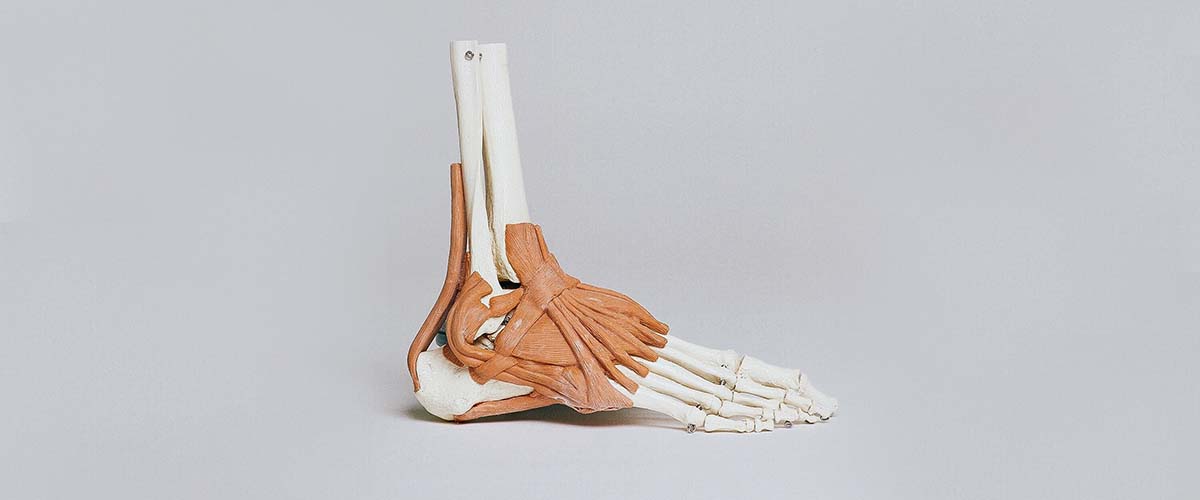
The foot has 26 bones, and fractures range from a simple crack in a metatarsal to complex heel and talus fractures. Many heal well in a boot or stiff-soled shoe, but some, such as navicular stress fractures and displaced talus fractures, carry a higher risk of slow healing and long-term problems.12,27 Getting the right diagnosis early matters, because foot fractures, especially stress fractures, are frequently missed.9
- Pain, swelling and bruising after a fall, twist or crush, or gradual pain with training
- The Ottawa rules help decide who needs X-rays1,2
- Most metatarsal fractures heal without surgery6,7
- Navicular, talus and sesamoid stress fractures are high risk12,14
- Displaced heel and talus fractures often need surgery21,29
Types of foot fractures
- Metatarsal fractures: the long bones of the forefoot, from a twist, fall or dropped object. Fifth metatarsal and Jones fractures have their own page: Jones and fifth metatarsal fractures.
- Stress fractures: fatigue fractures from repetitive loading, common in runners and military recruits; most often in the metatarsals, navicular and heel.
- Midfoot fractures: navicular, cuboid and cuneiform fractures, often with ligament injury. See Lisfranc injuries.
- Calcaneus (heel bone) fractures: usually from a fall from height or a car crash.
- Talus fractures: the bone that links the leg and foot; uncommon but serious.
Symptoms
- Pain, swelling and bruising, often unable to bear weight
- Point tenderness over the broken bone
- With stress fractures: aching that builds with activity and eases with rest, then pain with everyday walking
- With heel fractures: a wide, bruised heel, often after a fall from height
Diagnosis
Dr. Dold examines the foot and orders X-rays when needed. The Ottawa ankle and midfoot rules are very sensitive for ruling out fractures,1,2 and using them reduced foot X-rays by 14%.3 Midfoot fractures are uncommon and are often missed on standard X-rays,4,5 so a CT scan is used for midfoot, heel and talus fractures, and MRI for suspected stress fractures when X-rays are normal.
Metatarsal fractures
Most metatarsal fractures heal well without surgery, in a walking boot or stiff-soled shoe with weight-bearing as comfortable:
- Fractures of the second to fourth metatarsals healed with good outcomes even when displaced beyond commonly cited thresholds.6
- Spiral fifth metatarsal shaft fractures treated in a shoe allowed earlier pain-free walking than a boot.7
- In children, very few metatarsal shaft fractures need surgery.8
Surgery is considered for fractures that are badly displaced, multiple, open or involving the joint, or when the forefoot alignment would be altered.
Stress fractures
Stress fractures occur in up to 15% of runners.10 They are divided into low-risk and high-risk sites:
- Low risk (most metatarsal shaft stress fractures): rest from impact, a boot or stiff shoe and a gradual return to activity.10,11,18
- High risk (navicular, talus, sesamoids, base of the fifth metatarsal): higher rates of nonunion and longer recovery,12 needing early imaging and non-weight-bearing immobilization.13 Navicular bone stress injuries had the longest return to sport, about 127 days on average.14
For navicular stress fractures, return to sport averaged 16 weeks after surgery vs 22 weeks with non-surgical treatment, and weight-bearing should be avoided if treated without surgery.15,16
Preventing the next one: Dr. Dold looks for the reasons behind a stress fracture: training errors, running mechanics, foot strength,17 vitamin D and calcium intake,18,19 and, especially in female athletes, low energy availability and menstrual changes, which impair bone health.20
Heel (calcaneus) fractures
Displaced fractures into the heel joint are among the most debated injuries in foot surgery:
- In 7 randomized trials (908 patients), surgery improved shoe wear and walking but increased wound complications.21
- Surgery reduced later subtalar fusion but had more complications,22 and increased return to pre-injury work.23
- A heel that heals out of position can cause painful arthritis and deformity, and poor reduction gives the worst results.24
- Minimally invasive approaches, such as the sinus tarsi approach, reduce wound complications with similar results.25,26
Non-surgical treatment is reasonable for non-displaced fractures and for patients with smoking, diabetes or vascular problems that raise the risk of wound complications.
Talus fractures
Talus fractures are serious because the talus has a fragile blood supply. Displaced talar neck fractures need prompt reduction and fixation.27 Even with modern fixation:
- Osteonecrosis developed in 31% to 42% of patients, rising with displacement and open injuries,28,30 although over a third of cases revascularized without collapse in one series.29
- Post-traumatic arthritis was common (68%), though only 19% needed salvage surgery.31
Outcomes depend mainly on the severity of the injury.32
Recovery
- Metatarsal fractures: usually about 6 weeks in a boot or stiff shoe, then a gradual return to normal shoes.
- Stress fractures: low-risk fractures often allow running again in about 6 to 12 weeks; high-risk fractures take longer.14
- Heel and talus fractures: a period of non-weight-bearing, often 6 to 12 weeks, then therapy; full recovery takes many months.
Dr. Dold reviews your timeline based on your fracture and treatment. Ankle fractures are covered on the ankle fractures page.
Frequently asked questions
Can I walk on a broken foot?
Many metatarsal fractures can be walked on in a boot or stiff-soled shoe. Navicular, talus and heel fractures, and high-risk stress fractures, usually need a period without weight-bearing. Get it checked before walking on it.
How do I know if I have a stress fracture?
Pain that builds with running or walking and eases with rest, with tenderness over one spot on a bone, is typical. X-rays may be normal early; an MRI can confirm it.
How long does a broken foot take to heal?
Many metatarsal fractures heal in about 6 weeks. Navicular, heel and talus fractures take longer, and full recovery can take several months.
Does a heel fracture always need surgery?
No. Non-displaced fractures are treated without surgery, and even displaced fractures can be treated non-surgically in some patients. Surgery can restore the heel shape and improve shoe wear and walking but has a higher risk of wound problems.
What can I do to prevent another stress fracture?
Gradual training increases, footwear and running form changes, foot and calf strengthening, adequate calories, calcium and vitamin D, and evaluation of bone health when needed.
Think you have a fracture? See fracture care in Frisco: same-day appointments and walk-ins Monday, Wednesday and Friday, 8:30–10:30 am.
Research cited on this page
- Bachmann LM, Kolb E, Koller MT, et al. Accuracy of Ottawa ankle rules to exclude fractures of the ankle and mid-foot: systematic review. BMJ. 2003;326(7386):417. PubMed
The Ottawa ankle and midfoot rules reliably exclude fractures; fewer than 1.4% of rule-negative patients had a fracture. - Beckenkamp PR, Lin CC, Macaskill P, et al. Diagnostic accuracy of the Ottawa Ankle and Midfoot Rules: a systematic review with meta-analysis. Br J Sports Med. 2017;51(6):504-510. PubMed
Across 66 studies, the Ottawa ankle and midfoot rules had very high sensitivity for ruling out fractures. - Stiell I. Ottawa ankle rules. Can Fam Physician. 1996;42:478-80. PubMed
Using the Ottawa rules reduced foot X-rays by 14%. - Grivas TB, Vasiliadis ED, Koufopoulos G, et al. Midfoot fractures. Clin Podiatr Med Surg. 2006;23(2):323-41, vi. PubMed
Midfoot fractures are uncommon and often involve more than one structure, so a high index of suspicion is key. - Bradshaw CL. Navicular and Cuboid Fractures. Clin Podiatr Med Surg. 2024;41(3):425-435. PubMed
Navicular and cuboid fractures are often missed on standard X-rays; advanced imaging is used when suspicion is high. - Lorance A, Tsagkaris C, Chlasta A, et al. Do displacement thresholds matter? Outcomes of non-operative treatment in metatarsal II-IV fractures. J Foot Ankle Surg. 2026. PubMed
Non-surgical treatment of second to fourth metatarsal fractures beyond common displacement thresholds still healed with good outcomes. - Morgan C, Abbasian A. Management of spiral diaphyseal fractures of the fifth metatarsal: A case series and a review of literature. Foot (Edinb). 2020;43:101654. PubMed
Spiral fifth metatarsal shaft fractures treated in a shoe allowed earlier pain-free walking than a boot. - Robertson NB, Roocroft JH, Edmonds EW. Childhood metatarsal shaft fractures: treatment outcomes and relative indications for surgical intervention. J Child Orthop. 2012;6(2):125-9. PubMed
In 337 children with metatarsal shaft fractures, only 10 needed surgery; none under 12 years. - Welck MJ, Hayes T, Pastides P, et al. Stress fractures of the foot and ankle. Injury. 2017;48(8):1722-1726. PubMed
Foot and ankle stress fractures are frequently missed; late diagnosis can lead to prolonged pain and nonunion. - Greaser MC. Foot and Ankle Stress Fractures in Athletes. Orthop Clin North Am. 2016;47(4):809-22. PubMed
Stress fractures occur in up to 15% of runners; low-risk ones heal with rest and protected weight-bearing, high-risk ones more often need surgery. - Hossain M, Clutton J, Ridgewell M, et al. Stress Fractures of the Foot. Clin Sports Med. 2015;34(4):769-90. PubMed
Most foot stress fractures can be treated with a period of non-weight-bearing followed by a gradual return to activity. - Paavana T, Rammohan R, Hariharan K. Stress fractures of the foot – current evidence on management. J Clin Orthop Trauma. 2024;50:102381. PubMed
Navicular, talus and sesamoid stress fractures are high risk because of higher nonunion rates and longer recovery. - McInnis KC, Ramey LN. High-Risk Stress Fractures: Diagnosis and Management. PM R. 2016;8(3 Suppl):S113-24. PubMed
High-risk stress fractures need early imaging and non-weight-bearing immobilization with a careful return to sport. - Hoenig T, Eissele J, Strahl A, et al. Return to sport following low-risk and high-risk bone stress injuries: a systematic review and meta-analysis. Br J Sports Med. 2023;57(7):427-432. PubMed
Across 2,974 bone stress injuries, navicular injuries had the longest return to sport (about 127 days) and higher complication rates. - Mallee WH, Weel H, van Dijk CN, et al. Surgical versus conservative treatment for high-risk stress fractures of the lower leg (anterior tibial cortex, navicular and fifth metatarsal base): a systematic review. Br J Sports Med. 2015;49(6):370-6. PubMed
For navicular stress fractures, return to sport averaged 16 weeks after surgery vs 22 weeks with conservative care; weight-bearing should be avoided if treated without surgery. - Monteagudo M, Martínez-de-Albornoz P. Navicular Fracture. Foot Ankle Clin. 2022;27(2):457-474. PubMed
Most navicular fractures are low-energy avulsions treated without surgery; stress fracture diagnosis is commonly delayed. - Warden SJ, Davis IS, Fredericson M. Management and prevention of bone stress injuries in long-distance runners. J Orthop Sports Phys Ther. 2014;44(10):749-65. PubMed
Bone stress injuries can be reduced with training changes, softer running and strengthening of the foot muscles. - da Rocha Lemos Costa TM, Borba VZC, Correa RGP, et al. Stress fractures. Arch Endocrinol Metab. 2022;66(5):765-773. PubMed
Low-risk stress fractures are managed conservatively; calcium and vitamin D supplementation might help. - Tenforde AS, Sayres LC, Sainani KL, et al. Evaluating the relationship of calcium and vitamin D in the prevention of stress fracture injuries in the young athlete: a review of the literature. PM R. 2010;2(10):945-9. PubMed
Limited evidence suggests calcium and vitamin D may reduce stress fractures; studies in athletes are few. - Maya J, Misra M. The female athlete triad: review of current literature. Curr Opin Endocrinol Diabetes Obes. 2022;29(1):44-51. PubMed
Low energy availability in female athletes impairs bone health and raises stress fracture risk. - Zhang W, Lin F, Chen E, et al. Operative Versus Nonoperative Treatment of Displaced Intra-Articular Calcaneal Fractures: A Meta-Analysis of Randomized Controlled Trials. J Orthop Trauma. 2016;30(3):e75-81. PubMed
In 7 randomized trials (908 patients), surgery for displaced calcaneal fractures improved shoe wear and walking but increased wound complications. - Luo X, Li Q, He S, et al. Operative Versus Nonoperative Treatment for Displaced Intra-Articular Calcaneal Fractures: A Meta-Analysis of Randomized Controlled Trials. J Foot Ankle Surg. 2016;55(4):821-8. PubMed
Evidence is insufficient to show surgery is better for displaced calcaneal fractures; surgery reduced later subtalar fusion but had more complications. - Meena S, Hooda A, Sharma P, et al. Operative versus Non operative treatment of displaced intraarticular fracture of calcaneum: a meta-analysis of randomized controlled trials. Acta Orthop Belg. 2017;83(1):161-169. PubMed
Surgery for calcaneal fractures increased return to pre-injury work but had more complications. - Rammelt S, Sangeorzan BJ, Swords MP. Calcaneal Fractures – Should We or Should We not Operate?. Indian J Orthop. 2018;52(3):220-230. PubMed
Displaced calcaneal fractures that heal out of position cause painful arthritis and foot deformity; poor reduction gives the worst results. - Wagstrom EA, Downes JM. Limited Approaches to Calcaneal Fractures. Curr Rev Musculoskelet Med. 2018;11(3):485-494. PubMed
Minimally invasive calcaneal fixation reduced wound complications with outcomes similar to open surgery. - Shi F, Wu S, Cai W, et al. Comparison of 5 Treatment Approaches for Displaced Intra-articular Calcaneal Fractures: A Systematic Review and Bayesian Network Meta-Analysis. J Foot Ankle Surg. 2020;59(6):1254-1264. PubMed
Among calcaneal fracture approaches, the sinus tarsi (minimally invasive) approach ranked highly for satisfaction and lower wound problems. - Lee C, Brodke D, Perdue PW, et al. Talus Fractures: Evaluation and Treatment. J Am Acad Orthop Surg. 2020;28(20):e878-e887. PubMed
Despite modern fixation, osteonecrosis and arthritis remain common after talus fractures. - Dodd A, Lefaivre KA. Outcomes of Talar Neck Fractures: A Systematic Review and Meta-analysis. J Orthop Trauma. 2015;29(5):210-5. PubMed
The overall osteonecrosis rate after talar neck fractures was 31%, rising with Hawkins type. - Vallier HA, Nork SE, Barei DP, et al. Talar neck fractures: results and outcomes. J Bone Joint Surg Am. 2004;86(8):1616-24. PubMed
After talar neck fixation, 49% showed osteonecrosis but over a third of those revascularized without collapse. - Alley MC, Vallier HA, Tornetta P, et al. Identifying Risk Factors for Osteonecrosis After Talar Fracture. J Orthop Trauma. 2024;38(1):25-30. PubMed
In 798 talar fractures, 42% developed osteonecrosis; neck fractures, more displacement and open injuries had higher rates. - Halvorson JJ, Winter SB, Teasdall RD, et al. Talar neck fractures: a systematic review of the literature. J Foot Ankle Surg. 2013;52(1):56-61. PubMed
Post-traumatic arthritis developed in 68% after talar neck fractures, though only 19% needed salvage surgery. - Saravi B, Lang G, Ruff R, et al. Conservative and Surgical Treatment of Talar Fractures: A Systematic Review and Meta-Analysis on Clinical Outcomes and Complications. Int J Environ Res Public Health. 2021;18(16). PubMed
Talar fractures are associated with relatively poor outcomes and high rates of osteonecrosis and arthritis.
Medically reviewed by Andrew P. Dold, MD, FAOA, FAAOS, FACS, FRCSC. Last reviewed October 2026. This page is general information, not medical advice. Your own diagnosis and treatment plan depend on your exam and imaging.