









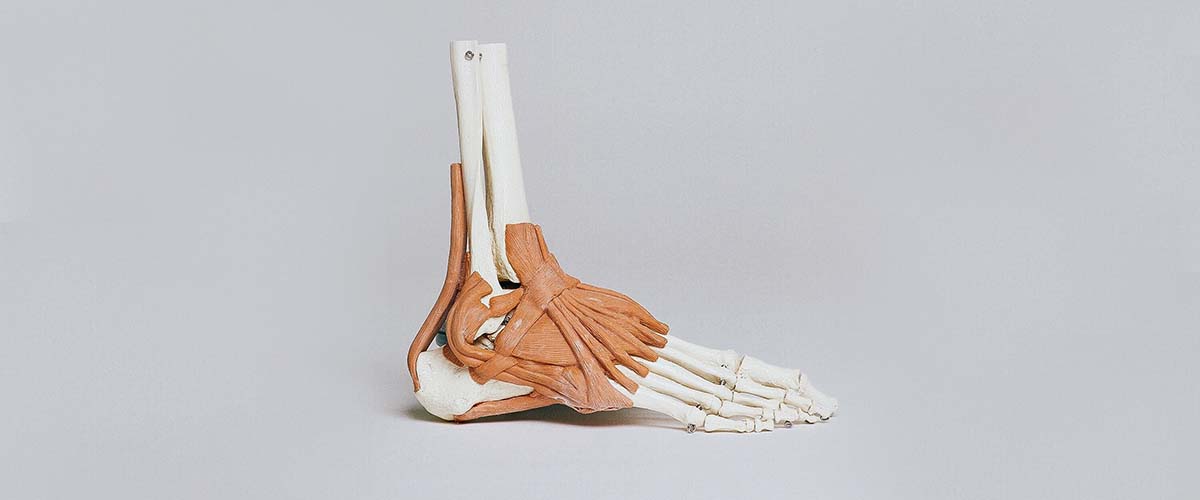
A bunion (hallux valgus) is a bump on the inside of the foot at the base of the big toe. The first metatarsal bone drifts toward the other foot while the big toe angles toward the second toe. Bunions affect roughly one in five people,1 run strongly in families,3 and are more common in women and with age.2 Many never need surgery, but when a bunion keeps hurting despite good shoes, surgery reliably reduces pain.8,9,13
- A painful bump at the big toe joint, often with redness from shoe pressure
- Genetics, footwear and foot shape all play a role3,4,5
- Wider shoes, toe spacers and orthoses can ease symptoms but do not straighten the bone9,10,11
- Surgery is for pain, not appearance alone
- Several surgical options exist, including minimally invasive techniques18,19,20
Symptoms
- A bump on the inside of the big toe joint that rubs in shoes
- Pain, swelling or redness over the bump
- The big toe crowding or overlapping the second toe
- Pain under the ball of the foot (transfer metatarsalgia) or hammertoes in more advanced bunions
Quality of life falls as the deformity becomes more severe.6
What causes bunions?
Bunions are strongly inherited.3 Narrow or poorly fitting shoes and high heels are associated with bunions and with forefoot pain,4,5 and loose ligaments, flat feet and arthritis can contribute. A smaller bump on the outside of the foot at the little toe is called a tailor’s bunion, or bunionette.36
Diagnosis
Dr. Dold examines the foot standing and walking, checks the big toe joint for arthritis and stiffness, and orders weight-bearing X-rays to measure the angles between the bones. These measurements, plus whether the joint is arthritic, guide which treatment fits your foot.
Non-surgical treatment
Non-surgical care aims to make the foot comfortable:
- Shoes with a wide, deep toe box and a low heel
- Toe spacers, bunion pads and orthoses with a toe separator, which can relieve pain10,11,12
- Night splints, which may slightly improve alignment while worn10,12
- Exercises for the foot muscles10
These measures help symptoms but do not permanently correct the bone alignment. In a randomized trial, orthoses gave short-term relief, while surgery was more effective for painful bunions over time.9
When is surgery recommended?
Surgery is considered when the bunion stays painful and limits your walking, activities or choice of shoes despite good non-surgical care. Surgery for appearance alone is not recommended. A Cochrane review found that surgery may give a clinically important reduction in pain compared with non-surgical treatment,8 and studies show improved quality of life afterward.13
Surgical options
The operation depends on the size of the deformity, the flexibility of the foot and whether the big toe joint is arthritic. Differences between the standard osteotomies are small.14
- Distal osteotomy (chevron) and scarf osteotomy: the first metatarsal is cut and shifted to straighten it, held with small screws. Both work well;15,16 adding a small cut in the big toe (Akin osteotomy) lowers the recurrence rate.17
- Minimally invasive bunion surgery: the bone is corrected through small incisions. Results have been comparable to open surgery,19,20,21 with some studies favoring the minimally invasive approach,18,22 and it may reduce early pain.33 Stiffness and recurrence are the main risks to discuss.23
- Lapidus procedure (first tarsometatarsal fusion): fuses the joint at the base of the first metatarsal, giving powerful correction for larger or unstable bunions;24 modern plate fixation allows earlier weight bearing.25,26
- Big toe joint fusion: for bunions with arthritis or severe deformity; most patients return to their sports.31
Recovery and risks
Most bunion operations are outpatient procedures done with an ankle block to control pain.33,34 Patients usually walk in a protective post-operative shoe, with swelling settling over several months. The risk of blood clots after foot and ankle surgery is low.35 Bunions can come back: pooled radiographic recurrence was about 25%, more likely with larger deformities and when the correction is incomplete or the metatarsal remains rotated.27,28,29 When a correction fails, revision surgery can still give good results.30
Bunions in teenagers
Juvenile bunions are often treated with shoes and observation until growth is complete. In selected growing children, a guided-growth procedure on the first metatarsal can gradually correct the angle.32
Frequently asked questions
Can a bunion go away without surgery?
No. Shoes, spacers and orthoses can make a bunion comfortable, but they do not straighten the bone.
Is minimally invasive bunion surgery better?
Studies show results comparable to open surgery, and it may reduce early pain. The right technique depends on your foot.
How long is recovery from bunion surgery?
Most people walk in a protective shoe soon after surgery and return to normal shoes over about 6 to 12 weeks, with swelling settling over several months.
Will my bunion come back?
It can. Recurrence is more likely with larger deformities or incomplete correction, which is why the procedure is matched to your X-rays.
Should I have surgery for a bunion that does not hurt?
Generally no. Surgery is recommended for pain and functional problems, not appearance alone.
Research cited on this page
- Cai Y, Song Y, He M, et al. Global prevalence and incidence of hallux valgus: a systematic review and meta-analysis. J Foot Ankle Res. 2023;16(1):63. PubMed
Hallux valgus affects about 19% of people worldwide. - Nix S, Smith M, Vicenzino B. Prevalence of hallux valgus in the general population: a systematic review and meta-analysis. J Foot Ankle Res. 2010;3:21. PubMed
Bunions are common, more so in women and with increasing age. - Hannan MT, Menz HB, Jordan JM, et al. High heritability of hallux valgus and lesser toe deformities in adult men and women. Arthritis Care Res (Hoboken). 2013;65(9):1515-21. PubMed
Hallux valgus and lesser toe deformities are highly heritable. - Menz HB, Morris ME. Footwear characteristics and foot problems in older people. Gerontology. 2005;51(5):346-51. PubMed
Poorly fitting shoes are common in older people and strongly associated with forefoot problems and foot pain. - Puszczałowska-Lizis E, Dąbrowiecki D, Jandziś S, et al. Foot Deformities in Women Are Associated with Wearing High-Heeled Shoes. Med Sci Monit. 2019;25:7746-7754. PubMed
In women, the type of footwear worn was associated with hallux valgus. - Menz HB, Roddy E, Thomas E, et al. Impact of hallux valgus severity on general and foot-specific health-related quality of life. Arthritis Care Res (Hoboken). 2011;63(3):396-404. PubMed
Quality of life declines progressively as the bunion becomes more severe. - Ferrari J. Bunions. BMJ Clin Evid. 2009;2009. PubMed
An evidence summary of surgical and non-surgical bunion treatments. - Dias CG, Godoy-Santos AL, Ferrari J, et al. Surgical interventions for treating hallux valgus and bunions. Cochrane Database Syst Rev. 2024;7(7):CD013726. PubMed
Cochrane review: surgery may give a clinically important reduction in pain compared with no or non-surgical treatment; different osteotomies gave similar results. - Torkki M, Malmivaara A, Seitsalo S, et al. Surgery vs orthosis vs watchful waiting for hallux valgus: a randomized controlled trial. JAMA. 2001;285(19):2474-80. PubMed
In a randomized trial, osteotomy surgery was effective for painful bunions; orthoses gave only short-term relief. - Ying J, Xu Y, István B, et al. Adjusted Indirect and Mixed Comparisons of Conservative Treatments for Hallux Valgus: A Systematic Review and Network Meta-Analysis. Int J Environ Res Public Health. 2021;18(7). PubMed
Toe separators, exercise, night splints and dry needling may improve alignment and comfort, but higher-quality studies are needed. - Kwan MY, Yick KL, Yip J, et al. Hallux valgus orthosis characteristics and effectiveness: a systematic review with meta-analysis. BMJ Open. 2021;11(8):e047273. PubMed
Orthoses with a toe separator or alignment element helped reduce the bunion angle and foot pain. - Tehraninasr A, Saeedi H, Forogh B, et al. Effects of insole with toe-separator and night splint on patients with painful hallux valgus: a comparative study. Prosthet Orthot Int. 2008;32(1):79-83. PubMed
An insole with a toe separator reduced pain; both it and a night splint slightly reduced the bunion angles. - Hernández-Castillejo LE, Martínez Vizcaíno V, Garrido-Miguel M, et al. Effectiveness of hallux valgus surgery on patient quality of life: a systematic review and meta-analysis. Acta Orthop. 2020;91(4):450-456. PubMed
Bunion surgery reduced pain and improved quality of life, particularly physical and social function. - Klugarova J, Hood V, Bath-Hextall F, et al. Effectiveness of surgery for adults with hallux valgus deformity: a systematic review. JBI Database System Rev Implement Rep. 2017;15(6):1671-1710. PubMed
Differences between osteotomy techniques on clinical outcomes were minimal. - Peng YN, Peng YH, Chen CPC. Chevron osteotomy and scarf osteotomy for hallux valgus angle and intermetatarsal angle correction: a systematic review and meta-analysis of randomized controlled trials. J Orthop Surg Res. 2024;19(1):566. PubMed
Chevron osteotomy corrected the big-toe angle slightly more than scarf osteotomy, with similar scores and complications. - Smith SE, Landorf KB, Butterworth PA, et al. Scarf versus chevron osteotomy for the correction of 1-2 intermetatarsal angle in hallux valgus: a systematic review and meta-analysis. J Foot Ankle Surg. 2012;51(4):437-44. PubMed
Scarf and chevron osteotomies both corrected the deformity, with only a small difference in correction. - Butler JJ, Hartman H, Rettig S, et al. Similar outcomes following scarf-Akin osteotomy compared to scarf-alone osteotomy for the treatment of hallux valgus: A systematic review and meta-analysis. Foot Ankle Surg. 2024;30(4):299-308. PubMed
Adding an Akin osteotomy to a scarf osteotomy lowered the recurrence rate without more complications. - Ji L, Wang K, Ding S, et al. Minimally Invasive vs. Open Surgery for Hallux Valgus: A Meta-Analysis. Front Surg. 2022;9:843410. PubMed
In one meta-analysis, minimally invasive surgery had better clinical and radiographic outcomes than open surgery. - Alimy AR, Polzer H, Ocokoljic A, et al. Does Minimally Invasive Surgery Provide Better Clinical or Radiographic Outcomes Than Open Surgery in the Treatment of Hallux Valgus Deformity? A Systematic Review and Meta-analysis. Clin Orthop Relat Res. 2023;481(6):1143-1155. PubMed
In another meta-analysis, minimally invasive surgery did not give better clinical or radiographic results than open surgery. - Kaufmann G, Dammerer D, Heyenbrock F, et al. Minimally invasive versus open chevron osteotomy for hallux valgus correction: a randomized controlled trial. Int Orthop. 2019;43(2):343-350. PubMed
Minimally invasive chevron osteotomy gave results comparable to the open technique. - Ferreira GF, Borges VQ, Moraes LVM, et al. Percutaneous Chevron/Akin (PECA) versus open scarf/Akin (SA) osteotomy treatment for hallux valgus: A systematic review and meta-analysis. PLoS One. 2021;16(2):e0242496. PubMed
Percutaneous chevron-Akin and open scarf-Akin gave similar correction, pain relief and function at 6 months. - Ruberto P, Calori S, Bocchino G, et al. Utilisation of the minimally invasive chevron akin (mica) osteotomy for severe hallux valgus: a systematic review. Musculoskelet Surg. 2025;109(2):133-143. PubMed
Minimally invasive chevron-Akin surgery achieved good outcomes and high satisfaction even for severe bunions. - Miranda MAM, Martins C, Cortegana IM, et al. Complications on Percutaneous Hallux Valgus Surgery: A Systematic Review. J Foot Ankle Surg. 2021;60(3):548-554. PubMed
After percutaneous surgery, stiffness (about 18%), recurrence and metatarsal shortening (about 15% each) were the most reported complications. - Willegger M, Holinka J, Ristl R, et al. Correction power and complications of first tarsometatarsal joint arthrodesis for hallux valgus deformity. Int Orthop. 2015;39(3):467-76. PubMed
First tarsometatarsal fusion (Lapidus) had greater corrective power than metatarsal osteotomies. - Waehner M, Klos K, Polzer H, et al. Lapidus Arthrodesis for Correction of Hallux Valgus Deformity: A Systematic Review and Meta-Analysis. Foot Ankle Spec. 2026;19(1):58-69. PubMed
For Lapidus fusion, plantar plating allowed early weight bearing with the lowest nonunion and hardware removal rates. - Barp EA, Erickson JG, Smith HL, et al. Evaluation of Fixation Techniques for Metatarsocuneiform Arthrodesis. J Foot Ankle Surg. 2017;56(3):468-473. PubMed
The overall nonunion rate after Lapidus fusion was 6.7%, higher in men. - Ezzatvar Y, López-Bueno L, Fuentes-Aparicio L, et al. Prevalence and Predisposing Factors for Recurrence after Hallux Valgus Surgery: A Systematic Review and Meta-Analysis. J Clin Med. 2021;10(24). PubMed
Pooled recurrence after bunion surgery was about 25%; larger deformities and residual angles predicted recurrence. - Lalevee M, de Cesar Netto C, ReSurg, et al. Recurrence Rates With Longer-Term Follow-up After Hallux Valgus Surgical Treatment With Distal Metatarsal Osteotomies: A Systematic Review and Meta-analysis. Foot Ankle Int. 2023;44(3):210-222. PubMed
At 5 or more years after distal osteotomies, recurrence rates were similar except for the older Mitchell technique. - Najefi AA, Alsafi MK, Katmeh R, et al. First Metatarsal Rotation After Scarf Osteotomy for Hallux Valgus. Foot Ankle Spec. 2024;17(4):399-405. PubMed
Residual rotation of the first metatarsal after scarf osteotomy was linked to worse outcomes. - Migliorini F, Eschweiler J, Tingart M, et al. Revision surgeries for failed hallux valgus correction: A systematic review. Surgeon. 2021;19(6):e497-e506. PubMed
Revision surgery for a failed bunion correction can give satisfying results with careful planning. - Baumann AN, Walley KC, Kermanshahi N, et al. Return to Sport After First Metatarsophalangeal Arthrodesis: A Systematic Review. Foot Ankle Int. 2023;44(12):1319-1327. PubMed
Most patients returned to their sports at a similar or higher level after big-toe joint fusion. - Artioli E, Mazzotti A, Langone L, et al. First Metatarsal Hemiepiphysiodesis for the Treatment of Juvenile Hallux Valgus: A Systematic Review. J Pediatr Orthop. 2023;43(9):584-589. PubMed
Guided growth (hemiepiphysiodesis) of the first metatarsal was safe for juvenile bunions. - Wust M, Desai N, Joshi GP, et al. Pain management after hallux valgus repair surgery: an updated systematic review and procedure-specific postoperative pain management (PROSPECT) recommendations. Eur J Anaesthesiol. 2026;43(1):11-18. PubMed
For pain control after bunion surgery, an ankle block is the first-choice technique, and minimally invasive surgery is recommended over open osteotomy. - Singh VK, Ridgers S, Sott AH. Ankle block in forefoot reconstruction before or after inflation of tourniquet–Does timing matter?. Foot Ankle Surg. 2013;19(1):15-7. PubMed
A regional ankle block controlled pain after forefoot surgery. - Mangwani J, Houchen-Wolloff L, Malhotra K, et al. UK Foot and Ankle Thromboembolism (UK-FATE). Bone Joint J. 2024;106-B(11):1249-1256. PubMed
The 90-day risk of symptomatic blood clots after foot and ankle surgery was low. - Coll MC, Beech MI. Scarf osteotomy for reduction of tailors bunion deformities: Systematic review and meta-analysis. Foot (Edinb). 2023;55:101982. PubMed
Scarf osteotomy for a tailor’s bunion (bunionette) gave good correction, few complications and high satisfaction.
Medically reviewed by Andrew P. Dold, MD, FAOA, FAAOS, FACS, FRCSC. Last reviewed October 2026. This page is general information, not medical advice. Your own diagnosis and treatment plan depend on your exam and imaging.