








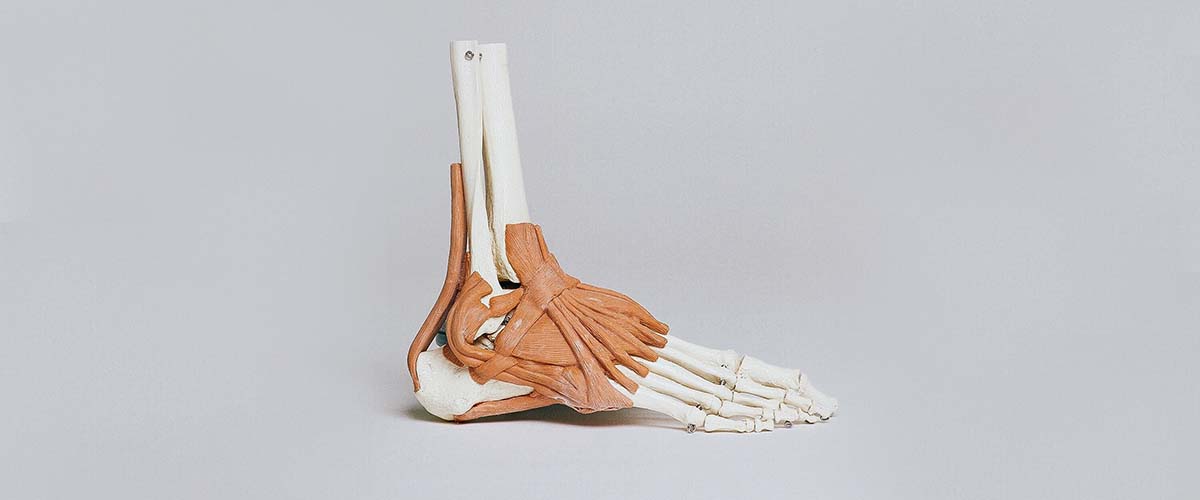
The sesamoids are two small, pea-shaped bones under the big-toe joint, embedded in the tendon that bends the big toe. They act like a pulley and absorb much of the force when you push off, which is why they are vulnerable in running, dancing and jumping sports. Sesamoid problems include inflammation (sesamoiditis), stress fractures, acute fractures and loss of blood supply (avascular necrosis).1,4
- Pain under the ball of the foot at the big toe, worse with push-off
- Stress fractures here are high risk and slow to heal10
- A divided (bipartite) sesamoid is a normal variant in about 1 in 7 feet and can mimic a fracture5,7
- Treatment starts with offloading pads, stiff shoes or a boot1,13
- Sesamoidectomy or fixation for injuries that don’t heal13,19
Types of sesamoid problems
- Sesamoiditis: irritation and inflammation of the sesamoids and surrounding tissue from overload.1
- Stress fractures: from repetitive loading; classed as high risk because of higher nonunion rates and longer recovery.10,11
- Acute fractures: from a fall, landing or hyperextension injury, often with turf toe.
- Avascular necrosis (osteonecrosis): loss of blood supply, often in young female athletes; it overlaps with stress fracture and nonunion.14
- Arthritis or cartilage wear between the sesamoid and the metatarsal head.1
Symptoms
- Pain under the big-toe joint, especially when pushing off, running, jumping or dancing
- Pain when bending the big toe upward
- Swelling or tenderness directly over one sesamoid
- Walking on the outside of the foot to avoid pressure
Diagnosis
Pain under the big toe has more than 30 possible causes, so an accurate diagnosis matters.2,3 Dr. Dold presses on each sesamoid, checks big-toe motion and alignment, and looks for contributing factors such as a high arch or bunion. Imaging:
- X-rays, including a special sesamoid view. About 1 in 7 feet has a divided (partite) sesamoid, usually the inner one, which can look like a fracture.5,6,9
- MRI distinguishes fracture, bone stress and avascular necrosis, and can tell a fractured bipartite sesamoid from a normal variant.7,8
- CT shows fracture lines and healing.
Non-surgical treatment
Most sesamoid problems are treated without surgery first:1,13
- Offloading: a dancer’s pad or cut-out insole to take pressure off the sesamoid, plus a stiff-soled shoe or carbon-fiber plate
- Taping to limit upward bending of the big toe
- A walking boot or cast, sometimes non-weight-bearing, for fractures and severe pain11
- Activity modification and a gradual return to impact
- Anti-inflammatory medicines for sesamoiditis when safe
Conservative care is usually tried for 2 to 6 months for sesamoid stress fractures.13 Most young athletes with sesamoid fractures did well without surgery, but recovery can be slow: return to sport averaged about 161 days in one study.12 Shockwave therapy and PRP are being explored as ways to avoid surgery,15,16,17 though the evidence is still limited to small studies.
Surgery
When pain persists after months of good non-surgical care, or a fracture does not heal, options include:
- Internal fixation or bone grafting of a fracture or nonunion, preserving the sesamoid. Internal fixation showed high rates of return to full sport.13 Temporary fixation of the big-toe joint has also been used, with return to sport at about 80 days.18
- Sesamoidectomy (removing the damaged sesamoid): athletes returned to activity at about 11 weeks with a 5.7% complication rate,19 with low morbidity and no meaningful change in toe alignment.20 Inner (tibial) and outer (fibular) sesamoidectomy both relieved pain while preserving alignment when the soft tissues are carefully repaired,21,22,23 and 88% would have surgery again in one series.22 Arthroscopic techniques are also used.24
For avascular necrosis, removing the affected bone most commonly leads to complete satisfaction when offloading fails.14
Recovery
- Sesamoiditis: usually several weeks to a few months with offloading.
- Stress fractures treated without surgery: often 3 to 6 months or longer.12,13
- After sesamoidectomy: return to activity in about 3 months on average.19
Dr. Dold reviews your expected timeline based on your diagnosis and treatment.
Frequently asked questions
What is sesamoiditis?
Irritation of the two small bones under the big-toe joint and the tissue around them, usually from overload in running, jumping or dancing, or in high-heeled shoes.
Is a bipartite sesamoid a fracture?
Not necessarily. About 1 in 7 feet has a sesamoid that is naturally divided into two pieces. An MRI or comparison with the other foot can help tell a normal variant from a fracture.
Why do sesamoid fractures take so long to heal?
The sesamoids carry high loads with every step and have a limited blood supply, so stress fractures here are considered high risk and can take months to heal.
Will removing a sesamoid change my big toe?
When done carefully with soft-tissue repair, studies show little change in alignment and good pain relief. Your surgeon will discuss the small risk of toe drift or weakness.
Can I keep running with sesamoid pain?
Running through sesamoid pain risks turning a stress reaction into a fracture or nonunion. Offloading early usually shortens recovery.
Research cited on this page
- Cohen BE. Hallux sesamoid disorders. Foot Ankle Clin. 2009;14(1):91-104. PubMed
Sesamoid problems include acute fractures, stress fractures, nonunions, osteonecrosis, cartilage wear and sesamoiditis; treatment ranges from orthotics and immobilization to surgery. - Oloff LM, Schulhofer SD. Sesamoid complex disorders. Clin Podiatr Med Surg. 1996;13(3):497-513. PubMed
Pain under the sesamoids has more than 30 possible causes, so accurate diagnosis matters. - McBryde AM, Anderson RB. Sesamoid foot problems in the athlete. Clin Sports Med. 1988;7(1):51-60. PubMed
Sesamoid injuries in athletes demand a high index of suspicion and a thorough diagnostic effort. - Lee DK, Mulder GD, Schwartz AK. Hallux, sesamoid, and first metatarsal injuries. Clin Podiatr Med Surg. 2011;28(1):43-56. PubMed
Hallux and sesamoid injuries affect the first ray, which is essential for push-off in walking. - Munuera PV, Domínguez G, Reina M, et al. Bipartite hallucal sesamoid bones: relationship with hallux valgus and metatarsal index. Skeletal Radiol. 2007;36(11):1043-50. PubMed
14.6% of feet had at least one partite (divided) sesamoid, most often the medial one. - Higuchi J, Matsumoto T, Kasai T, et al. Relationship between medial partite hallux sesamoid and hallux valgus in the general population. Foot Ankle Surg. 2023;29(8):621-626. PubMed
A partite medial sesamoid was found in 12.7% of feet. - Lee SYS, Tan TJ, Yan YY. Fracture of a Bipartite Medial Hallux Sesamoid Masquerading as a Tripartite Variant: A Case Report and Review of the Literature. J Foot Ankle Surg. 2019;58(5):980-983. PubMed
A fractured bipartite sesamoid can masquerade as a normal variant; MRI helps tell them apart. - Lombard C, Gillet R, Rauch A, et al. Hallux sesamoid complex imaging: a practical diagnostic approach. Skeletal Radiol. 2020;49(12):1889-1901. PubMed
Imaging (X-ray, CT, MRI) separates intrinsic sesamoid problems from conditions affecting them secondarily. - Summers A. Accessory ossicles and sesamoid bones: recognition and treatment. Emerg Nurse. 2015;22(10):27-32. PubMed
Normal accessory bones and sesamoids can look like, or hide, fractures on foot X-rays. - Paavana T, Rammohan R, Hariharan K. Stress fractures of the foot – current evidence on management. J Clin Orthop Trauma. 2024;50:102381. PubMed
Hallux sesamoid stress fractures are high risk because of higher nonunion rates and longer recovery. - McInnis KC, Ramey LN. High-Risk Stress Fractures: Diagnosis and Management. PM R. 2016;8(3 Suppl):S113-24. PubMed
High-risk stress fractures need early imaging, non-weight-bearing immobilization and a careful return to sport. - Stein CJ, Sugimoto D, Slick NR, et al. Hallux sesamoid fractures in young athletes. Phys Sportsmed. 2019;47(4):441-447. PubMed
Most young athletes with sesamoid fractures did well without surgery, but recovery to pain-free return averaged about 161 days. - Robertson GAJ, Goffin JS, Wood AM. Return to sport following stress fractures of the great toe sesamoids: a systematic review. Br Med Bull. 2017;122(1):135-149. PubMed
Conservative care for 2 to 6 months is tried first for sesamoid stress fractures; internal fixation showed high rates of return to full sport. - Bartosiak K, McCormick JJ. Avascular Necrosis of the Sesamoids. Foot Ankle Clin. 2019;24(1):57-67. PubMed
Sesamoid osteonecrosis often affects young female athletes; when offloading fails, excising the bone most commonly leads to complete satisfaction. - Nakajima K. Avoiding Hallux Sesamoidectomy: A Narrative Review. J Clin Med. 2025;14(21). PubMed
Shockwave therapy and PRP are being used as ways to avoid sesamoid excision, along with newer surgical alternatives. - Le HM, Stracciolini A, Stein CJ, et al. Platelet rich plasma for hallux sesamoid injuries: a case series. Phys Sportsmed. 2022;50(2):181-184. PubMed
In a small case series, athletes returned to impact activity 6 to 9 weeks after PRP for sesamoid injuries. - Thompson D, Malliaropoulos N, Padhiar N. Sesamoid osteonecrosis treated with radial extracorporeal shock wave therapy. BMJ Case Rep. 2017;2017. PubMed
Radial shockwave therapy was used as an alternative to surgery for sesamoid osteonecrosis in a single patient who had failed conservative care. - Moran CJ, Viard B, Tourné Y. Long term follow up on treatment of hallux sesamoid fracture with temporary first metatarsal joint internal fixation. Foot (Edinb). 2024;60:102104. PubMed
Temporary fixation of the big-toe joint for sesamoid fractures allowed return to sport at about 80 days with no further surgery at 10 years. - Saxena A, Fournier M, Patel P, et al. Sesamoidectomy in Athletes: Outcomes From 2-Centers. J Foot Ankle Surg. 2022;61(1):139-142. PubMed
In athletes who failed conservative care, sesamoidectomy allowed return to activity at about 11 weeks with a 5.7% complication rate. - Kane JM, Brodsky JW, Daoud Y. Radiographic Results and Return to Activity After Sesamoidectomy for Fracture. Foot Ankle Int. 2017;38(10):1100-1106. PubMed
Sesamoidectomy for fractures that failed non-surgical care had low morbidity and no clinically significant change in alignment. - Lee S, James WC, Cohen BE, et al. Evaluation of hallux alignment and functional outcome after isolated tibial sesamoidectomy. Foot Ankle Int. 2005;26(10):803-9. PubMed
Tibial (inner) sesamoidectomy was safe and effective; careful soft-tissue repair avoided hallux malalignment. - Ford SE, Adair CR, Cohen BE, et al. Efficacy, Outcomes, and Alignment Following Isolated Fibular Sesamoidectomy via a Plantar Approach. Foot Ankle Int. 2019;40(12):1375-1381. PubMed
Fibular (outer) sesamoidectomy relieved pain at a median of 5 years without changing hallux alignment; 88% would have surgery again. - Mehtar M, Saragas NP, Ferrao PN. Functional and patient reported outcomes following lateral hallucal sesamoidectomy. Foot (Edinb). 2020;43:101656. PubMed
Lateral sesamoidectomy via a plantar approach gave excellent patient-reported outcomes with preserved motion. - Nakajima K. Arthroscopic Sesamoidectomy for Hallux Sesamoid Disorders. J Foot Ankle Surg. 2022;61(1):175-180. PubMed
Arthroscopic sesamoidectomy had good outcomes, but patients should be aware of possible complications.
Medically reviewed by Andrew P. Dold, MD, FAOA, FAAOS, FACS, FRCSC. Last reviewed October 2026. This page is general information, not medical advice. Your own diagnosis and treatment plan depend on your exam and imaging.