








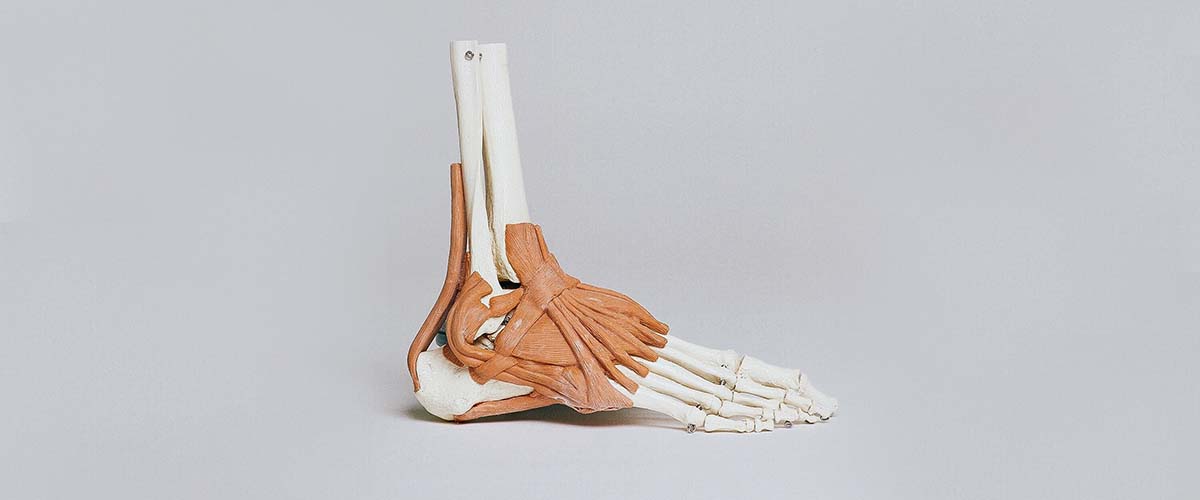
An ankle fracture is a break in one or more of the bones that form the ankle joint: the fibula on the outside and the tibia on the inside and back. Many ankle fractures heal in a boot or cast; others are unstable and need surgery to restore the joint’s alignment. The key question Dr. Dold answers is whether your ankle is stable.
- Usually from a twist, fall or sports injury
- Pain, swelling and difficulty bearing weight; bruising spreads over days
- X-rays, sometimes with stress views, show whether the ankle is stable
- Stable fractures heal in a boot or cast; unstable fractures may need surgery
- Bone healing typically takes about 6 weeks, with full recovery over months
Types of ankle fracture
- Lateral malleolus fracture: a break of the outer bone (fibula), the most common type
- Medial malleolus fracture: a break of the inner bone (tibia)
- Bimalleolar or trimalleolar fracture: two or three parts of the ankle broken, usually unstable
- Syndesmosis injury: a tear of the ligaments that hold the tibia and fibula together, often with a fracture
Diagnosis
X-rays show the fracture and the alignment of the joint. Stress X-rays or weight-bearing X-rays help decide whether the ankle is stable; a CT scan is sometimes used for complex fractures. Dr. Dold also checks the ligaments, as with high ankle sprains.
Non-surgical treatment
Stable fractures, where the ankle joint stays aligned, are treated in a walking boot or cast. Research increasingly supports non-surgical care in selected cases. In a randomized trial of 126 patients with outer-ankle (Weber B) fractures that were unstable on stress testing but well aligned on standard X-rays, a cast gave results that were not worse than surgery at two years, with fewer treatment-related harms.1 In adults over 60 with unstable fractures, a carefully molded close-contact cast gave similar function to surgery at 6 months, although the bone more often healed slightly out of position.2
Surgery
When the joint is out of alignment or both sides of the ankle are broken, surgery restores alignment so the ankle can heal properly and lower the risk of arthritis. The usual operation is open reduction and internal fixation (ORIF): the bones are put back in place and held with a plate and screws. Syndesmosis injuries are stabilized with screws or a flexible suture-button device. Wound and infection problems were more common after surgery than casting in older adults,2 so Dr. Dold weighs the benefits for each patient.
Recovery
After surgery, many patients now start bearing weight early in a boot. In a randomized trial of 561 patients, walking on the ankle from 2 weeks after surgery was not worse than waiting 6 weeks.3 Bone healing typically takes about 6 weeks; strength, balance and running return over the following months with physical therapy.
What the research shows
- Stable fractures heal well without surgery: for a stable outer-ankle (Weber B) fracture, a randomized trial found 3 weeks in a cast or brace was as effective as 6 weeks in a cast, and functional braces are more comfortable. A recent trial found casting was non-inferior to surgery even for some fractures that looked unstable only on stress testing, as long as the joint stayed aligned on X-ray.
- Stress X-rays guide the decision: swelling and inner-ankle tenderness do not reliably show whether the deltoid ligament is torn; weight-bearing or stress X-rays measure joint stability more accurately.
- Surgery for unstable fractures: when the ankle joint shifts out of position, fixation restores alignment. In adults over 60 with unstable fractures, a large trial found that a carefully molded cast gave results similar to surgery at 6 months, so treatment is individualized.
- Syndesmosis (high ankle) injuries: when the joint between the tibia and fibula is unstable, flexible suture-button fixation gave better function and fewer repeat operations than screws in several studies, and routine screw removal is not required.
- Walk early: randomized trials, including the large UK WAX trial, show that early weight-bearing in a boot after surgery is safe and can speed return to function and work.
- Recovery takes time: most function returns by about 6 months, but some stiffness or swelling can persist for a year or two, and return to sport varies widely.
Frequently asked questions
Do all ankle fractures need surgery?
No. Stable fractures heal in a boot or cast. Surgery is for fractures where the joint is out of alignment or unstable.
Can I walk on a broken ankle?
It depends on the fracture. Many stable fractures allow walking in a boot, and after surgery many patients start bearing weight early. Follow your surgeon’s plan.
How long does an ankle fracture take to heal?
Bone healing typically takes about 6 weeks; full recovery of strength and sport takes several months.
Will the plate and screws need to come out?
Usually not. Hardware is removed only if it causes irritation or another problem.
Research cited on this page
- Kortekangas T, Lehtola R, Leskelä HV, et al. Cast immobilisation versus surgery for unstable lateral malleolus fractures (SUPER-FIN): randomised non-inferiority clinical trial. BMJ. 2026;392:e085295. PubMed
In 126 patients with stress-unstable Weber B fractures and a well-aligned joint, a cast was not worse than surgery at two years, with fewer treatment-related harms. - Willett K, Keene DJ, Mistry D, et al. Close contact casting vs surgery for initial treatment of unstable ankle fractures in older adults: a randomized clinical trial. JAMA. 2016;316(14):1455-1463. PubMed
In 620 adults over 60, casting gave similar function at 6 months. Infection and wound breakdown were more common after surgery (10% vs 1%); healing out of position was more common after casting (15% vs 3%), and 19% of the cast group later had surgery. - Bretherton CP, Achten J, Jogarah V, et al. Early versus delayed weight-bearing following operatively treated ankle fracture (WAX): a non-inferiority, multicentre, randomised controlled trial. Lancet. 2024;403(10446):2787-2797. PubMed
In 561 patients, weight bearing from 2 weeks after surgery was not inferior to waiting 6 weeks, with similar complication rates. - Kortekangas T, Haapasalo H, Flinkkilä T, et al. Three week versus six week immobilisation for stable Weber B type ankle fractures: randomised, multicentre, non-inferiority clinical trial. BMJ. 2019;364:k5432. PubMed
Randomized trial (BMJ): for stable Weber B fractures, 3 weeks in a cast or brace was as effective as 6 weeks in a cast. - van den Berg C, Haak T, Weil NL, et al. Functional bracing treatment for stable type B ankle fractures. Injury. 2018;49(8):1607-1611. PubMed
Randomized trial: a functional brace was more comfortable and allowed more motion at 6 weeks than a cast, with similar results at 1 year. - Boutis K, Willan AR, Babyn P, et al. A randomized, controlled trial of a removable brace versus casting in children with low-risk ankle fractures. Pediatrics. 2007;119(6):e1256-63. PubMed
Randomized trial in children with low-risk ankle fractures: a removable brace gave faster recovery and was preferred over a cast. - van den Bekerom MP, Mutsaerts EL, van Dijk CN. Evaluation of the integrity of the deltoid ligament in supination external rotation ankle fractures: a systematic review of the literature. Arch Orthop Trauma Surg. 2009;129(2):227-35. PubMed
Systematic review: swelling, bruising and medial tenderness poorly predict deltoid ligament injury; stress radiographs are more reliable. - Wang J, Stride D, Horner NS, et al. The Role of Deltoid Ligament Repair in Ankle Fractures With Syndesmotic Instability: A Systematic Review. J Foot Ankle Surg. 2021;60(1):132-139. PubMed
Systematic review: deltoid ligament repair lowered syndesmotic malreduction and hardware-removal rates compared with syndesmotic screws. - Guo W, Lin W, Chen W, et al. Comparison of deltoid ligament repair and non-repair in acute ankle fracture: A meta-analysis of comparative studies. PLoS One. 2021;16(11):e0258785. PubMed
Meta-analysis: deltoid ligament repair improved medial clear space, function scores and complication rates in selected fractures. - Carter TH, Oliver WM, Bell KR, et al. Operative vs Nonoperative Management of Unstable Medial Malleolus Fractures: A Randomized Clinical Trial. JAMA Netw Open. 2024;7(1):e2351308. PubMed
Randomized trial: fixing well-reduced medial malleolus fractures after fibular fixation did not improve the primary outcome. - Hoelsbrekken SE, Kaul-Jensen K, Mørch T, et al. Nonoperative treatment of the medial malleolus in bimalleolar and trimalleolar ankle fractures: a randomized controlled trial. J Orthop Trauma. 2013;27(11):633-7. PubMed
Randomized trial: non-operative treatment of minimally displaced medial malleolus fractures after fibular fixation gave satisfactory results. - Pakarinen HJ, Flinkkilä TE, Ohtonen PP, et al. Syndesmotic fixation in supination-external rotation ankle fractures: a prospective randomized study. Foot Ankle Int. 2011;32(12):1103-9. PubMed
Randomized trial: syndesmotic screw fixation did not improve outcomes in supination-external rotation fractures where instability was not confirmed. - Andersen MR, Frihagen F, Hellund JC, et al. Randomized Trial Comparing Suture Button with Single Syndesmotic Screw for Syndesmosis Injury. J Bone Joint Surg Am. 2018;100(1):2-12. PubMed
Randomized trial: suture-button syndesmotic fixation gave better function and less widening than a screw. - Inge SY, Pull Ter Gunne AF, Aarts CAM, et al. A systematic review on dynamic versus static distal tibiofibular fixation. Injury. 2016;47(12):2627-2634. PubMed
Systematic review: dynamic (suture-button) syndesmotic fixation had fewer reoperations and complications than static screws. - Schepers T. Acute distal tibiofibular syndesmosis injury: a systematic review of suture-button versus syndesmotic screw repair. Int Orthop. 2012;36(6):1199-206. PubMed
Systematic review: suture-button fixation had similar outcomes to screws, quicker return to work and fewer implant removals. - Dingemans SA, Rammelt S, White TO, et al. Should syndesmotic screws be removed after surgical fixation of unstable ankle fractures? a systematic review. Bone Joint J. 2016;98-B(11):1497-1504. PubMed
Systematic review: routine removal of syndesmotic screws is not supported. - Dehghan N, McKee MD, Jenkinson RJ, et al. Early Weightbearing and Range of Motion Versus Non-Weightbearing and Immobilization After Open Reduction and Internal Fixation of Unstable Ankle Fractures: A Randomized Controlled Trial. J Orthop Trauma. 2016;30(7):345-52. PubMed
Randomized trial: early weight-bearing and motion after fixation improved early function without increasing complications. - Khojaly R, Rowan FE, Shah V, et al. Immediate Weight-Bearing Compared with Non-Weight-Bearing After Operative Ankle Fracture Fixation: Results of the INWN Pragmatic, Randomized, Multicenter Trial. J Bone Joint Surg Am. 2025;107(13):1423-1438. PubMed
Randomized trial: immediate weight-bearing in a boot after fixation improved function and return to work compared with 6 weeks non-weight-bearing in a cast. - Lewis SR, Pritchard MW, Parker R, et al. Rehabilitation for ankle fractures in adults. Cochrane Database Syst Rev. 2024;9(9):CD005595. PubMed
Cochrane review: early weight-bearing may improve outcomes in the first 6 months after surgery, though the difference may be small. - Moseley AM, Beckenkamp PR, Haas M, et al. Rehabilitation After Immobilization for Ankle Fracture: The EXACT Randomized Clinical Trial. JAMA. 2015;314(13):1376-85. PubMed
Randomized trial: supervised exercise added no benefit over advice alone for isolated, uncomplicated ankle fractures. - Beckenkamp PR, Lin CW, Chagpar S, et al. Prognosis of physical function following ankle fracture: a systematic review with meta-analysis. J Orthop Sports Phys Ther. 2014;44(11):841-51, B2. PubMed
Meta-analysis: about 80% of function returns by 6 months, but recovery is often incomplete at 2 years. - Del Buono A, Smith R, Coco M, et al. Return to sports after ankle fractures: a systematic review. Br Med Bull. 2013;106:179-91. PubMed
Systematic review: time to return to sport after ankle fracture ranged widely, from 3 to 51 weeks.
Medically reviewed by Andrew P. Dold, MD, FAOA, FAAOS, FACS, FRCSC. Last reviewed October 2026. This page is general information, not medical advice. Your own diagnosis and treatment plan depend on your exam and imaging.