









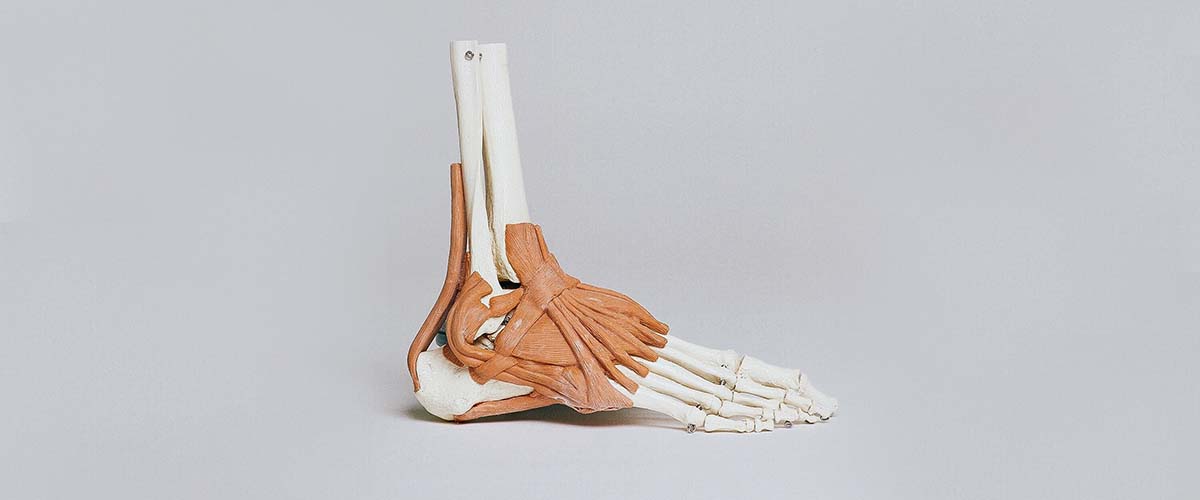
Ankle arthritis is wear of the cartilage in the main ankle joint, where the shinbone (tibia) meets the talus. Unlike hip and knee arthritis, most ankle arthritis follows an injury: in one large series, 70% of arthritic ankles were post-traumatic, often years after a fracture or repeated sprains.1,2 It often affects younger, active people,3 and end-stage ankle arthritis can be as disabling as end-stage hip arthritis.5
- Deep ankle pain, stiffness and swelling, often years after a fracture or sprains1,3
- Diagnosed with weight-bearing X-rays4
- Bracing, shoe changes, activity changes and exercise come first2,7
- PRP was no better than placebo in a randomized trial of ankle arthritis10,11
- For end-stage arthritis, fusion and ankle replacement gave similar results in a large randomized trial18
Causes
- Previous injury: ankle fractures, cartilage injuries and long-standing ankle instability are the most common causes.1,3
- Inflammatory arthritis such as rheumatoid arthritis.1
- Primary (wear-and-tear) osteoarthritis, which is less common in the ankle than in the hip or knee.1,2
- Malalignment: a heel or ankle that tilts in or out loads one side of the joint.3
Symptoms
- Aching pain deep in the front of the ankle, worse with walking, stairs and uneven ground
- Stiffness, especially in the morning or after sitting
- Swelling after activity
- Pain and blocking when bending the foot upward, from bone spurs at the front of the ankle
- A limp or difficulty with longer walks
Diagnosis
Dr. Dold examines the ankle and the alignment of the whole leg and foot, and orders standing (weight-bearing) X-rays, which are the basis of diagnosis.4 A CT scan helps plan surgery, and an MRI can look at cartilage, bone bruising and tendons when X-rays don’t explain the pain. A numbing injection can help confirm that the ankle joint, rather than a nearby joint, is the main source of pain.
Non-surgical treatment
Most people start with non-surgical care, which centers on reducing pain and keeping you active:2,6,7
- Shoes and bracing: rocker-bottom soles, cushioned heels, an ankle brace or a custom ankle-foot orthosis
- Activity changes: swapping impact exercise for cycling, swimming or the elliptical
- Physical therapy for strength, balance and motion
- Weight management to reduce load on the joint
- Anti-inflammatory medicines when safe for you
Injections: what the research shows
- Cortisone: often used for short-term relief of flare-ups.
- Hyaluronic acid (gel): early studies showed pain relief with weekly injections, but the evidence is limited and much of it is borrowed from knee research.8,9
- PRP (platelet-rich plasma): in a well-designed randomized trial of 100 patients, PRP was no better than a placebo injection at 26 weeks or at 1 year.10,11 A pooled analysis that combined several joints reported some pain benefit in the ankle,12 but the higher-quality ankle-specific trial did not support it.
Responses vary, and PRP may still help selected patients, particularly those hoping to delay surgery. Dr. Dold discusses the evidence openly so you can decide whether an injection is worth trying.
Joint-preserving surgery
For earlier arthritis, or arthritis on one side of the joint, the goal is to delay or avoid fusion or replacement:
- Ankle arthroscopy: removing bone spurs and inflamed tissue through small incisions. Results were good or excellent in 77% of ankles with early arthritis and 53% with moderate arthritis.13
- Realignment osteotomy (supramalleolar osteotomy): cutting and realigning the shinbone to shift load to the healthier side of the joint. Across 851 patients, function improved with low complication rates, and about 10% later needed fusion or replacement.14
- Distraction arthroplasty: an external frame that gently separates the joint for several weeks. Some reviews report promising short- to mid-term results,15,17 while others found small improvements and high failure rates,16 so careful patient selection matters.
End-stage arthritis: fusion or replacement?
When the joint is worn out and non-surgical care no longer helps, the two main operations are ankle fusion (arthrodesis) and total ankle replacement (arthroplasty).6,7
In the TARVA randomized trial of 303 patients, both operations improved pain and function similarly at 1 year. Replacement had more wound-healing problems and nerve injuries, while fusion had more blood clots and a 7% rate of symptomatic nonunion.18 Large Canadian studies found similar results: function was comparable, but replacement had more reoperations and complications,19,21 and at long-term follow-up 70% of fusions vs 58% of replacements needed no further surgery.20
Fusion is often favored for younger, heavy-labor patients, and replacement for older, less active patients,22 but each decision depends on your age, activity, alignment, bone quality and the joints around the ankle. If total ankle replacement is the right option for you, Dr. Dold can refer you to a foot and ankle colleague who performs it.
Ankle fusion
Ankle fusion joins the tibia and talus so the painful joint no longer moves. It reliably relieves pain. When the ankle is not badly deformed, it can often be done arthroscopically. Compared with open fusion, arthroscopic fusion has been associated with higher fusion rates, less blood loss and shorter hospital stays,23,24 and better scores at 1 and 2 years.25
After fusion, the joints next to the ankle take on more motion. Whether fusion causes arthritis in those joints is debated,26 but arthritis in surrounding joints appears to increase over time.27 Most people walk well after a fusion, though gait is not completely normal.28
Total ankle replacement
Ankle replacement resurfaces the joint with metal and plastic components so the ankle keeps some motion. It improves pain, function and motion, with benefits shown out to 10 years.29 Replacement gives more ankle motion and a more symmetrical gait than fusion, although neither restores completely normal walking.28
Implants can wear or loosen over time:
- National joint registries report revision-free survival of 80% to 91% at 5 years and 66% to 84% at 10 years.33
- Earlier reviews reported implant survival of 80% to 95% at 8 to 12 years,30 and studies with at least 10 years of follow-up report survivorship from 66% to 94.4%.31
- Revision and reoperation become more common with longer follow-up.32,34
- Obesity was not linked to more early complications,35 but was linked to higher odds of revision.36
If a replacement fails, it can be revised or converted to a fusion, though results of these salvage operations are less predictable.37
Recovery
- Arthroscopy: usually outpatient, with walking in a boot as comfort allows and a return to normal shoes over a few weeks.
- Fusion and replacement: a period of protected weight-bearing in a splint or boot, followed by physical therapy. Full recovery after fusion or replacement takes many months.
Dr. Dold reviews your expected recovery timeline before surgery based on the procedure and your health.
Frequently asked questions
Is ankle arthritis the same as hip or knee arthritis?
Ankle cartilage is thinner and the arthritis is usually caused by a previous injury rather than age alone. Most ankle arthritis is post-traumatic, and it often affects younger people.
Do PRP injections help ankle arthritis?
In a randomized trial of 100 patients, PRP was no better than a placebo injection at 26 weeks or 1 year. Dr. Dold reviews this evidence with you before recommending any injection.
Which is better, ankle fusion or ankle replacement?
Neither is right for everyone. In a randomized trial both improved pain and function similarly at 1 year. Replacement keeps motion but has more reoperations over time; fusion is very durable but stiffens the ankle. Age, activity, alignment and bone quality guide the choice.
How long does an ankle replacement last?
Registry data show that most implants are still in place at 5 years, and many last 10 years or more, but some need revision over time.
Can I walk normally after an ankle fusion?
Most people walk well after a fusion, especially with supportive or rocker-soled shoes. Neither fusion nor replacement fully restores a normal gait.
Research cited on this page
- Saltzman CL, Salamon ML, Blanchard GM, et al. Epidemiology of ankle arthritis: report of a consecutive series of 639 patients from a tertiary orthopaedic center. Iowa Orthop J. 2005;25:44-6. PubMed
In 639 arthritic ankles, 70% were post-traumatic, 12% rheumatoid and 7% primary osteoarthritis. - Le V, Veljkovic A, Salat P, et al. Ankle Arthritis. Foot Ankle Orthop. 2019;4(3):2473011419852931. PubMed
More than 70% of ankle arthritis is post-traumatic; treatment starts with lifestyle and shoe changes, bracing, therapy and anti-inflammatories. - Herrera-Pérez M, González-Martín D, Vallejo-Márquez M, et al. Ankle Osteoarthritis Aetiology. J Clin Med. 2021;10(19). PubMed
Trauma causes more than 75% of ankle arthritis, which tends to affect younger, active people. - Jantzen C, Ebskov LB, Andersen KH, et al. [Ankle arthrosis]. Ugeskr Laeger. 2020;182(42). PubMed
Ankle arthritis affects 1% to 4% of the population; diagnosis is based on weight-bearing X-rays. - Glazebrook M, Daniels T, Younger A, et al. Comparison of health-related quality of life between patients with end-stage ankle and hip arthrosis. J Bone Joint Surg Am. 2008;90(3):499-505. PubMed
The disability from end-stage ankle arthritis is at least as severe as from end-stage hip arthritis. - Anastasio AT, Lau B, Adams S. Ankle Osteoarthritis. J Am Acad Orthop Surg. 2024;32(16):738-746. PubMed
Conservative care centers on pain relief; surgery for end-stage disease centers on fusion and ankle replacement. - Hayes BJ, Gonzalez T, Smith JT, et al. Ankle Arthritis: You Can’t Always Replace It. J Am Acad Orthop Surg. 2016;24(2):e29-38. PubMed
Bracing, shoe changes and selective injections come first; replacement and fusion are the two main operations, each with proponents. - Khosla SK, Baumhauer JF. Dietary and viscosupplementation in ankle arthritis. Foot Ankle Clin. 2008;13(3):353-61, vii. PubMed
Evidence for supplements and gel injections in the ankle is drawn largely from knee studies. - Salk R, Chang T, D’Costa W, et al. Viscosupplementation (hyaluronans) in the treatment of ankle osteoarthritis. Clin Podiatr Med Surg. 2005;22(4):585-97, vii. PubMed
Five weekly hyaluronate injections were well tolerated and relieved pain; the authors called for a larger saline-controlled trial. - Paget LDA, Reurink G, de Vos RJ, et al. Effect of Platelet-Rich Plasma Injections vs Placebo on Ankle Symptoms and Function in Patients With Ankle Osteoarthritis: A Randomized Clinical Trial. JAMA. 2021;326(16):1595-1605. PubMed
In a randomized trial of 100 patients, PRP was no better than placebo injection at 26 weeks. - Paget LDA, Reurink G, de Vos RJ, et al. Platelet-Rich Plasma Injections for the Treatment of Ankle Osteoarthritis. Am J Sports Med. 2023;51(10):2625-2634. PubMed
At 52 weeks, PRP still did not improve ankle symptoms or function compared with placebo. - Xiong Y, Gong C, Peng X, et al. Efficacy and safety of platelet-rich plasma injections for the treatment of osteoarthritis: a systematic review and meta-analysis of randomized controlled trials. Front Med (Lausanne). 2023;10:1204144. PubMed
A pooled analysis of 24 trials across several joints reported pain benefit from PRP in ankle arthritis. - Tol JL, Verheyen CP, van Dijk CN. Arthroscopic treatment of anterior impingement in the ankle. J Bone Joint Surg Br. 2001;83(1):9-13. PubMed
Arthroscopic removal of spurs gave good or excellent results in 77% with early arthritis and 53% with moderate arthritis. - Christidis P, Lampridis V, Kalitsis C, et al. Supramalleolar osteotomies for ankle arthritis: a systematic review. Arch Orthop Trauma Surg. 2023;143(9):5549-5564. PubMed
Across 851 patients, realignment osteotomy improved function with low complications; about 10% later needed fusion or replacement. - Ghasemi SA, Machi AS, Buksbaum J, et al. Ankle Distraction Arthroplasty: A Survivorship Review and Meta-Analysis. J Foot Ankle Surg. 2023;62(6):996-1004. PubMed
Distraction arthroplasty showed promising short- to mid-term results as a way to delay fusion or replacement. - Arshad Z, Aslam A, Abu-Zeinah K, et al. Distraction arthroplasty in the management of osteoarthritis of the ankle: A systematic review. Foot Ankle Surg. 2022;28(8):1150-1162. PubMed
Improvements after distraction arthroplasty were small and failure rates up to 52% were reported. - Herrera-Perez M, Alrashidi Y, Galhoum AE, et al. Debridement and hinged motion distraction is superior to debridement alone in patients with ankle osteoarthritis: a prospective randomized controlled trial. Knee Surg Sports Traumatol Arthrosc. 2019;27(9):2802-2812. PubMed
Debridement with hinged distraction led to fewer repeat operations than debridement alone. - Goldberg AJ, Chowdhury K, Bordea E, et al. Total Ankle Replacement Versus Arthrodesis for End-Stage Ankle Osteoarthritis: A Randomized Controlled Trial. Ann Intern Med. 2022;175(12):1648-1657. PubMed
TARVA trial (303 patients): replacement and fusion improved similarly at 1 year; replacement had more wound problems, fusion more clots and a 7% symptomatic nonunion rate. - Daniels TR, Younger AS, Penner M, et al. Intermediate-term results of total ankle replacement and ankle arthrodesis: a COFAS multicenter study. J Bone Joint Surg Am. 2014;96(2):135-42. PubMed
In 388 ankles at about 5.5 years, outcomes were comparable; major complications were 7% after fusion vs 19% after replacement. - Glazebrook M, Balasubramaniam U, Walls A, et al. Outcomes of Total Ankle Replacement Versus Ankle Arthrodesis for the Treatment of End-Stage Ankle Arthritis: A Concise Follow-up, at a Minimum of 10 Years, of a Previous Report. J Bone Joint Surg Am. 2025;107(6):552-557. PubMed
At long-term follow-up, function was similar; 70% of fusions vs 58% of replacements needed no further surgery. - Veljkovic AN, Daniels TR, Glazebrook MA, et al. Outcomes of Total Ankle Replacement, Arthroscopic Ankle Arthrodesis, and Open Ankle Arthrodesis for Isolated Non-Deformed End-Stage Ankle Arthritis. J Bone Joint Surg Am. 2019;101(17):1523-1529. PubMed
In ankles without deformity, arthroscopic fusion, open fusion and replacement had comparable outcomes; replacement had more reoperations. - Weatherall JM, Mroczek K, McLaurin T, et al. Post-traumatic ankle arthritis. Bull Hosp Jt Dis (2013). 2013;71(1):104-12. PubMed
Fusion remains the standard for younger heavy laborers; replacement suits older, less active patients. - Mok TN, He Q, Panneerselavam S, et al. Open versus arthroscopic ankle arthrodesis: a systematic review and meta-analysis. J Orthop Surg Res. 2020;15(1):187. PubMed
Arthroscopic fusion had a higher fusion rate, less blood loss and shorter hospital stay than open fusion. - Quayle J, Shafafy R, Khan MA, et al. Arthroscopic versus open ankle arthrodesis. Foot Ankle Surg. 2018;24(2):137-142. PubMed
Union occurred in 98% of arthroscopic vs 83% of open fusions, with fewer complications after arthroscopy. - Townshend D, Di Silvestro M, Krause F, et al. Arthroscopic versus open ankle arthrodesis: a multicenter comparative case series. J Bone Joint Surg Am. 2013;95(2):98-102. PubMed
In a multicenter comparison, arthroscopic fusion gave better 1- and 2-year scores and a shorter stay. - Ling JS, Smyth NA, Fraser EJ, et al. Investigating the relationship between ankle arthrodesis and adjacent-joint arthritis in the hindfoot: a systematic review. J Bone Joint Surg Am. 2015;97(6):513-20. PubMed
There is no clear consensus on whether ankle fusion causes arthritis in neighboring joints. - Cardoso DV, Veljkovic A. General Considerations About Foot and Ankle Arthrodesis. Any Way to Improve Our Results?. Foot Ankle Clin. 2022;27(4):701-722. PubMed
Arthritis in surrounding joints after foot and ankle fusion appears to increase with time. - Piriou P, Culpan P, Mullins M, et al. Ankle replacement versus arthrodesis: a comparative gait analysis study. Foot Ankle Int. 2008;29(1):3-9. PubMed
Neither fusion nor replacement restored normal gait; replacement gave more ankle motion and more symmetrical timing. - Zaidi R, Cro S, Gurusamy K, et al. The outcome of total ankle replacement: a systematic review and meta-analysis. Bone Joint J. 2013;95-B(11):1500-7. PubMed
Ankle replacement improved pain, function and motion, with benefits lasting 10 years; evidence quality was weak. - Easley ME, Adams SB, Hembree WC, et al. Results of total ankle arthroplasty. J Bone Joint Surg Am. 2011;93(15):1455-68. PubMed
Implant survival was reported at 70% to 98% at 3 to 6 years and 80% to 95% at 8 to 12 years. - Lee MS, Mathson L, Andrews C, et al. Long-term Outcomes After Total Ankle Arthroplasty: A Systematic Review. Foot Ankle Orthop. 2024;9(4):24730114241294073. PubMed
At a minimum of 10 years, ankle replacement survivorship ranged from 66% to 94.4%. - Onggo JR, Nambiar M, Phan K, et al. Outcome after total ankle arthroplasty with a minimum of five years follow-up: A systematic review and meta-analysis. Foot Ankle Surg. 2020;26(5):556-563. PubMed
At 5 or more years, function improved substantially, but revision and reoperation became more common over time. - Perry TA, Silman A, Culliford D, et al. Survival of primary ankle replacements: data from global joint registries. J Foot Ankle Res. 2022;15(1):33. PubMed
Across national registries, revision-free survival was 80% to 91% at 5 years and 66% to 84% at 10 years. - McKenna BJ, Cook J, Cook EA, et al. Total Ankle Arthroplasty Survivorship: A Meta-analysis. J Foot Ankle Surg. 2020;59(5):1040-1048. PubMed
The most commonly reported problems after ankle replacement were technical error, subsidence and implant failure. - Kim BI, Anastasio AT, Wixted CM, et al. Total Ankle Arthroplasty: Does Obesity Matter?. Foot Ankle Int. 2023;44(7):587-595. PubMed
Obesity was not associated with more complications after ankle replacement at midterm follow-up. - Varga C, Váncsa S, Agócs G, et al. Obesity and Ankle Prosthesis Revision: A Systematic Review and Meta-analysis. Foot Ankle Int. 2023;44(12):1305-1318. PubMed
Across 10,388 patients, obesity was linked to higher odds of revision after ankle replacement. - Kamrad I, Henricson A, Magnusson H, et al. Outcome After Salvage Arthrodesis for Failed Total Ankle Replacement. Foot Ankle Int. 2016;37(3):255-61. PubMed
Fusion after a failed ankle replacement healed in 90%, but fewer than half of patients were satisfied.
Medically reviewed by Andrew P. Dold, MD, FAOA, FAAOS, FACS, FRCSC. Last reviewed October 2026. This page is general information, not medical advice. Your own diagnosis and treatment plan depend on your exam and imaging.