









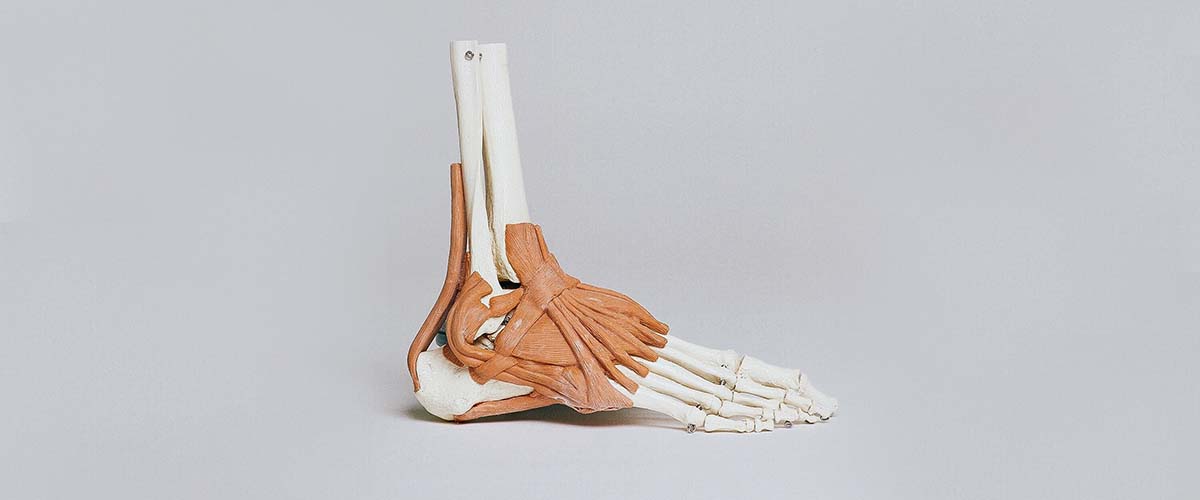
The tibialis anterior is the main muscle that lifts the foot and ankle upward. Its tendon crosses the front of the ankle to the inside of the midfoot. A rupture is uncommon,1 and it is often missed because the pain can be mild: the main sign is often a sudden foot drop, with the foot slapping or the toes catching while walking.6,7 Younger people usually tear it in an injury, while older adults more often rupture a worn tendon with little or no trauma.4
- A sudden ‘foot drop’, foot slap or toe catching when walking
- A lump at the front of the ankle where the torn tendon has pulled back
- Often mistaken for a nerve problem or ankle sprain7,9
- Surgery generally restores better function than a brace11
- Early repair tends to give better results than late reconstruction12
Causes
- Traumatic ruptures: a forceful pull or a cut, usually in younger patients (average age 39 in one series).4
- Atraumatic (spontaneous) ruptures: degeneration of the tendon in older adults (average age 73),4 usually where the tendon glides under a band of tissue at the front of the ankle.5
- Risk factors include diabetes, inflammatory arthritis, steroid use and previous injections near the tendon.
Symptoms
- Weakness lifting the foot, a foot that slaps down or toes that catch when walking
- A high-stepping (steppage) gait to clear the foot8
- A tender lump in front of the ankle (the retracted tendon end)
- Mild pain or swelling over the front of the ankle or inner midfoot
Because pain may be mild, many ruptures are diagnosed weeks or months later.6,7
Diagnosis
Dr. Dold checks ankle dorsiflexion strength, feels for the tendon and the gap, and watches you walk. Other toe-lifting tendons can partly compensate, which is why the diagnosis is easy to miss. A sudden foot drop can also come from a nerve problem, so the exam distinguishes the two.9 MRI or ultrasound confirms the rupture and shows how far the tendon has retracted.10
Non-surgical treatment
For less active patients or those with health risks for surgery, an ankle-foot orthosis (AFO) can control the foot drop, and some patients function well this way.14 Tendinopathy (degeneration without a full tear) is treated first with activity and shoe changes.3,21
Surgery
For most active patients, surgery gives better function than non-surgical care, with good results at any age.11 Mild residual weakness is common but rarely limits function.11
- Direct repair: reattaching or sewing the tendon ends, ideally soon after injury. Ruptures repaired in the acute phase had better outcomes than late repairs,12 although one series found similar results with delayed repair.13
- Reconstruction: for chronic ruptures with a gap, the tendon is bridged with a graft. Allograft and autograft reconstructions had similar outcomes,17 and hamstring autograft reconstruction allowed all patients to walk without a brace.18 A neighboring tendon (extensor hallucis longus) can also be transferred.19
After repair, function scores improved substantially in published series (for example, from 55.5 to 93.6),15,16 and patients were generally satisfied.15,20
Tendinopathy
Degeneration of the distal tendon without a complete tear can cause pain over the inner midfoot, often at night and in active walkers. Conservative care comes first;21 for those who don’t improve, decompression or debridement of the tendon reduced pain substantially.21,22
Recovery
- After repair or reconstruction: a splint or cast, then a boot, with protected weight-bearing for several weeks, followed by physical therapy to restore strength and gait.
- Most people walk without a brace afterward, though full strength can take many months.
Dr. Dold reviews your timeline based on your procedure.
Frequently asked questions
How do I know if I’ve ruptured my tibialis anterior tendon?
A sudden foot slap or toes catching when you walk, weakness lifting your foot and a lump at the front of the ankle are typical. Pain is often mild, so it’s easy to miss.
Is it a nerve problem or a tendon rupture?
Both can cause foot drop. An exam (and sometimes MRI or nerve studies) tells them apart; a palpable gap or lump at the front of the ankle points to the tendon.
Do I need surgery?
For active people, surgery generally gives better function. Some less active patients do well with an ankle-foot brace.
What if it’s been months?
Chronic ruptures can still be reconstructed with a tendon graft or transfer, though earlier repair tends to give better results.
How long is recovery?
Expect several weeks in a cast or boot, then months of therapy to rebuild strength.
Research cited on this page
- Harkin E, Pinzur M, Schiff A. Treatment of Acute and Chronic Tibialis Anterior Tendon Rupture and Tendinopathy. Foot Ankle Clin. 2017;22(4):819-831. PubMed
Tibialis anterior rupture is rare and has been studied mostly in case reports and small series. - Moyer J, Kosanovich R. Anterior tibial tendon injuries. Clin Podiatr Med Surg. 2002;19(3):433-40, vi-vii. PubMed
Most reported anterior tibial tendon injuries were complete ruptures. - Pedowitz D, Beck D. Presentation, Diagnosis, and Nonsurgical Treatment Options of the Anterior Tibial Tendon, Posterior Tibial Tendon, Peroneals, and Achilles. Foot Ankle Clin. 2017;22(4):677-687. PubMed
Ruptures of the anterior tibial tendon are more common than tendinopathy; tendinopathy is first treated with activity and shoe changes. - Levitsky MM, Freibott CE, Greisberg JK, et al. Risk Factors for Anterior Tibial Tendon Pathology. Foot Ankle Int. 2021;42(3):329-332. PubMed
Traumatic ruptures occurred in younger patients (average 39) and atraumatic ruptures in older patients (average 73). - Petersen W, Stein V, Bobka T. Structure of the human tibialis anterior tendon. J Anat. 2000;197 Pt 4(Pt 4):617-25. PubMed
Most spontaneous ruptures occur where the tendon glides under the retinaculum near the ankle. - Negrine JP. Tibialis anterior rupture: acute and chronic. Foot Ankle Clin. 2007;12(4):569-72, v. PubMed
A sudden foot drop is often the presenting symptom, and the diagnosis is frequently delayed. - Vosoughi AR, Heyes G, Molloy AP, et al. Management of tibialis anterior tendon rupture: Recommendations based on the literature review. Foot Ankle Surg. 2020;26(5):487-493. PubMed
Tibialis anterior rupture is commonly diagnosed late because signs can be mild; there is no clear consensus on management. - Rimoldi RL, Oberlander MA, Waldrop JI, et al. Acute rupture of the tibialis anterior tendon: a case report. Foot Ankle. 1991;12(3):176-7. PubMed
Medial midfoot pain and a high-stepping (steppage) gait were keys to diagnosing an acute rupture. - Kennelly KD, Shapiro SA, Kumar N, et al. Spontaneous tibialis anterior tendon rupture: a rare cause of foot drop. Neurology. 2007;68(22):1949-51. PubMed
Spontaneous tibialis anterior rupture is a rare cause of foot drop that can be mistaken for a nerve problem. - Khoury NJ, el-Khoury GY, Saltzman CL, et al. Rupture of the anterior tibial tendon: diagnosis by MR imaging. AJR Am J Roentgenol. 1996;167(2):351-4. PubMed
MRI can diagnose rupture of the anterior tibial tendon. - Tickner A, Thorng S, Martin M, et al. Management of Isolated Anterior Tibial Tendon Rupture: A Systematic Review and Meta-Analysis. J Foot Ankle Surg. 2019;58(2):213-220. PubMed
Surgery gave better function than non-surgical care; mild residual weakness usually did not limit function, and good results occurred at any age. - Duelfer KA, McAlister JE. Tibialis Anterior Tendon Rupture Surgical Treatments and Outcomes: A Systematic Review and Meta-Analysis. J Foot Ankle Surg. 2023;62(4):628-636. PubMed
Ruptures repaired in the acute phase had better outcomes than those repaired late. - Johansen JK, Jordan M, Thomas M, et al. Surgical treatment of tibialis anterior tendon rupture. Foot Ankle Surg. 2021;27(5):515-520. PubMed
In one series, acute and delayed repair had similar outcomes, and age did not predict results. - Ouzounian TJ, Anderson R. Anterior tibial tendon rupture. Foot Ankle Int. 1995;16(7):406-10. PubMed
Operatively treated patients gained function and strength; some less active patients did well with a brace. - Kopp FJ, Backus S, Deland JT, et al. Anterior tibial tendon rupture: results of operative treatment. Foot Ankle Int. 2007;28(10):1045-7. PubMed
After surgery, scores improved from 71.9 to 89.8, and all patients were satisfied. - Sammarco VJ, Sammarco GJ, Henning C, et al. Surgical repair of acute and chronic tibialis anterior tendon ruptures. J Bone Joint Surg Am. 2009;91(2):325-32. PubMed
After repair of acute and chronic ruptures, scores improved from 55.5 to 93.6 and gait improved in 18 of 19. - Andronic O, Unterfrauner I, Jud L, et al. Outcomes of Tibialis Anterior Tendon Reconstruction with Autograft or Allograft. Foot Ankle Int. 2022;43(1):2-11. PubMed
Allograft and autograft reconstructions for chronic ruptures had similar patient-reported outcomes. - Karnovsky SC, Desandis B, Papson AK, et al. Tibialis Anterior Reconstruction With Hamstring Autograft Using a Minimally Invasive Approach. Foot Ankle Int. 2018;39(5):535-541. PubMed
Hamstring autograft reconstruction gave good outcomes, and all patients walked without a brace. - Fraissler L, Horas K, Bölch S, et al. Extensor hallucis longus-transfer for tibialis anterior tendon rupture repair. Oper Orthop Traumatol. 2019;31(2):143-148. PubMed
Extensor hallucis longus transfer restored function in most patients, with about two-thirds of normal dorsiflexion strength. - Cignetti C, Peng J, McGee A, et al. Tibialis anterior tendinosis: Clinical characterization and surgical treatment. Foot (Edinb). 2019;39:79-84. PubMed
Surgery for tibialis anterior tendinosis restored function with high satisfaction. - Lemmens L, van Beek N, Verfaillie S. Postoperative results of distal tibialis anterior tendinosis. Foot Ankle Surg. 2020;26(8):851-854. PubMed
For distal tibialis anterior tendinopathy, conservative care comes first; surgery for failures gave very good long-term results. - De Cock L, Van Eynde E, Vandeputte G. Clinical results of distal anterior tibial tendon decompression. Foot Ankle Surg. 2021;27(7):827-831. PubMed
Decompression of the distal tibialis anterior tendon reduced pain from 6.7 to 1.1.
Medically reviewed by Andrew P. Dold, MD, FAOA, FAAOS, FACS, FRCSC. Last reviewed October 2026. This page is general information, not medical advice. Your own diagnosis and treatment plan depend on your exam and imaging.