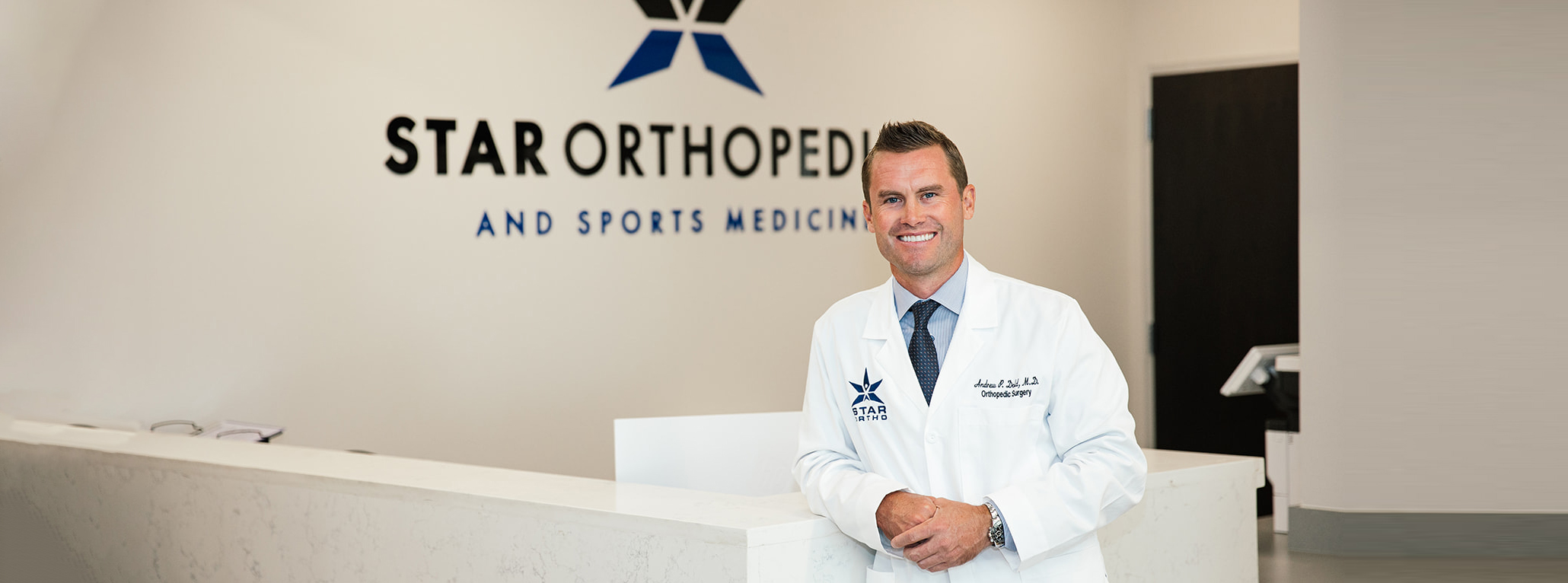








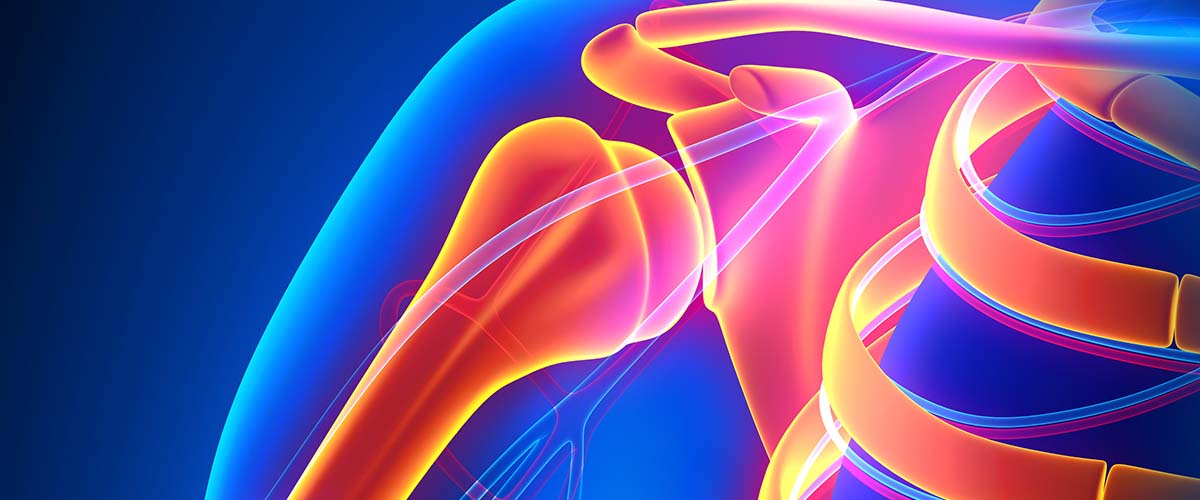
An AC joint separation (shoulder separation) is an injury to the acromioclavicular joint, where the collarbone (clavicle) meets the top of the shoulder blade (acromion). It usually happens from a fall or a direct hit onto the point of the shoulder. Despite the name, it is different from a shoulder dislocation. Dr. Andrew Dold, a board-certified, fellowship-trained sports medicine surgeon in Frisco, Texas, treats AC joint injuries of every grade, from a sling and therapy to suture-button reconstruction.
- Most common in active men aged 20 to 39, usually from sports
- Type I and II injuries are treated without surgery
- Type III injuries usually get a trial of non-surgical care first; surgery is considered if symptoms persist
- Type IV to VI injuries usually need surgery
- Dr. Dold reconstructs the joint with a suture-button technique, occasionally adding a tendon graft
Who gets an AC separation?
In a population study, AC dislocations occurred in about 1.8 per 10,000 people per year. Men were affected about 8.5 times as often as women, half of the injuries were in people aged 20 to 39, sports were the most common cause and type III was the most common grade.1
Grades of AC joint injury
AC injuries are graded from I to VI (the Rockwood classification) based on which ligaments are torn and how far the collarbone moves.2
| Type | What is injured | Usual treatment |
|---|---|---|
| I | Sprain of the AC ligaments; no displacement | Non-surgical |
| II | AC ligaments torn; coracoclavicular (CC) ligaments sprained; slight displacement | Non-surgical |
| III | AC and CC ligaments torn; visible bump at the end of the collarbone | Trial of non-surgical care first |
| IV | Collarbone displaced backward | Usually surgery |
| V | Severe upward displacement with muscle detachment | Usually surgery |
| VI | Collarbone displaced below the shoulder blade (rare) | Surgery |
Diagnosis
Dr. Dold examines the shoulder for tenderness, a step-off or bump at the AC joint and whether the collarbone can be pushed back into place. X-rays, sometimes including views of both shoulders, show how far the collarbone has moved and rule out a collarbone fracture.
Treatment without surgery
Type I and II injuries, and most type III injuries, are treated with a sling for comfort, ice, early motion and physical therapy to restore strength and shoulder-blade control. A visible bump may remain, but function is usually good.
For type III injuries, a meta-analysis of 10 studies found no difference between surgery and non-surgical treatment in pain, strength, function scores or arthritis, although surgery restored the position of the joint better.3 A 2026 meta-analysis of randomized trials including types III to V found no difference in function scores at 2 years or more, while some trials favored non-surgical treatment in the early months.4 This is why Dr. Dold usually starts with non-surgical care for type III injuries and considers surgery if pain, weakness or shoulder-blade problems persist, or for selected athletes and manual workers.
Surgery
For type IV to VI injuries, and type III injuries that do not improve, Dr. Dold reconstructs the joint using a suture-button technique: strong suture tape is passed through small holes in the collarbone and the coracoid process and secured with buttons, holding the collarbone in position while the ligaments heal. Occasionally, especially for chronic injuries, he adds a tendon graft to reconstruct the coracoclavicular ligaments. You can read more about the AC TightRope suture-button technique on the manufacturer’s website.
Fixing the coracoclavicular ligaments with suspensory devices such as suture buttons had better outcome scores and fewer complications than older plate or wire fixation of the joint in a systematic review of type III injuries.5 Compared with the hook plate, suture-button (suspensory loop) fixation produced better function and less pain, but a somewhat higher complication rate, in another meta-analysis.6 In a randomized trial, early recovery was faster without surgery than with hook-plate fixation, and results were equal by 6 months, which is why surgery is reserved for the right patients.7
Recovery after surgery
Most patients use a sling for several weeks, then begin gradual motion and strengthening. Heavy lifting and contact sports are usually restricted for several months. Dr. Dold will give you a specific plan.
Why see Dr. Dold
- Board certified by the American Board of Orthopaedic Surgery, with subspecialty certification in Sports Medicine
- Sports medicine and arthroscopy fellowship at NYU Langone / Hospital for Joint Diseases; orthopedic residency at the University of Toronto
- Fellow of the American College of Surgeons (FACS), the American Academy of Orthopaedic Surgeons (FAAOS), the American Orthopaedic Association (FAOA) and the Royal College of Surgeons of Canada (FRCSC)
- Author of a SLAP repair book chapter (Springer, 2017) and research on shoulder suture anchors (KSSTA, 2013)
- Team physician and surgical consultant to Rugby Canada; has cared for professional athletes from the NFL, NBA, NHL, MLS, PGA Tour and Major League Rugby
- D Magazine Best Doctors (Collin County), 2019–2026 · Rated 4.9 on Google
Frequently asked questions
Is a shoulder separation the same as a dislocation?
No. A separation involves the AC joint at the top of the shoulder, between the collarbone and shoulder blade. A dislocation involves the ball-and-socket joint.
Will I always have a bump?
Higher-grade injuries often leave a visible bump at the end of the collarbone. In most type III injuries, the bump does not affect function.3
Does a type III AC separation need surgery?
Usually not at first. Studies show similar long-term function with or without surgery, so Dr. Dold starts with non-surgical care and considers surgery if symptoms persist.3,4
What surgery does Dr. Dold perform?
A suture-button reconstruction that holds the collarbone in place, occasionally adding a tendon graft.
How long is recovery?
Most type I and II injuries improve within weeks. After surgery, return to contact sports or heavy work usually takes several months.
Research cited on this page
- Chillemi C, Franceschini V, Dei Giudici L, et al. Epidemiology of isolated acromioclavicular joint dislocation. Emerg Med Int. 2013;2013:171609. PubMed
- Mazzocca AD, Arciero RA, Bicos J. Evaluation and treatment of acromioclavicular joint injuries. Am J Sports Med. 2007;35(2):316-329. PubMed
- Tang G, Zhang Y, Liu Y, et al. Comparison of surgical and conservative treatment of Rockwood type-III acromioclavicular dislocation: A meta-analysis. Medicine (Baltimore). 2018;97(4):e9690. PubMed
- Lameire DL, Cecere M, Chan A, et al. Outcomes After Operative Versus Nonoperative Management of Type III to V Acromioclavicular Joint Dislocations: A Systematic Review and Meta-analysis of Randomized Controlled Trials. Orthop J Sports Med. 2026;14(7):23259671261440812. PubMed
- Okereke I, Abdelfatah E. Surgical Management of Acute Rockwood Grade III Acromioclavicular Joint Dislocations: A Systematic Review. Cureus. 2022;14(9):e28657. PubMed
- Arirachakaran A, Boonard M, Piyapittayanun P, et al. Post-operative outcomes and complications of suspensory loop fixation device versus hook plate in acute unstable acromioclavicular joint dislocation: a systematic review and meta-analysis. J Orthop Traumatol. 2017;18(4):293-304. PubMed
- Canadian Orthopaedic Trauma Society. Multicenter Randomized Clinical Trial of Nonoperative Versus Operative Treatment of Acute Acromio-Clavicular Joint Dislocation. J Orthop Trauma. 2015;29(11):479-487. PubMed
Medically reviewed by Andrew P. Dold, MD, FAOA, FAAOS, FACS, FRCSC. Last reviewed October 2026. This page is general information, not medical advice. Individual results vary.