









A clavicle (collarbone) fracture is one of the most common broken bones, usually from a fall onto the shoulder or a direct hit in sports, cycling or a car accident. Dr. Andrew Dold, a board-certified sports medicine surgeon in Frisco, Texas, treats clavicle fractures in athletes and active adults. He trained with Dr. Michael McKee at the University of Toronto, whose research helped define when collarbone fractures benefit from surgery.
- About 80% of clavicle fractures are in the middle third of the bone
- Symptoms: pain over the collarbone, swelling, bruising, a bump or deformity, and pain moving the shoulder
- X-rays confirm the diagnosis and show how far the bone has shifted
- Most heal in a sling, with gentle motion at 2–4 weeks, strengthening at 6–10 weeks and no restrictions by about 12 weeks
- Surgery may be recommended for significantly displaced fractures and is sometimes considered for athletes
Definition
A clavicle fracture is a common injury caused by trauma to the shoulder. This diagnosis is most commonly seen in males under 30 years old, but can be seen in all populations. Approximately 80% of these fractures will occur in the middle third of the clavicle due to the lack of muscular and ligamentous support to this section of the bone.
Anatomy
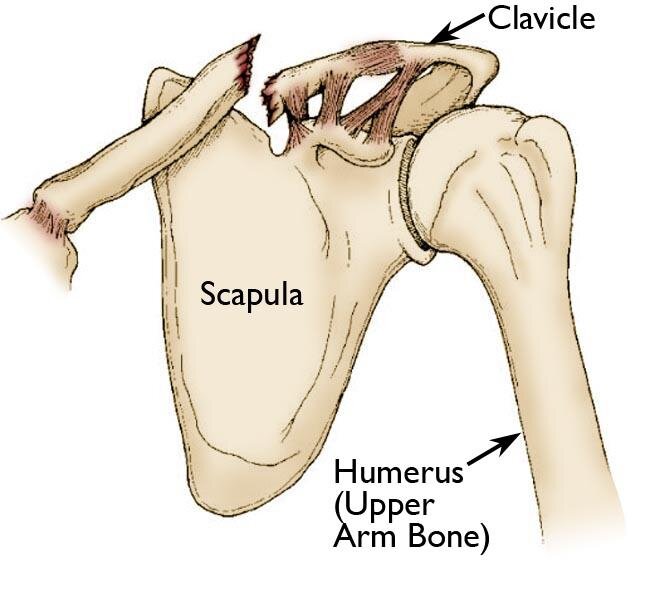
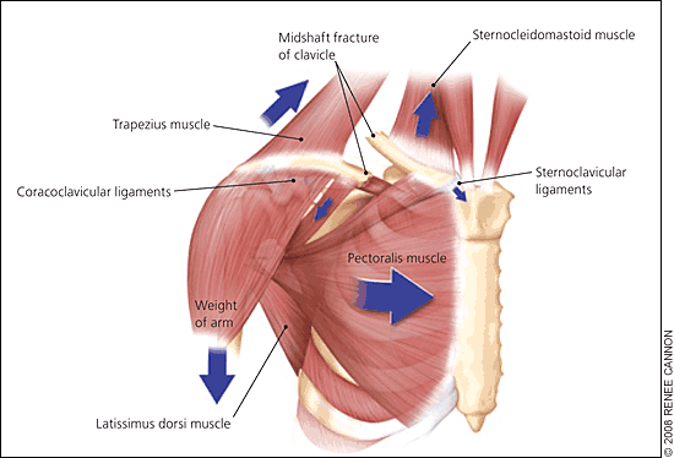
The collar bone is an S-shaped bone that resides between the scapula (shoulder blade) and the sternum. It acts as a strut between the shoulder girdle and the thorax, or ribcage. When the clavicle breaks, the medial fragment generally displaces superiorly and posteriorly due to attachment of the sternocleidomastoid muscle while the lateral fragment displaces inferiorly, shortened, and internally rotated due to the pectoralis muscle and weight of the arm.
Patient Presentation
Collar bone fractures are typically the result of a fall onto the affected arm or direct trauma to the shoulder. Symptoms after sustaining a clavicle fracture include pain over the collar bone, inability to move the shoulder without discomfort, swelling, bruising, tenderness, and possible deformity if the fracture is significantly displaced.
Diagnosis
X-rays are needed to confirm the diagnosis and determine the severity of a clavicle fracture. An AP view of your shoulder will be performed as well as a Zanca view which helps to determine degree of displacement. CT scans are rarely required. A physical exam will also be performed to assess for areas of tenderness, deformities, skin changes, and possible neurovascular injuries.
Classification
Clavicle fractures are first organized by their location on the bone. Middle third clavicle fractures are most common followed by the lateral third and then the medial third. There are several classification systems that can be utilized.
Allman Classification
Group 1 = Middle third
Group 2 = Lateral third
Group 3 = Medial third
Neer Classification
The Neer Classification further differentiates group 2 fractures of the Allman classification.
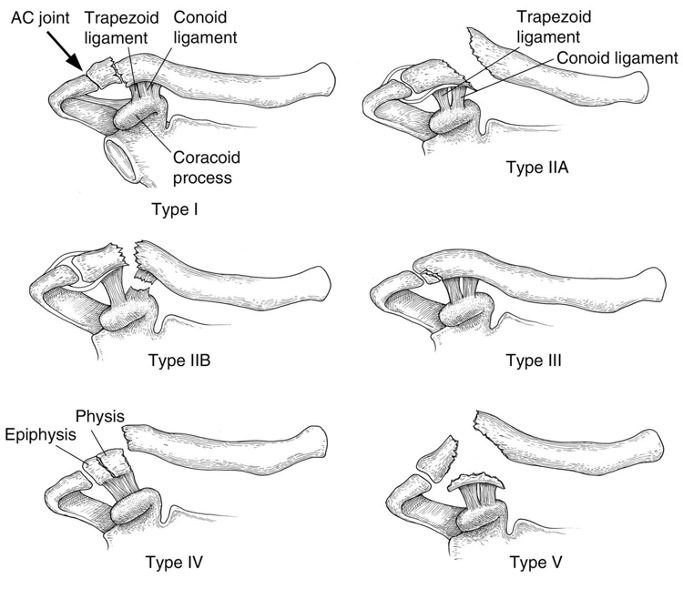
The Neer Classification of Clavicle Fractures
AO/OTA Classification:
-
Proximal (medial) segment – extra-articular, partial articular, complete articular
-
Middle (diaphyseal) segment – simple, wedge, multi-fragmentary
-
Distal (lateral) segment – extra-articular, partial articular, complete articular
-
CC ligament complex intact, non-displaced – non-operative
-
CC ligament complex partial disruption, displaced – non-operative vs operative
-
CC ligament complex complete disruption, displaced – operative
-
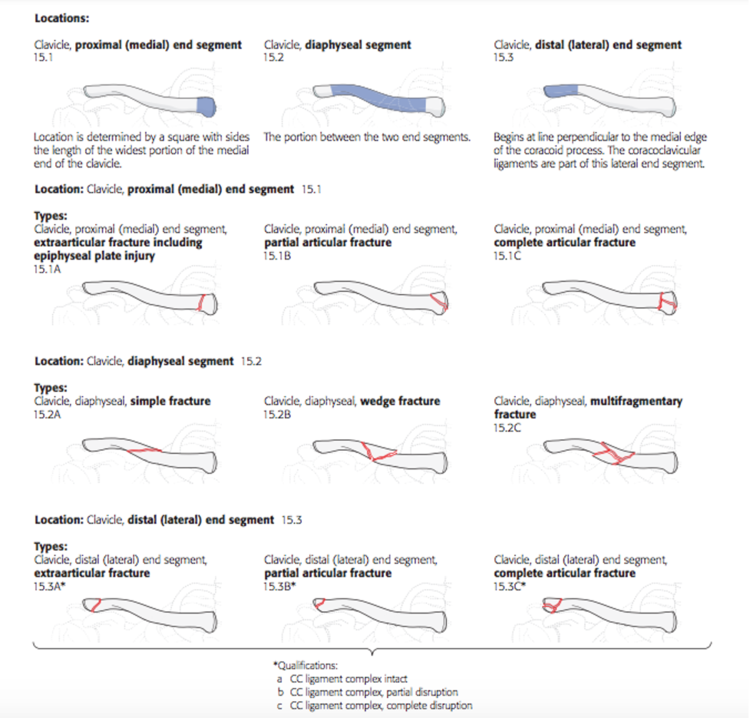
The AO Classification of Clavicle Fractures
Non-Operative Vs Operative Management
Most clavicle fractures are managed non-operatively in a sling for 2-3 weeks along with rest, ice, and physical therapy. The sling or shoulder immobilizer will provide support for the shoulder while the fracture heals. The patient may remove the sling when he or she has minimal pain and x-rays show the fracture is healing appropriately. Gentle range of motion exercises can begin at 2-4 weeks, strengthening at 6-10 weeks and most patients have no restrictions by 12 weeks.
Surgery may be recommended for significantly displaced clavicle fractures to decrease the incidence of malunion or nonunion across the fracture site. In the right patient, this may improve functional outcomes and overall satisfaction with your shoulder. Surgery may also be considered in contact athletes or year-round athletes due to quicker return to sport.
Complications of surgery are rare but can include damage to neurovascular structures, infection, malunion, nonunion, or hardware prominence that may require removal if continuously symptomatic. These complications are more common in smokers, patients with poor nutrition, diabetes, and steroid use.
Dr. Dold is accepting new patients. To schedule a consultation, either schedule online (our staff will contact you by phone and text within an hour of your request, during business hours, to confirm your appointment date and time) or call the office at 469.850.0680.
Important Clavicle Fracture Articles To Consider:
Operative versus nonoperative care of displaced midshaft clavicular fractures: a meta-analysis of randomized clinical trials (McKee et al. 2012).
Nonoperative treatment compared with plate fixation of displaced midshaft clavicular fractures. Surgical technique (JBJS 2008, COTS and McKee et al.)
McKee: What I Have Learned Most About Fixing Displaced Fractures of the Clavicle
*Dr. Dold trained with Dr. Michael McKee at the University of Toronto.
Management of distal clavicle fractures (JAAOS 2011).
Return to sport following clavicle fractures: a systematic review (NYU Bulletin 2016).
Comparison of plate osteosynthesis versus non-operative management for mid-shaft clavicle fractures-A prospective study (Injury 2018).
Surgery for the fractured clavicle: factors predicting nonunion (JSES 2018).
What the research shows
Collarbone fractures have been studied in several large randomized trials, including the Canadian trial led by Dr. McKee. Here is what they show.
Surgery or a sling for displaced midshaft fractures
Randomized trials consistently show that plate fixation lowers the risk of the bone not healing (nonunion), from roughly 1 in 10 without surgery to about 1 in 100 with surgery, and allows a faster early recovery. However, several meta-analyses find that long-term shoulder function is similar for most patients, and second operations, often to remove a plate, are common after surgery. This is why the decision is individualized, based on how far the bone has shifted, your sport or job, and your preferences.
Athletes and teens
Surgery has been associated with a higher and faster return to sport. In children and teenagers, both surgical and non-surgical treatment give excellent results, so surgery is used more selectively.
Fixation choices
Plates and intramedullary devices give similar healing rates with different trade-offs. For non-surgical care, a simple sling is usually used; in one trial it was more comfortable than a figure-of-eight bandage.
Fractures at the outer end
Many distal clavicle fractures do well without surgery. Unstable fractures may need fixation, and newer suture-button techniques have low revision rates.
Frequently asked questions
Does a broken collarbone need surgery?
Most clavicle fractures heal without surgery in a sling. Surgery may be recommended for significantly displaced fractures to lower the risk of the bone healing poorly or not healing, and it is sometimes considered for contact or year-round athletes.
How long does a broken collarbone take to heal?
With non-surgical treatment, patients typically use a sling for about 2 to 3 weeks, begin gentle motion at 2 to 4 weeks and strengthening at 6 to 10 weeks, and most have no restrictions by about 12 weeks.
How long do I wear a sling for a clavicle fracture?
Usually about 2 to 3 weeks, or until pain is minimal and X-rays show the fracture is healing.
How do I know if my collarbone is broken?
Pain over the collarbone after a fall or hit, swelling, bruising, a visible bump, and pain when moving the arm are common signs. An X-ray confirms it.
When can I return to sports after a clavicle fracture?
Return depends on healing, motion and strength. Surgery may allow a quicker return for some athletes. Dr. Dold will guide your return based on X-rays and your recovery.
What are the risks of clavicle surgery?
Risks are uncommon but include infection, injury to nearby nerves or blood vessels, the bone not healing, and a prominent plate that may need removal later. They are more common in smokers and people with diabetes or poor nutrition.
Think you have a fracture? See fracture care in Frisco: same-day appointments and walk-ins Monday, Wednesday and Friday, 8:30–10:30 am.
Research cited on this page
- Altamimi SA, McKee MD, Canadian Orthopaedic Trauma Society. Nonoperative treatment compared with plate fixation of displaced midshaft clavicular fractures. Surgical technique. J Bone Joint Surg Am. 2008;90 Suppl 2 Pt 1:1-8. PubMed
The Canadian multicenter randomized trial found plate fixation of displaced midshaft fractures improved function and lowered nonunion and malunion at 1 year; hardware removal was the most common reason for another operation. - McKee RC, Whelan DB, Schemitsch EH, et al. Operative versus nonoperative care of displaced midshaft clavicular fractures: a meta-analysis of randomized clinical trials. J Bone Joint Surg Am. 2012;94(8):675-84. PubMed
A meta-analysis of randomized trials found surgery lowered nonunion and symptomatic malunion and allowed earlier functional return, with little evidence yet of better long-term function. - Ahrens PM, Garlick NI, Barber J, et al. The Clavicle Trial: A Multicenter Randomized Controlled Trial Comparing Operative with Nonoperative Treatment of Displaced Midshaft Clavicle Fractures. J Bone Joint Surg Am. 2017;99(16):1345-1354. PubMed
The UK Clavicle Trial found nonunion at 9 months was 0.8% after surgery and 11% without surgery. - Axelrod DE, Ekhtiari S, Bozzo A, et al. What Is the Best Evidence for Management of Displaced Midshaft Clavicle Fractures? A Systematic Review and Network Meta-analysis of 22 Randomized Controlled Trials. Clin Orthop Relat Res. 2020;478(2):392-402. PubMed
A 2020 evidence review found surgery made healing at 1 year more likely, but did not improve function scores by a clinically important amount overall. - Woltz S, Krijnen P, Schipper IB. Plate Fixation Versus Nonoperative Treatment for Displaced Midshaft Clavicular Fractures: A Meta-Analysis of Randomized Controlled Trials. J Bone Joint Surg Am. 2017;99(12):1051-1057. PubMed
A meta-analysis found plate fixation reduced nonunion without a clinically relevant advantage in final function; second operations were common after both treatments. - Amer K, Smith B, Thomson JE, et al. Operative Versus Nonoperative Outcomes of Middle-Third Clavicle Fractures: A Systematic Review and Meta-Analysis. J Orthop Trauma. 2020;34(1):e6-e13. PubMed
Surgery lowered nonunion and symptomatic malunion, but function scores were similar, so the clinical significance is uncertain. - Lenza M, Buchbinder R, Johnston RV, et al. Surgical versus conservative interventions for treating fractures of the middle third of the clavicle. Cochrane Database Syst Rev. 2013(6):CD009363. PubMed
A Cochrane review found limited randomized evidence and recommended choosing treatment individually. - Houwert RM, Smeeing DP, Ahmed Ali U, et al. Plate fixation or intramedullary fixation for midshaft clavicle fractures: a systematic review and meta-analysis of randomized controlled trials and observational studies. J Shoulder Elbow Surg. 2016;25(7):1195-203. PubMed
Plate fixation led to more re-interventions and re-fractures after implant removal than intramedullary nailing, with similar function and healing. - Li L, Yang X, Xing F, et al. Plate fixation versus intramedullary nail or Knowles pin fixation for displaced midshaft clavicle fractures: A meta-analysis of randomized controlled trials. Medicine (Baltimore). 2020;99(39):e22284. PubMed
A meta-analysis found intramedullary fixation had similar nonunion and re-operation rates to plating, with better early shoulder function. - Fuglesang HFS, Flugsrud GB, Randsborg PH, et al. Plate fixation versus intramedullary nailing of completely displaced midshaft fractures of the clavicle: a prospective randomised controlled trial. Bone Joint J. 2017;99-B(8):1095-1101. PubMed
A randomized trial found plating and elastic nailing both restored function; plating recovered faster in comminuted fractures, while nailing had shorter surgery and fewer infections. - Boutros M, Awad G, Adio A, et al. Dual-plating is associated with lower implant removal rates compared with single-plate fixation for midshaft clavicle fractures: a meta-analysis. Eur J Orthop Surg Traumatol. 2025;36(1):22. PubMed
A 2025 meta-analysis found dual-plate fixation led to fewer implant removals and reoperations than a single plate. - Jarvis NE, Halliday L, Sinnott M, et al. Surgery for the fractured clavicle: factors predicting nonunion. J Shoulder Elbow Surg. 2018;27(5):e155-e159. PubMed
In 82 plated fractures, fixation failed in about 12%, and failure was not related to plate type. - Lenza M, Belloti JC, Andriolo RB, et al. Conservative interventions for treating middle third clavicle fractures in adolescents and adults. Cochrane Database Syst Rev. 2014(5):CD007121. PubMed
A Cochrane review found too little evidence to say whether a sling or a figure-of-eight bandage is preferable for non-surgical treatment. - Ersen A, Atalar AC, Birisik F, et al. Comparison of simple arm sling and figure of eight clavicular bandage for midshaft clavicular fractures: a randomised controlled study. Bone Joint J. 2015;97-B(11):1562-5. PubMed
In a randomized trial, patients treated with a figure-of-eight bandage reported more pain than those using a simple sling. - Gao B, Dwivedi S, Patel SA, et al. Operative Versus Nonoperative Management of Displaced Midshaft Clavicle Fractures in Pediatric and Adolescent Patients: A Systematic Review and Meta-Analysis. J Orthop Trauma. 2019;33(11):e439-e446. PubMed
In children and teens, both surgical and non-surgical treatment of displaced midshaft fractures gave excellent healing and outcomes. - Robertson GA, Wood AM. Return to sport following clavicle fractures: a systematic review. Br Med Bull. 2016;119(1):111-28. PubMed
Surgery for displaced midshaft fractures offered higher and faster return to sport than non-surgical care. - Bhardwaj A, Sharma G, Patil A, et al. Comparison of plate osteosynthesis versus non-operative management for mid-shaft clavicle fractures-A prospective study. Injury. 2018;49(6):1104-1107. PubMed
A prospective study found plating gave better function and X-ray results than non-surgical care for displaced midshaft fractures. - Banerjee R, Waterman B, Padalecki J, et al. Management of distal clavicle fractures. J Am Acad Orthop Surg. 2011;19(7):392-401. PubMed
For distal clavicle fractures, non-surgical and surgical care gave similar results in many patients, with displacement and patient demands guiding the decision. - Asadollahi S, Bucknill A. Hook Plate Fixation for Acute Unstable Distal Clavicle Fracture: A Systematic Review and Meta-analysis. J Orthop Trauma. 2019;33(8):417-422. PubMed
For unstable distal clavicle fractures, hook plates gave similar function and healing to other fixation methods but more complications. - Fox HM, Ramsey DC, Thompson AR, et al. Neer Type-II Distal Clavicle Fractures: A Cost-Effectiveness Analysis of Fixation Techniques. J Bone Joint Surg Am. 2020;102(3):254-261. PubMed
For Neer type II distal clavicle fractures, suture-button fixation was cost-effective because of low revision and high healing rates.
Medically reviewed by Andrew P. Dold, MD, FAOA, FAAOS, FACS, FRCSC. This page is general information, not medical advice. Individual results vary.