









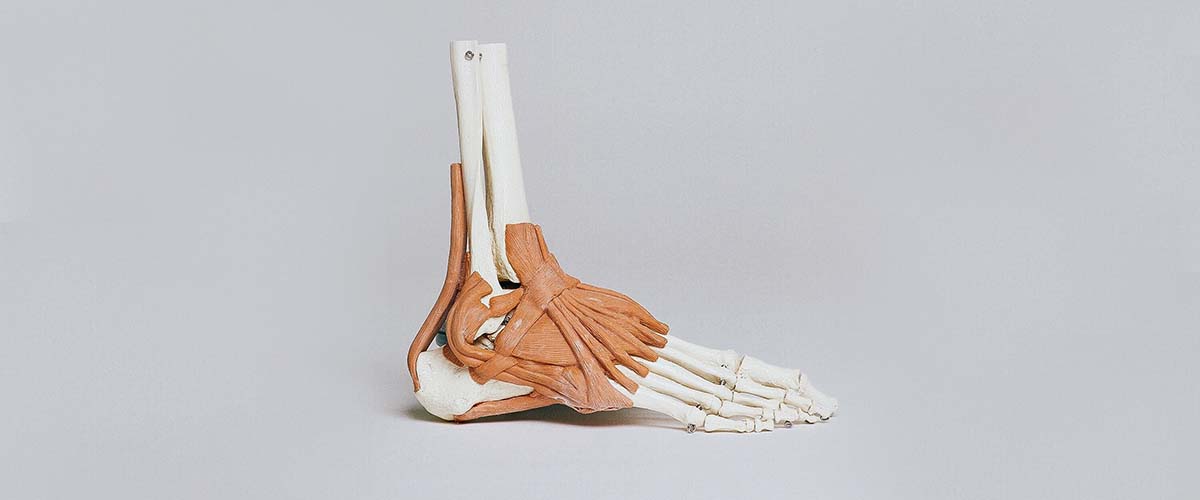
Hallux rigidus is arthritis of the big toe joint (the first metatarsophalangeal, or MTP, joint). The cartilage wears down and bone spurs form on top of the joint, so the toe becomes stiff and painful, especially when you push off to walk or run. It is common: an estimated 20% to 30% of adults over 50 have some degree of it.1
- Pain and stiffness at the base of the big toe, worse when pushing off
- A bony bump on top of the joint that rubs in shoes
- Stiff-soled shoes, rocker soles and inserts limit painful motion8,9
- Cheilectomy (removing bone spurs) helps milder cases13
- Fusion is the most reliable operation for advanced arthritis18,29
Symptoms
- Pain at the big toe joint when walking, running, squatting or wearing heels
- Stiffness, especially when bending the toe upward
- A bump on top of the joint, sometimes with numbness from shoe pressure
- Walking on the outside of the foot to avoid the painful joint
Some patients describe burning or tingling, and nerve-type pain is more common than once thought in big-toe arthritis.4
Causes and diagnosis
The cause is often unclear. It does not appear to be caused by a long first metatarsal, a tight calf or footwear.2 Previous injury, such as turf toe, can contribute. Weight-bearing X-rays show joint-space narrowing and spurs and are used to grade severity, which guides treatment.6 MRI can show cartilage and bone changes when the diagnosis is unclear.3
Non-surgical treatment
Treatment starts with limiting painful motion of the joint:6,11
- Stiff-soled or rocker-sole shoes and a roomy toe box
- Carbon-fibre shoe-stiffening inserts or a Morton’s extension orthosis
- Anti-inflammatory medicine when safe
- A steroid injection into the joint for flare-ups
The evidence is mixed. In one randomized trial, shoe-stiffening inserts reduced pain more than sham inserts at 12 weeks,8 while a 2024 Cochrane review rated the overall benefit of orthoses, inserts and a single hyaluronic acid injection as not clinically important.7 In practice, many patients do well: in a large series, nearly half were managed successfully with orthoses.10
Joint-preserving surgery
For mild to moderate arthritis, surgery can keep the joint moving:
- Cheilectomy: removal of the bone spurs on top of the joint.12 Foot scores improved substantially in pooled studies, with about 11% complications and 7% revisions;13 minimally invasive cheilectomy had fewer complications than open surgery.14
- Osteotomy: a Moberg osteotomy of the toe, alone or with cheilectomy, shifts motion into a less painful range;15,16 a metatarsal osteotomy has allowed many active adults to return to sport.17
Arthritis can progress after joint-preserving surgery.32
Fusion and joint replacement options
Big toe joint fusion (first MTP arthrodesis) is the standard operation for advanced hallux rigidus.18,19 The joint is fixed in a functional position, usually with a plate,20,21 eliminating the painful motion. Compared with implants, fusion provides more reliable pain relief with fewer revisions,27,28,29,30 and most patients return to walking, golf, running and other sports.33,34
Implants aim to preserve motion. A synthetic cartilage implant matched fusion for pain and function at 2 years in a randomized trial,23,24 but later independent studies have been mixed, and pain relief appears to favor fusion.25,26,27 Metal hemiarthroplasty and interpositional arthroplasty are other options with higher complication rates.28,31 Dr. Dold will discuss which option matches your arthritis, activity and goals.
Frequently asked questions
Can hallux rigidus be cured without surgery?
The arthritis does not reverse, but many people stay comfortable with stiff-soled shoes, inserts and occasional injections.
Will I be able to walk normally after a big toe fusion?
Yes. Most patients walk normally and many return to running, golf and other sports. Very high heels are usually no longer comfortable.
Is an implant better than a fusion?
Implants preserve motion, but fusion gives more reliable pain relief with fewer revisions. The choice depends on your arthritis and goals.
What is a cheilectomy?
A procedure that removes the bone spurs on top of the joint so the toe can bend with less pain. It is most suitable for mild to moderate arthritis.
Research cited on this page
- Acker AS, Mendes de Carvalho KA, Hanselman AE. Hallux Rigidus: Update on Conservative Management. Foot Ankle Clin. 2024;29(3):405-415. PubMed
Hallux rigidus is estimated to affect 20% to 30% of people aged 50 and older, though not all have symptoms. - Coughlin MJ, Shurnas PS. Hallux rigidus: demographics, etiology, and radiographic assessment. Foot Ankle Int. 2003;24(10):731-43. PubMed
Hallux rigidus was not linked to a long first metatarsal, tight calf, foot posture or footwear. - Munteanu SE, Auhl M, Tan JM, et al. Characterisation of first metatarsophalangeal joint osteoarthritis using magnetic resonance imaging. Clin Rheumatol. 2021;40(12):5067-5076. PubMed
MRI shows that big-toe arthritis involves the whole joint: bone spurs, bone marrow changes, cysts, synovitis and cartilage loss. - Menz HB, Allan JJ, Buldt AK, et al. Neuropathic Pain Associated With First Metatarsophalangeal Joint Osteoarthritis: Frequency and Associated Factors. Arthritis Care Res (Hoboken). 2023;75(10):2127-2133. PubMed
A significant proportion of people with big-toe arthritis report nerve-type (neuropathic) pain, which may explain poor responses to some treatments. - Roddy E, Menz HB. Foot osteoarthritis: latest evidence and developments. Ther Adv Musculoskelet Dis. 2018;10(4):91-103. PubMed
A review of foot osteoarthritis: few randomized trials exist, with some evidence for physical treatments. - Hamid KS, Parekh SG. Clinical Presentation and Management of Hallux Rigidus. Foot Ankle Clin. 2015;20(3):391-9. PubMed
Anti-inflammatories, steroid injections and shoe or orthotic changes are the main non-surgical options. - Munteanu SE, Buldt A, Lithgow MJ, et al. Non-surgical interventions for treating osteoarthritis of the big toe joint. Cochrane Database Syst Rev. 2024;6(6):CD007809. PubMed
Cochrane review: evidence for non-surgical treatment is limited; single placebo-controlled trials showed no clinically important benefit of arch orthoses, shoe-stiffening inserts or one hyaluronic acid injection. - Munteanu SE, Landorf KB, McClelland JA, et al. Shoe-stiffening inserts for first metatarsophalangeal joint osteoarthritis: a randomised trial. Osteoarthritis Cartilage. 2021;29(4):480-490. PubMed
In a randomized trial, carbon-fibre shoe-stiffening inserts reduced foot pain more than sham inserts at 12 weeks. - McClelland JA, Allan JJ, Auhl M, et al. Effects of Shoe-Stiffening Inserts on Lower Extremity Kinematics in Individuals With First Metatarsophalangeal Joint Osteoarthritis. Arthritis Care Res (Hoboken). 2022;74(11):1849-1856. PubMed
Shoe-stiffening inserts reduce how far the big toe bends during walking. - Grady JF, Axe TM, Zager EJ, et al. A retrospective analysis of 772 patients with hallux limitus. J Am Podiatr Med Assoc. 2002;92(2):102-8. PubMed
In 772 patients, 47% were successfully treated with orthoses; 38% went on to surgery. - Murawski CD, Anderson RB. Managing Hallux Rigidus in the Elite Athlete. Foot Ankle Clin. 2024;29(3):455-469. PubMed
Anti-inflammatories, injections, shoe modifications and orthoses are the mainstay of care in athletes; surgery is considered when they fail. - Razik A, Sott AH. Cheilectomy for Hallux Rigidus. Foot Ankle Clin. 2016;21(3):451-7. PubMed
Cheilectomy removes the bone spurs on top of the joint to relieve impingement. - Arceri A, Di Paola G, Mazzotti A, et al. Reviewing Evidence and Patient Outcomes of Cheilectomy for Hallux Rigidus: A Systematic Review and Meta-Analysis. J Clin Med. 2024;13(23). PubMed
After cheilectomy, foot scores improved from about 62 to 83; complications occurred in 11% and revision in about 7%. - Cristofaro C, Mercier M, Lameire DL, et al. Outcomes Following Minimally Invasive vs Open Cheilectomy for Hallux Rigidus: A Systematic Review. Foot Ankle Spec. 2025:19386400251345538. PubMed
Open cheilectomy had more complications than minimally invasive cheilectomy. - Maes DJA, De Vil J, Kalmar AF, et al. Clinical and Radiological Outcomes of Hallux Rigidus Treated With Cheilectomy and a Moberg-Akin Osteotomy. Foot Ankle Int. 2020;41(3):294-302. PubMed
Cheilectomy combined with an osteotomy of the toe was effective for hallux rigidus. - Warganich T, Harris T. Moberg Osteotomy for Hallux Rigidus. Foot Ankle Clin. 2015;20(3):433-50. PubMed
The Moberg osteotomy shifts the big toe’s motion into a less painful range. - Ceccarini P, Donantoni M, Nuzzo G, et al. Return to sport after osteotomy in patients with hallux rigidus. Foot Ankle Surg. 2026;32(2):145-151. PubMed
A joint-preserving metatarsal osteotomy gave good pain relief and a high return-to-sport rate in active adults with moderate disease. - Acker AS, Liles J, Easley ME. Arthrodesis for Hallux Rigidus. Foot Ankle Clin. 2024;29(3):507-520. PubMed
Big toe joint fusion has been a cornerstone treatment for advanced arthritis for decades, in younger and older patients. - Roth W, Hoch C, Gross CE, et al. First metatarsophalangeal arthrodesis outcomes for hallux rigidus versus hallux valgus. Foot Ankle Surg. 2023;29(1):50-55. PubMed
Fusion outcomes were similar whether done for hallux rigidus or bunions. - Kang YS, Bridgen A. First metatarsophalangeal joint arthrodesis/fusion: a systematic review of modern fixation techniques. J Foot Ankle Res. 2022;15(1):30. PubMed
Plate fixation gave the most favorable overall results for big-toe fusion, including fewer complications and earlier walking. - Hodel S, Viehöfer A, Wirth S. Minimally invasive arthrodesis of the first metatarsophalangeal joint: A systematic literature review. Foot Ankle Surg. 2020;26(6):601-606. PubMed
Minimally invasive big-toe fusion had outcomes comparable to open surgery. - Weber C, Yao D, Schwarze M, et al. Risk Analysis of Nonunion After First Metatarsophalangeal Joint Arthrodesis. Foot Ankle Spec. 2021;14(2):120-125. PubMed
Nonunion after fusion was linked to other health conditions, more advanced arthritis and the final position of the toe. - Baumhauer JF, Singh D, Glazebrook M, et al. Prospective, Randomized, Multi-centered Clinical Trial Assessing Safety and Efficacy of a Synthetic Cartilage Implant Versus First Metatarsophalangeal Arthrodesis in Advanced Hallux Rigidus. Foot Ankle Int. 2016;37(5):457-69. PubMed
In a randomized trial, a synthetic cartilage implant gave pain relief and function equivalent to fusion at 2 years while preserving motion. - Glazebrook M, Younger ASE, Daniels TR, et al. Treatment of first metatarsophalangeal joint arthritis using hemiarthroplasty with a synthetic cartilage implant or arthrodesis: A comparison of operative and recovery time. Foot Ankle Surg. 2018;24(5):440-447. PubMed
The synthetic cartilage implant required less operating time and allowed faster recovery than fusion. - Fletcher WR, Collins T, Fox A, et al. Mid-term efficacy of the Cartiva synthetic cartilage implant in symptomatic hallux rigidus. Bone Jt Open. 2024;5(9):799-805. PubMed
Independent mid-term follow-up of the synthetic implant was reassuring, but some patients’ scores deteriorated. - Schapira B, Johnson O, Faroug R. Surgical Outcomes of Synthetic Cartilage Implant Hemiarthroplasty for Metatarsophalangeal Arthropathy. Cureus. 2023;15(11):e49036. PubMed
In one independent series, many patients still had pain or stiffness after the synthetic implant. - Jeremic A, Abussa R. Cartiva or fusion for Hallux Rigidus? A systematic review and meta-analysis. J Foot Ankle Surg. 2026;65(4):138.e1-138.e6. PubMed
The synthetic implant may preserve motion with similar short-term function, while pain relief likely favors fusion. - de Bot RTAL, Veldman HD, Eurlings R, et al. Metallic hemiarthroplasty or arthrodesis of the first metatarsophalangeal joint as treatment for hallux rigidus: A systematic review and meta-analysis. Foot Ankle Surg. 2022;28(2):139-152. PubMed
Metal hemiarthroplasty and fusion both had excellent outcomes; fusion appeared better for pain. - Stevens J, de Bot RTAL, Hermus JPS, et al. Clinical Outcome Following Total Joint Replacement and Arthrodesis for Hallux Rigidus: A Systematic Review. JBJS Rev. 2017;5(11):e2. PubMed
Fusion improved pain and outcomes more, with fewer complications and revisions, than total joint replacement. - Park YH, Jung JH, Kang SH, et al. Implant Arthroplasty versus Arthrodesis for the Treatment of Advanced Hallux Rigidus: A Meta-analysis of Comparative Studies. J Foot Ankle Surg. 2019;58(1):137-143. PubMed
Pain scores were lower after fusion than after implant arthroplasty; other outcomes were similar. - Butler JJ, Shimozono Y, Gianakos AL, et al. Interpositional Arthroplasty in the Treatment of Hallux Rigidus: A Systematic Review. J Foot Ankle Surg. 2022;61(3):657-662. PubMed
Interpositional arthroplasty improved motion, but complications occurred in about 22%, most often pain under the ball of the foot. - Grimm MPD, Irwin TA. Complications of Hallux Rigidus Surgery. Foot Ankle Clin. 2022;27(2):253-269. PubMed
Joint-preserving surgery can be followed by progression of arthritis or continued pain; each procedure has its own risks. - Stumpner T, Obermayr S, Abdel-Nour G, et al. Return to sport after arthrodesis and implant arthroplasty for hallux rigidus : a systematic review. Arch Orthop Trauma Surg. 2025;145(1):471. PubMed
Fusion offers reliable long-term sports function; implants may give short-term advantages but carry more complications. - Baumann AN, Walley KC, Kermanshahi N, et al. Return to Sport After First Metatarsophalangeal Arthrodesis: A Systematic Review. Foot Ankle Int. 2023;44(12):1319-1327. PubMed
Most patients returned to their sports at a similar or higher level after big-toe fusion. - Galois L, Hemmer J, Ray V, et al. Surgical options for hallux rigidus: state of the art and review of the literature. Eur J Orthop Surg Traumatol. 2020;30(1):57-65. PubMed
A review of surgical options, from osteotomies and cheilectomy to implants and fusion.
Medically reviewed by Andrew P. Dold, MD, FAOA, FAAOS, FACS, FRCSC. Last reviewed October 2026. This page is general information, not medical advice. Your own diagnosis and treatment plan depend on your exam and imaging.