








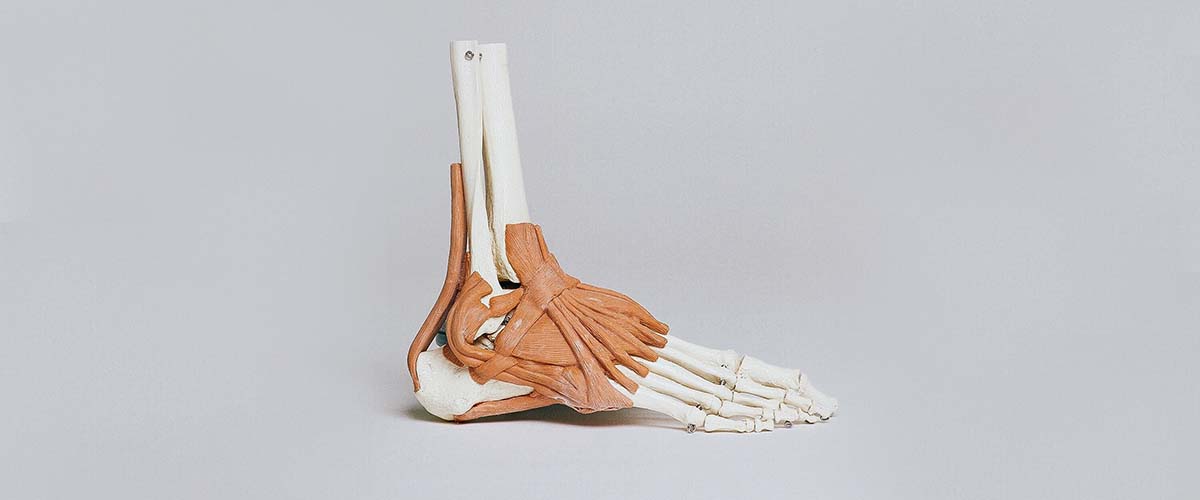
The flexor hallucis longus (FHL) tendon runs down the back of the ankle, through a tight tunnel behind the talus and under the arch to the big toe, which it bends downward. Irritation of this tendon, often called dancer’s tendinitis, causes pain behind the inner ankle or along the arch. It is common in ballet dancers and athletes who repeatedly point the foot,4,5 but it also occurs in non-dancers and is often misdiagnosed as plantar fasciitis or tarsal tunnel syndrome.1,2
- Pain behind the inner ankle or along the arch, worse when rising onto the toes
- Sometimes a catching or snapping big toe (hallux saltans)9,10
- Often confused with plantar fasciitis or tarsal tunnel syndrome1
- A focused stretching program avoided surgery in 44% of patients11
- Release surgery has high success rates in dancers and athletes14,16
Causes
- Repetitive pointing of the foot and push-off: ballet (relevé and en pointe), running, jumping and soccer.4
- Narrowing of the tendon tunnel behind the talus, causing stenosing tenosynovitis.2,5
- Posterior ankle impingement: an os trigonum (an extra bone) or a large bony process at the back of the talus can pinch the tendon.3,23
- Tendon tears or lacerations from injury.24
Symptoms
- Pain behind the inner ankle bone or deep along the arch
- Pain rising onto the toes, pushing off or pointing the foot
- Pain or weakness bending the big toe against resistance
- Catching, triggering or snapping of the big toe9
Diagnosis
Dr. Dold examines the path of the tendon, checks big-toe strength and motion with the ankle in different positions, and looks for posterior ankle impingement. Because FHL problems overlap with plantar fasciitis and tarsal tunnel symptoms, they are commonly misdiagnosed; in one study many patients had a delay of more than a year.1,11 MRI shows tenosynovitis, tendon tears and an os trigonum,1,8 and dynamic ultrasound can show the tendon catching.9 Imaging can look normal even when the tendon is painful, so the exam matters.7
Non-surgical treatment
- Relative rest from the aggravating activity (for dancers, limiting relevé and pointe work)
- Specific FHL stretching: a non-surgical program with targeted stretching, and a boot for severe cases, made surgery unnecessary for 44% of patients.11
- Strengthening and technique work: shifting load from the FHL to the larger calf muscles; a toes-off heel raise helps some dancers.12
- Anti-inflammatory medicines and activity modification3
Conservative care is the first-line treatment.3
Surgery
For pain that persists despite good non-surgical care, the tight tendon sheath is released (tenolysis), and an os trigonum or bone spur causing impingement is removed at the same time:3,19
- In dancers, over 97% considered FHL tenolysis a success and 98% would repeat it.14 Earlier dancer series also reported good results with few complications.6,15
- Arthroscopic FHL release gave 70% good or excellent results, and 81% returned to their previous activity.16
- After posterior ankle arthroscopy, professional footballers returned to training in about 34 days.18
- Both open and arthroscopic approaches work well in dancers.13,17,20
The tendon runs next to the tibial nerve and blood vessels, so careful technique is essential; complete blind releases risk injuring them.21
FHL tears and lacerations
Not every FHL laceration needs repair; the decision depends on where and how it was injured and the timing.24 In young athletes, unrepaired FHL lacerations did not cause evident disability in running sports,25 though repair is often considered when the cut ends are close and function matters.
Recovery
- Non-surgical: often several weeks to a few months.
- After release: early motion, with return to regular activity at about 9 weeks in one series2 and return to dance or sport over a few months.
Dr. Dold reviews your timeline based on your sport and treatment.
Frequently asked questions
What is dancer’s tendinitis?
Irritation of the flexor hallucis longus tendon behind the inner ankle, common in ballet dancers because of repetitive pointing and relevé. It also occurs in runners and other athletes.
Why does my big toe catch or snap?
A thickened FHL tendon can catch in its tunnel behind the ankle, causing the big toe to trigger or snap (hallux saltans).
Could my ‘plantar fasciitis’ actually be FHL tendonitis?
Possibly. FHL problems can cause arch and heel-area pain and are often misdiagnosed. Pain with bending the big toe against resistance points to the FHL.
Will stretching help?
A targeted FHL stretching program helped many patients avoid surgery in one study.
What is an os trigonum?
An extra small bone behind the ankle that some people have. It can pinch the FHL tendon and the back of the ankle when you point your foot, and can be removed if it causes symptoms.
Research cited on this page
- Schulhofer SD, Oloff LM. Flexor hallucis longus dysfunction: an overview. Clin Podiatr Med Surg. 2002;19(3):411-8, vi. PubMed
FHL problems often overlap with plantar fasciitis and tarsal tunnel symptoms and are commonly misdiagnosed; MRI helps recognize them. - Oloff LM, Schulhofer SD. Flexor hallucis longus dysfunction. J Foot Ankle Surg. 1998;37(2):101-9. PubMed
FHL stenosing tenosynovitis may be more common than reported; tenolysis returned patients to regular activity at about 9 weeks. - Rungprai C, Tennant JN, Phisitkul P. Disorders of the Flexor Hallucis Longus and Os Trigonum. Clin Sports Med. 2015;34(4):741-59. PubMed
FHL tenosynovitis is a common cause of posterior ankle impingement; conservative care comes first, then open or arthroscopic release. - Sharpe BD, Steginsky BD, Suhling M, et al. Posterior Ankle Impingement and Flexor Hallucis Longus Pathology. Clin Sports Med. 2020;39(4):911-930. PubMed
Posterior ankle impingement and FHL problems occur in athletes with forceful or repetitive pointing of the foot. - Hamilton WG. Stenosing tenosynovitis of the flexor hallucis longus tendon and posterior impingement upon the os trigonum in ballet dancers. Foot Ankle. 1982;3(2):74-80. PubMed
An early description of FHL stenosing tenosynovitis and posterior impingement in dancers. - Hamilton WG, Geppert MJ, Thompson FM. Pain in the posterior aspect of the ankle in dancers. Differential diagnosis and operative treatment. J Bone Joint Surg Am. 1996;78(10):1491-500. PubMed
After surgery for posterior ankle pain in dancers, 30 of 40 ankles had good or excellent results. - Mikkelsen P, Andersen A, Shih HS, et al. Flexor hallucis longus tendon morphology in dancers clinically diagnosed with tendinopathy. J Ultrasound. 2024;27(1):41-49. PubMed
In dancers with FHL tendinopathy, ultrasound did not show the tendon thickening one might expect, highlighting the need for clinical diagnosis. - Park SH, Chung BM, Kim S. MRI evaluation of interconnections between flexor hallucis longus and flexor digitorum longus around the Master knot of Henry. Eur Radiol. 2023;33(11):8289-8299. PubMed
MRI shows the variable connections between the FHL and FDL tendons in the midfoot. - Martinez-Salazar EL, Vicentini JRT, Johnson AH, et al. Hallux saltans due to stenosing tenosynovitis of flexor hallucis longus: dynamic sonography and arthroscopic findings. Skeletal Radiol. 2018;47(5):747-750. PubMed
Dynamic ultrasound showed FHL triggering and thickening in a patient with a snapping big toe (hallux saltans). - Riewruja K, Wattanatanagorn T, Apinun J. Snapping phenomenon around the ankle: An anatomy-based review. World J Orthop. 2025;16(11):110093. PubMed
Posterior ankle snapping typically involves the FHL (hallux saltans). - Michelson JD, Bernknopf JW, Charlson MD, et al. What Is the Efficacy of a Nonoperative Program Including a Specific Stretching Protocol for Flexor Hallucis Longus Tendonitis?. Clin Orthop Relat Res. 2021;479(12):2667-2676. PubMed
A non-surgical program with specific FHL stretching (and immobilization for severe cases) made surgery unnecessary for 44% of patients; many had been diagnosed late. - Rowley KM, Shih HS, Traina K, et al. Effects of a “toes-off” modified heel raise on muscle coordination in non-dancers, dancers, and dancers with flexor hallucis longus tendinopathy. Clin Biomech (Bristol). 2021;83:105287. PubMed
A toes-off heel raise reduced FHL activation in healthy dancers but not enough in dancers with FHL tendinopathy. - Rietveld ABMB, Hagemans FMT, Haitjema S, et al. Results of Treatment of Posterior Ankle Impingement Syndrome and Flexor Hallucis Longus Tendinopathy in Dancers: A Systematic Review. J Dance Med Sci. 2018;22(1):19-32. PubMed
Results of treatment for posterior impingement and FHL tendinopathy in dancers are generally favorable, but study quality is limited. - Barchi EI, Swensen S, Dimant OE, et al. Flexor Hallucis Longus Tenolysis and Tenosynovectomy in Dancers. J Foot Ankle Surg. 2022;61(1):84-87. PubMed
After FHL tenolysis in dancers, over 97% considered the procedure a success and 98% would repeat it. - Kolettis GJ, Micheli LJ, Klein JD. Release of the flexor hallucis longus tendon in ballet dancers. J Bone Joint Surg Am. 1996;78(9):1386-90. PubMed
Release of the FHL in ballet dancers relieved symptoms with no complications. - Corte-Real NM, Moreira RM, Guerra-Pinto F. Arthroscopic treatment of tenosynovitis of the flexor hallucis longus tendon. Foot Ankle Int. 2012;33(12):1108-12. PubMed
Arthroscopic FHL release gave 70% good or excellent results, and 81% returned to their previous activity. - Rietveld ABMB, Hagemans FMT. Operative Treatment of Posterior Ankle Impingement Syndrome and Flexor Hallucis Longus Tendinopathy in Dancers Open Versus Endoscopic Approach. J Dance Med Sci. 2018;22(1):11-18. PubMed
In dancers, open and endoscopic surgery for posterior impingement and FHL tendinopathy both had favorable results; early morbidity was higher after the endoscopic approach in this small series. - Calder JD, Sexton SA, Pearce CJ. Return to training and playing after posterior ankle arthroscopy for posterior impingement in elite professional soccer. Am J Sports Med. 2010;38(1):120-4. PubMed
After posterior ankle arthroscopy in professional footballers, average return to training was 34 days. - Smyth NA, Zwiers R, Wiegerinck JI, et al. Posterior hindfoot arthroscopy: a review. Am J Sports Med. 2014;42(1):225-34. PubMed
Posterior hindfoot arthroscopy is used for os trigonum, FHL and other posterior ankle problems. - Micheli LJ, Solomon R, Solomon J, et al. Posterior Ankle Decompression With Os Trigonum or Stieda Process Resection in Dancers: Case Series Report and Review of the Literature. J Foot Ankle Surg. 2021;60(4):706-711. PubMed
Open posterior ankle decompression in dancers gave a high return to dance with minimal complications. - Micicoi L, Rudel A, Frey-Ollivier S, et al. Flexor Hallucis Longus decompression under ultrasound guidance: A cadaver study. Orthop Traumatol Surg Res. 2023;109(8):103708. PubMed
In a cadaver study, complete ultrasound-guided FHL release injured the tibial nerve and vessels, while partial release did not. - Tokgöz MA, Kanatlı U, Vural A, et al. Endoscopic treatment of bilateral hallux saltans in an ordinary woman. Eklem Hastalik Cerrahisi. 2019;30(3):322-4. PubMed
Endoscopic release treated bilateral hallux saltans (triggering FHL). - Oesman I, Putra NHD, Andar AA, et al. Flexor hallucis longus impingement syndrome: A case report. Int J Surg Case Rep. 2024;121:109934. PubMed
A bony fragment from the back of the talus can cause FHL impingement treated arthroscopically. - Scaduto AA, Cracchiolo A. Lacerations and ruptures of the flexor or extensor hallucis longus tendons. Foot Ankle Clin. 2000;5(3):725-36, x. PubMed
Not all FHL lacerations need repair; the decision depends on the mechanism, site and timing. - Frenette JP, Jackson DW. Lacerations of the flexor hallucis longus in the young athlete. J Bone Joint Surg Am. 1977;59(5):673-6. PubMed
In young athletes, unrepaired FHL lacerations did not cause evident disability in running sports.
Medically reviewed by Andrew P. Dold, MD, FAOA, FAAOS, FACS, FRCSC. Last reviewed October 2026. This page is general information, not medical advice. Your own diagnosis and treatment plan depend on your exam and imaging.