








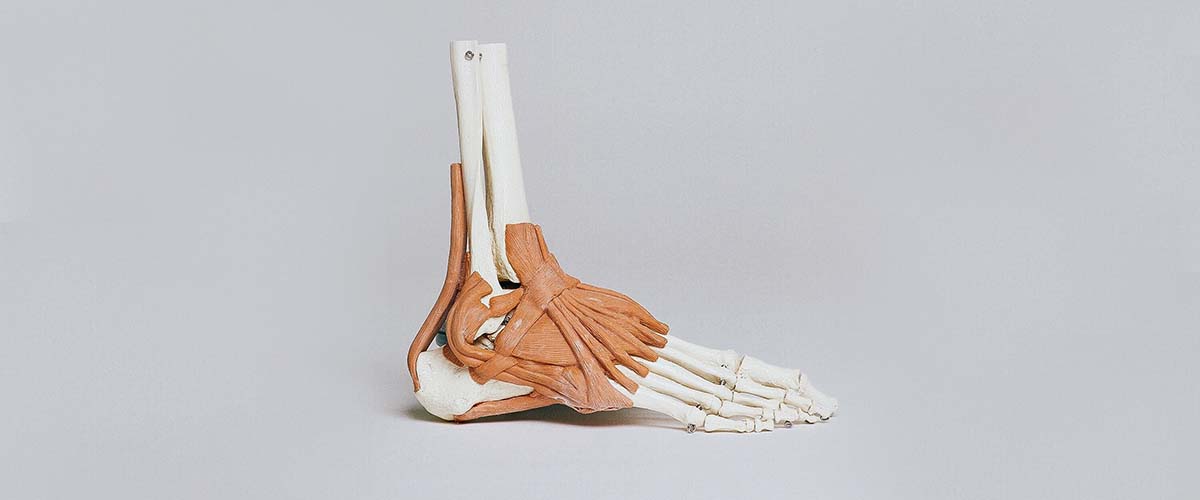
Plantar fasciitis is the most common cause of pain under the heel. The plantar fascia is a thick band of tissue that runs from the heel bone to the toes and supports the arch. With repeated strain, it becomes irritated and thickened where it attaches to the heel. The good news: most people get better without surgery, and the research gives a clear order of treatments to try.
- Sharp pain under the heel, worst with the first steps in the morning or after sitting
- Linked to a tight calf, higher body weight and long hours on your feet1,2
- Diagnosed by exam; ultrasound can confirm a thickened plantar fascia4
- Stretching, strengthening, taping and supportive shoes or insoles come first8
- Shockwave therapy, injections and, rarely, surgery are options when symptoms persist
What causes plantar fasciitis?
Plantar fasciitis is better thought of as an overload problem than an inflammation. Repeated stress where the fascia attaches to the heel causes small degenerative changes and thickening. Studies link it to:
- Higher body weight1,2
- A tight calf and limited ankle bend (dorsiflexion)2
- Spending most of the workday standing or walking2
- Running and other repetitive impact, especially after a sudden increase in activity
Symptoms
- Sharp or aching pain under the front and inside of the heel
- Pain with the first steps out of bed or after sitting, that eases a little as you walk
- Pain that returns after long periods of standing
- Tenderness when pressing on the bottom of the heel
Numbness, tingling, night pain, swelling or pain after an injury suggest another cause, such as a stress fracture or nerve entrapment, and should be checked.
How it is diagnosed
The diagnosis is usually made from your history and an exam. Imaging is used when the diagnosis is unclear or symptoms are not improving. On ultrasound, a plantar fascia thicker than 4 mm supports the diagnosis.4,5 X-rays may show a heel spur; spurs are more common in people with heel pain, but the spur itself is usually not the cause and rarely needs removal.4,5
How long does it last?
Plantar fasciitis can be stubborn. In a long-term study of 174 patients, about half were symptom free roughly 10 years after their heel pain started, and symptoms lasted longer in women and in people with pain in both heels.3 That is why a structured plan, rather than rest alone, matters.
First-line treatment
Clinical practice guidelines and consensus recommendations advise starting with education, stretching, taping and footwear changes.6,7,8
- Plantar fascia-specific stretching: pulling the toes back to stretch the arch before the first steps of the day. In randomized trials this did better than standard calf stretching, with lasting benefit at two years.10,11,12
- Calf stretching and strengthening: stretching has a large effect in trials,10 and a high-load heel-raise program improved function faster than stretching alone.13
- Taping: low-dye or kinesiology taping can relieve pain in the short term.14,15
- Supportive shoes and insoles: contoured full-length insoles help more than heel cups.20 Off-the-shelf insoles help many people; custom orthoses may give small additional benefit in selected patients.16,17,18,19,21
- Night splints: holding the foot at 90 degrees overnight helps some patients, though not all trials show a benefit.22,23,24
- Weight management and activity changes: reducing load on the heel while staying active.
Injections
Steroid (cortisone) injection can reduce pain for about a month, but the benefit fades and it is not clearly better than a placebo injection.26,27 Ultrasound guidance improves accuracy,28 and repeated injections carry a small risk of plantar fascia rupture and heel fat pad thinning,29 so Dr. Dold uses them selectively.
Platelet-rich plasma (PRP) is made from your own blood. In meta-analyses, PRP gave longer-lasting improvement in pain and function than steroid injection,32,33,34 although results are not consistent across every outcome.32 PRP is usually not covered by insurance. Botulinum toxin and dry needling have also shown benefit in trials.35,36,37,38,39
Shockwave therapy
Extracorporeal shockwave therapy (ESWT) delivers sound-wave pulses to the heel to stimulate healing. It is well supported for chronic plantar fasciitis: high-quality studies show a large effect on pain and function,40 and it outperformed steroid injection at mid-term.41,42,43
When is surgery needed?
Surgery is considered only after about 6 to 12 months of consistent non-surgical care. Options include:
- Gastrocnemius recession: lengthening the tight calf muscle through a small incision behind the knee. In a randomized trial with six-year follow-up, it gave better pain and function than stretching alone in patients with a tight calf,49,50 and pooled studies show about a 76% reduction in pain at one year.47,48
- Partial plantar fascia release: open or endoscopic, for selected patients.44,45,46
Surgery provides relief for most patients whose symptoms did not respond to other care, but no single procedure clearly outperforms the others,44 so Dr. Dold matches the operation to your exam.
Frequently asked questions
How long does plantar fasciitis take to go away?
Many people improve over several months with stretching, strengthening, taping and supportive footwear, but it can last a year or more. A structured plan shortens recovery for most patients.
Are cortisone shots good for plantar fasciitis?
They can relieve pain for a few weeks, but the effect fades and repeated injections carry a small risk of fascia rupture. Shockwave therapy and PRP have shown longer-lasting benefit in studies.
Do I need custom orthotics?
Not usually at first. Good shoes and over-the-counter contoured insoles help many people. Custom orthoses can help selected patients who do not improve.
Does a heel spur need to be removed?
Rarely. Heel spurs are common and are usually not the source of pain. Treatment focuses on the plantar fascia and the calf.
When should I consider surgery?
Only after 6 to 12 months of consistent non-surgical treatment. Gastrocnemius recession is an option for people with a tight calf.
Research cited on this page
- van Leeuwen KD, Rogers J, Winzenberg T, et al. Higher body mass index is associated with plantar fasciopathy/’plantar fasciitis’: systematic review and meta-analysis of various clinical and imaging risk factors. Br J Sports Med. 2016;50(16):972-81. PubMed
A higher body mass index was consistently associated with plantar fasciopathy. - Riddle DL, Pulisic M, Pidcoe P, et al. Risk factors for Plantar fasciitis: a matched case-control study. J Bone Joint Surg Am. 2003;85(5):872-7. PubMed
Reduced ankle dorsiflexion, a body mass index over 30 and spending most of the workday on your feet each raised the risk. - Hansen L, Krogh TP, Ellingsen T, et al. Long-Term Prognosis of Plantar Fasciitis: A 5- to 15-Year Follow-up Study of 174 Patients With Ultrasound Examination. Orthop J Sports Med. 2018;6(3):2325967118757983. PubMed
In 174 patients followed about 10 years, 54% were symptom free; symptoms lasted longer in women and in people with pain in both heels. - McMillan AM, Landorf KB, Barrett JT, et al. Diagnostic imaging for chronic plantar heel pain: a systematic review and meta-analysis. J Foot Ankle Res. 2009;2:32. PubMed
People with chronic heel pain are likely to have a thickened plantar fascia; a thickness over 4.0 mm on imaging is diagnostic of plantar fasciitis. - Drake C, Whittaker GA, Kaminski MR, et al. Medical imaging for plantar heel pain: a systematic review and meta-analysis. J Foot Ankle Res. 2022;15(1):4. PubMed
People with heel pain were more likely to have a thickened, abnormal plantar fascia, a thicker heel fat pad and a heel spur. - Koc TA, Bise CG, Neville C, et al. Heel Pain – Plantar Fasciitis: Revision 2023. J Orthop Sports Phys Ther. 2023;53(12):CPG1-CPG39. PubMed
The American Physical Therapy Association clinical practice guideline on heel pain and plantar fasciitis (2023 revision). - Martin RL, Davenport TE, Reischl SF, et al. Heel pain-plantar fasciitis: revision 2014. J Orthop Sports Phys Ther. 2014;44(11):A1-33. PubMed
The previous (2014) APTA clinical practice guideline on heel pain and plantar fasciitis. - Morrissey D, Cotchett M, Said J’Bari A, et al. Management of plantar heel pain: a best practice guide informed by a systematic review, expert clinical reasoning and patient values. Br J Sports Med. 2021;55(19):1106-1118. PubMed
Core care should include taping, stretching and individualized education; shockwave therapy and then custom orthoses are options for those who do not improve. - Crawford F, Thomson C. Interventions for treating plantar heel pain. Cochrane Database Syst Rev. 2003(3):CD000416. PubMed
An early Cochrane review found limited evidence for corticosteroid injection and little high-quality trial evidence for many common treatments. - Siriphorn A, Eksakulkla S. Calf stretching and plantar fascia-specific stretching for plantar fasciitis: A systematic review and meta-analysis. J Bodyw Mov Ther. 2020;24(4):222-232. PubMed
Calf and plantar fascia stretching had a large effect comparable to other treatments, based on moderate- to very-low-quality evidence. - DiGiovanni BF, Nawoczenski DA, Lintal ME, et al. Tissue-specific plantar fascia-stretching exercise enhances outcomes in patients with chronic heel pain. A prospective, randomized study. J Bone Joint Surg Am. 2003;85(7):1270-7. PubMed
Plantar fascia-specific stretching gave better results than standard Achilles stretching. - Digiovanni BF, Nawoczenski DA, Malay DP, et al. Plantar fascia-specific stretching exercise improves outcomes in patients with chronic plantar fasciitis. A prospective clinical trial with two-year follow-up. J Bone Joint Surg Am. 2006;88(8):1775-81. PubMed
At 2 years, plantar fascia-specific stretching produced marked, lasting reductions in pain and high satisfaction. - Rathleff MS, Mølgaard CM, Fredberg U, et al. High-load strength training improves outcome in patients with plantar fasciitis: A randomized controlled trial with 12-month follow-up. Scand J Med Sci Sports. 2015;25(3):e292-300. PubMed
High-load strength training improved foot function faster than stretching at 3 months, with no difference at 6 and 12 months. - Kim DH, Lee Y. Effect of Dynamic Taping versus Kinesiology Taping on Pain, Foot Function, Balance, and Foot Pressure in 3 Groups of Plantar Fasciitis Patients: A Randomized Clinical Study. Med Sci Monit. 2023;29:e941043. PubMed
Dynamic taping and kinesiology taping added to physical therapy were both more effective than physical therapy alone. - Raj S, Sharma C, Sundus H. Effect of Different Physiotherapeutic Interventions in Plantar Fasciitis: A Systematic Review and Meta-Analysis of Randomized Controlled Trials. Musculoskeletal Care. 2025;23(3):e70151. PubMed
Physical therapy treatments modestly reduced short-term pain; shockwave therapy and kinesiology taping appeared most promising. - Landorf KB, Keenan AM, Herbert RD. Effectiveness of foot orthoses to treat plantar fasciitis: a randomized trial. Arch Intern Med. 2006;166(12):1305-10. PubMed
Foot orthoses gave small short-term improvements in function but no long-term benefit over a sham insole. - Whittaker GA, Munteanu SE, Menz HB, et al. Foot orthoses for plantar heel pain: a systematic review and meta-analysis. Br J Sports Med. 2018;52(5):322-328. PubMed
Moderate-quality evidence that orthoses reduce pain in the medium term, though the size of the effect may not be clinically important. - Wrobel JS, Fleischer AE, Crews RT, et al. A randomized controlled trial of custom foot orthoses for the treatment of plantar heel pain. J Am Podiatr Med Assoc. 2015;105(4):281-94. PubMed
Custom orthoses increased daily activity; all groups improved morning pain with supportive shoes, stretching and ice. - Rasenberg N, Dijkgraaf LJM, Bindels PJ, et al. Can we predict which patients with plantar heel pain are more likely to benefit from insoles? A secondary exploratory analysis of a randomized controlled trial. J Foot Ankle Res. 2022;15(1):14. PubMed
Women and people with better baseline foot function were more likely to benefit from insoles. - Schuitema D, Greve C, Postema K, et al. Effectiveness of Mechanical Treatment for Plantar Fasciitis: A Systematic Review. J Sport Rehabil. 2020;29(5):657-674. PubMed
Contoured full-length insoles relieved symptoms better than heel cups; adding night splints or rocker shoes to insoles improved results. - Hawke F, Burns J, Radford JA, et al. Custom-made foot orthoses for the treatment of foot pain. Cochrane Database Syst Rev. 2008;2008(3):CD006801. PubMed
Cochrane review: limited but supportive evidence for custom-made foot orthoses in plantar fasciitis. - Powell M, Post WR, Keener J, et al. Effective treatment of chronic plantar fasciitis with dorsiflexion night splints: a crossover prospective randomized outcome study. Foot Ankle Int. 1998;19(1):10-8. PubMed
Most patients with chronic plantar fasciitis improved with dorsiflexion night splints. - Probe RA, Baca M, Adams R, et al. Night splint treatment for plantar fasciitis. A prospective randomized study. Clin Orthop Relat Res. 1999(368):190-5. PubMed
Adding a night splint to standard care did not improve results in this trial. - Batt ME, Tanji JL, Skattum N. Plantar fasciitis: a prospective randomized clinical trial of the tension night splint. Clin J Sport Med. 1996;6(3):158-62. PubMed
A tension night splint was effective when combined with a heel pad, stretching and anti-inflammatories. - Bourke J, Munteanu S, Merza E, et al. Efficacy of heel lifts for lower limb musculoskeletal conditions: A systematic review. J Foot Ankle Res. 2024;17(2):e12031. PubMed
Few trials have studied heel lifts, and the certainty of evidence is low. - David JA, Sankarapandian V, Christopher PR, et al. Injected corticosteroids for treating plantar heel pain in adults. Cochrane Database Syst Rev. 2017;6(6):CD009348. PubMed
Cochrane review: steroid injection may slightly reduce heel pain for up to one month, but not afterward (low-quality evidence). - Whittaker GA, Munteanu SE, Menz HB, et al. Corticosteroid injection for plantar heel pain: a systematic review and meta-analysis. BMC Musculoskelet Disord. 2019;20(1):378. PubMed
Steroid injection was more effective than some comparisons but not more effective than a placebo injection. - Li Z, Xia C, Yu A, et al. Ultrasound- versus palpation-guided injection of corticosteroid for plantar fasciitis: a meta-analysis. PLoS One. 2014;9(3):e92671. PubMed
Ultrasound-guided steroid injection tended to be more effective than injection guided by touch alone. - Mosca M, Fuiano M, Massimi S, et al. Ruptures of the Plantar Fascia: A Systematic Review of the Literature. Foot Ankle Spec. 2022;15(3):272-282. PubMed
Plantar fascia rupture is rare, and is more common in patients who have had steroid injections. - Montes-Salas R, Mahillo-Durán R, Gómez-Carrión Á, et al. Ultrasound-guided procedures for plantar fasciitis: a randomized clinical study. J Orthop Surg Res. 2024;19(1):436. PubMed
Steroid injection worked better in the short term, while ultrasound-guided needling did better at 4 months. - Guner S, Onder H, Guner SI, et al. Effectiveness of local tenoxicam versus corticosteroid injection for plantar fasciitis treatment. Orthopedics. 2013;36(10):e1322-6. PubMed
A non-steroidal (tenoxicam) injection and a steroid injection had similar pain scores at 12 months. - Herber A, Covarrubias O, Daher M, et al. Platelet rich plasma therapy versus other modalities for treatment of plantar fasciitis: A systematic review and meta-analysis. Foot Ankle Surg. 2024;30(4):285-293. PubMed
PRP reduced pain more than steroid injection, shockwave therapy or placebo, but not on every outcome measure. - Huang K, Giddins G, Wu LD. Platelet-Rich Plasma Versus Corticosteroid Injections in the Management of Elbow Epicondylitis and Plantar Fasciitis: An Updated Systematic Review and Meta-analysis. Am J Sports Med. 2020;48(10):2572-2585. PubMed
PRP gave better long-term functional improvement than steroid injection for plantar fasciitis. - Singh P, Madanipour S, Bhamra JS, et al. A systematic review and meta-analysis of platelet-rich plasma versus corticosteroid injections for plantar fasciopathy. Int Orthop. 2017;41(6):1169-1181. PubMed
PRP improved pain and function more than steroid injection at 3 months. - Li Q, Zhang J, Sun J, et al. Therapeutic efficacy and safety of botulinum toxin A injection in plantar fasciitis: A systematic review and meta-analysis. PLoS One. 2024;19(12):e0312908. PubMed
Botulinum toxin injection appeared effective and safe; larger trials are needed to confirm dosing and injection site. - Li TT, Liu ZY, Xiong L, et al. Clinical efficacy of botulinum toxin type A in the treatment of fasciitis pain: A systematic review and meta-analysis. Medicine (Baltimore). 2023;102(30):e34461. PubMed
Botulinum toxin type A had a significant pain-relieving effect in fasciitis. - Llurda-Almuzara L, Labata-Lezaun N, Meca-Rivera T, et al. Is Dry Needling Effective for the Management of Plantar Heel Pain or Plantar Fasciitis? An Updated Systematic Review and Meta-Analysis. Pain Med. 2021;22(7):1630-1641. PubMed
Moderate- to low-quality evidence that trigger point dry needling reduces heel pain and disability. - Cotchett MP, Munteanu SE, Landorf KB. Effectiveness of trigger point dry needling for plantar heel pain: a randomized controlled trial. Phys Ther. 2014;94(8):1083-94. PubMed
Dry needling reduced heel pain, with frequent minor, short-lived side effects. - Salehi S, Shadmehr A, Olyaei G, et al. Effects of dry needling and stretching exercise versus stretching exercise only on pain intensity, function, and sonographic characteristics of plantar fascia in the subjects with plantar fasciitis: a parallel single-blinded randomized controlled trial. Physiother Theory Pract. 2023;39(3):490-503. PubMed
Dry needling plus stretching was more effective than stretching alone. - Charles R, Fang L, Zhu R, et al. The effectiveness of shockwave therapy on patellar tendinopathy, Achilles tendinopathy, and plantar fasciitis: a systematic review and meta-analysis. Front Immunol. 2023;14:1193835. PubMed
High-quality evidence that shockwave therapy has a large effect on pain and function in plantar fasciitis. - Cortés-Pérez I, Moreno-Montilla L, Ibáñez-Vera AJ, et al. Efficacy of extracorporeal shockwave therapy, compared to corticosteroid injections, on pain, plantar fascia thickness and foot function in patients with plantar fasciitis: A systematic review and meta-analysis. Clin Rehabil. 2024;38(8):1023-1043. PubMed
Shockwave therapy was more effective than steroid injection for pain, fascia thickness and function at mid-term. - Guimarães JS, Arcanjo FL, Leporace G, et al. Effects of therapeutic interventions on pain due to plantar fasciitis: A systematic review and meta-analysis. Clin Rehabil. 2023;37(6):727-746. PubMed
In the medium and long term, shockwave therapy was the only treatment that improved pain compared with control. - Lippi L, Folli A, Moalli S, et al. Efficacy and tolerability of extracorporeal shock wave therapy in patients with plantar fasciopathy: a systematic review with meta-analysis and meta-regression. Eur J Phys Rehabil Med. 2024;60(5):832-846. PubMed
Shockwave therapy was effective and well tolerated; results depend on treatment settings. - Nayar SK, Alcock H, Vemulapalli K. Surgical treatment options for plantar fasciitis and their effectiveness: a systematic review and network meta-analysis. Arch Orthop Trauma Surg. 2023;143(8):4641-4651. PubMed
Surgery provided short- to medium-term relief for plantar fasciitis that did not respond to non-surgical care; no one procedure clearly outperformed the others. - Mao DW, Chandrakumara D, Zheng Q, et al. Endoscopic plantar fasciotomy for plantar fasciitis: A systematic review and network meta-analysis of the English literature. Foot (Edinb). 2019;41:63-73. PubMed
Endoscopic plantar fasciotomy showed good outcomes, though most studies were low-level evidence. - Çatal B, Keskinbora M, Uysal MA, et al. Endoscopic Plantar Fasciotomy; Deep Fascial Versus Superficial Fascial Approach: A Prospective Randomized Study. J Foot Ankle Surg. 2017;56(5):1001-1008. PubMed
Two endoscopic fasciotomy approaches gave similar final results, with high satisfaction. - Pickin CC, Elmajee M, Aljawadi A, et al. Gastrocnemius Recession in Recalcitrant Plantar Fasciitis: A Systematic Review. J Foot Ankle Surg. 2022;61(2):396-400. PubMed
After gastrocnemius recession, pain was reduced by about 76% at 12 months, with no major complications. - Arshad Z, Aslam A, Razzaq MA, et al. Gastrocnemius Release in the Management of Chronic Plantar Fasciitis: A Systematic Review. Foot Ankle Int. 2022;43(4):568-575. PubMed
Gastrocnemius recession is effective for plantar fasciitis in patients with a tight calf who do not respond to non-surgical treatment. - Molund M, Husebye EE, Hellesnes J, et al. Proximal Medial Gastrocnemius Recession and Stretching Versus Stretching as Treatment of Chronic Plantar Heel Pain. Foot Ankle Int. 2018;39(12):1423-1431. PubMed
In a randomized trial, gastrocnemius recession plus stretching was safe and effective for chronic heel pain. - Riiser MO, Husebye EE, Hellesnes J, et al. Outcomes After Proximal Medial Gastrocnemius Recession and Stretching vs Stretching as Treatment of Chronic Plantar Fasciitis at 6-Year Follow-up. Foot Ankle Int. 2024;45(1):1-9. PubMed
Six years after surgery, gastrocnemius recession plus stretching gave better function and less pain than stretching alone.
Medically reviewed by Andrew P. Dold, MD, FAOA, FAAOS, FACS, FRCSC. Last reviewed October 2026. This page is general information, not medical advice. Your own diagnosis and treatment plan depend on your exam and imaging.