







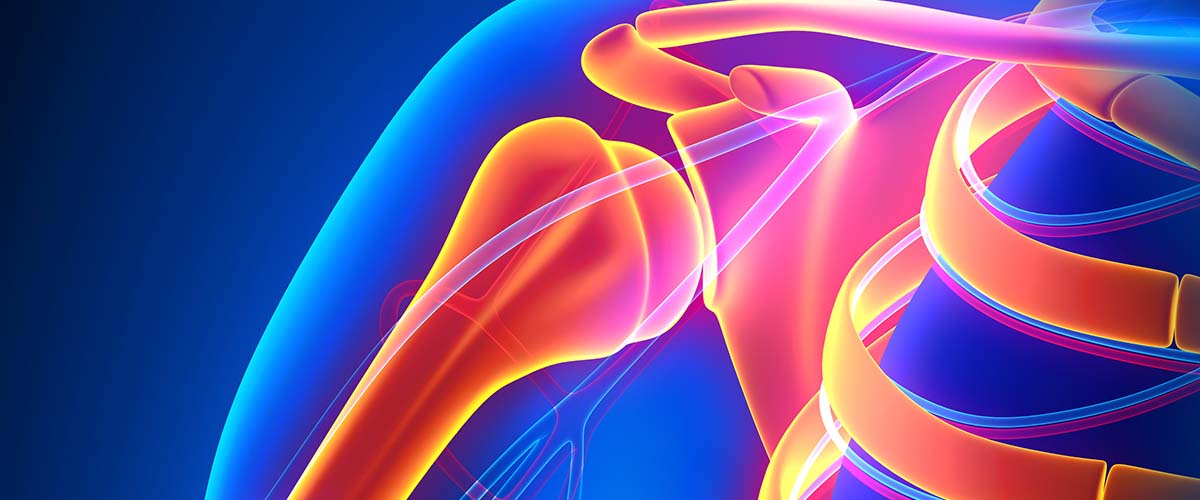
The sternoclavicular (SC) joint is where the inner end of the collarbone meets the breastbone (sternum), at the base of the neck. It is the only true joint connecting the arm to the trunk. SC joint injuries are uncommon. They range from sprains to dislocations, in which the collarbone pops forward (anterior) or backward (posterior). A posterior dislocation can press on the windpipe, food pipe and major blood vessels behind the breastbone, so it is treated as an emergency.1,2
- Pain and swelling where the collarbone meets the breastbone, after a fall or a blow to the shoulder or chest
- Anterior dislocations (a visible bump) are more common and are usually treated without surgery
- Posterior dislocations are rarer but can be dangerous and need urgent imaging and reduction
- In people under about 25, many “dislocations” are actually growth-plate fractures of the inner collarbone
- A CT scan is the key test
Warning signs: go to the emergency room
After an injury to the shoulder or chest, seek emergency care for difficulty breathing or swallowing, a choking feeling, hoarseness, or numbness, tingling, coldness or color change in the arm. These can be signs of a posterior SC dislocation pressing on structures behind the breastbone.
Causes
- A direct blow to the front of the chest (posterior dislocation)
- A force through the side of the shoulder, such as a tackle, pile-up or fall onto the shoulder, which levers the collarbone
- Motor vehicle accidents
- Occasionally, atraumatic looseness in people with loose joints
Diagnosis
The SC joint is hard to see on standard X-rays. A CT scan is the key test: it shows the direction of dislocation, any fracture or growth-plate injury and, with contrast, the relationship to the blood vessels behind the breastbone.
Treatment
Sprains are treated with a sling for comfort, ice and a gradual return to activity.
Anterior dislocations can sometimes be put back in place, but they often slip forward again. Many people do well with a persistent bump, and most are treated without surgery.
Posterior dislocations are reduced (put back in place) promptly, usually under anesthesia with a thoracic or vascular surgeon available. A systematic review recommends attempting closed reduction in the acute setting, with open surgery if closed reduction fails.1 When surgical stabilization is needed, reconstruction with a tendon graft had the lowest rates of recurrent instability and complications, while plate-and-screw techniques often required a second operation to remove the hardware.2 Pins and wires are avoided near the SC joint because they can migrate.
Recovery
After a sprain, most people return to sport within a few weeks. After reduction or reconstruction, the arm is protected in a sling for several weeks, followed by physical therapy, with return to contact sport usually after several months.
Frequently asked questions
Is an SC joint dislocation dangerous?
A forward (anterior) dislocation usually is not. A backward (posterior) dislocation can press on the windpipe, food pipe and major blood vessels, and needs urgent care.
Will the bump go away?
After an anterior dislocation, a bump often remains. It is usually painless over time and does not limit function for most people.
Do I need surgery?
Most SC sprains and anterior dislocations heal without surgery. Posterior dislocations that cannot be put back in place, or that keep slipping, may need surgical reconstruction.
Why do I need a CT scan?
The SC joint is hidden behind overlapping bones on X-ray. A CT scan shows the direction of the dislocation and any nearby fracture or growth-plate injury.
What is a medial clavicle growth-plate fracture?
The growth plate at the inner end of the collarbone is one of the last in the body to close, often not until the mid-20s. In teens and young adults, an injury here is often a growth-plate fracture rather than a true dislocation, and it usually heals well.
Research cited on this page
- Sernandez H, Riehl J. Sternoclavicular joint dislocation: a systematic review and meta-analysis. J Orthop Trauma. 2019;33(7):e251-e255. PubMed
For acute posterior SC dislocations, closed reduction should be attempted first, with open treatment if closed reduction fails. - Kendal JK, Thomas K, Lo IKY, Bois AJ. Clinical outcomes and complications following surgical management of traumatic posterior sternoclavicular joint dislocations: a systematic review. JBJS Rev. 2018;6(11):e2. PubMed
Overall complication rate 16%. Tendon-graft ligament reconstruction had the lowest recurrent instability and complication rates; plate fixation required a second operation for implant removal in 80% of cases.
Medically reviewed by Andrew P. Dold, MD, FAOA, FAAOS, FACS, FRCSC. Last reviewed October 2026. This page is general information, not medical advice. Your own diagnosis and treatment plan depend on your exam and imaging.