








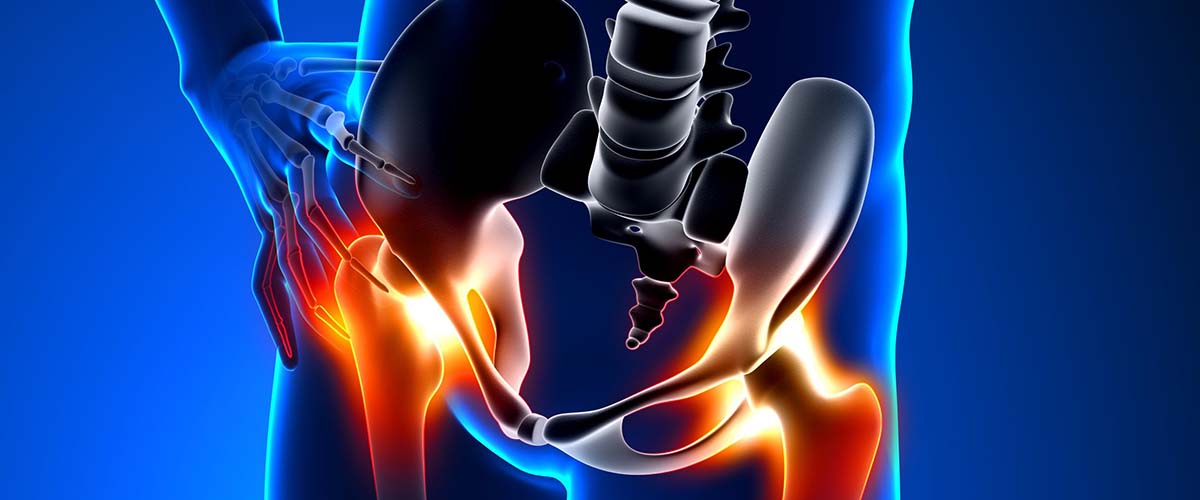
Greater trochanteric pain syndrome (GTPS) is the medical name for pain on the outside of the hip, over the bony point you can feel at the side of your upper thigh (the greater trochanter). It used to be called trochanteric bursitis, but we now know that in most people the main problem is irritation of the gluteal tendons, the tendons of the gluteus medius and gluteus minimus muscles that attach to that bone (gluteal tendinopathy). The bursa, a small fluid-filled cushion, may be inflamed too. GTPS is common, especially in women over 40. Dr. Andrew Dold, a board-certified, fellowship-trained sports medicine surgeon in Frisco, Texas, evaluates and treats outer hip pain, from exercise-based care to surgery for gluteal tendon tears.
- Pain on the outside of the hip, often worse lying on that side, on stairs and after long walks
- Usually a gluteal tendon problem, not just “bursitis”
- Much more common in women than men
- Education and a guided exercise program are the first-line treatment, with good results in a large randomized trial
- Surgery is reserved for gluteal tendon tears or stubborn cases that do not improve
What is greater trochanteric pain syndrome?
The gluteus medius and minimus are the main muscles that hold your pelvis level when you stand on one leg. Their tendons wrap over the greater trochanter like the rotator cuff wraps over the shoulder. When these tendons are overloaded, or squeezed against the bone, they can become painful and weakened over time. The thick band of tissue on the outside of the thigh (the iliotibial band, or IT band) lies over this area and can add pressure.
GTPS is common. In a study of about 3,000 adults aged 50 to 79, 17.6% had GTPS, and women were much more likely to have it than men (about 3 times the odds).1 It was also linked with low back pain and knee arthritis.1
Things that can make it more likely include:
- A sudden increase in walking, running, hiking or stair climbing
- Standing with your weight shifted onto one hip, or sitting with your legs crossed
- Weak hip muscles, or a stiff or painful back or knee that changes how you walk
- Changes in tendon health that come with age and hormonal changes
- A fall onto the side of the hip
Symptoms
- Aching or sharp pain on the outer side of the hip, sometimes spreading down the outside of the thigh
- Pain lying on the affected side at night, and sometimes on the other side too, because the top leg drops across the body
- Pain climbing stairs, getting up from a low chair or out of a car
- Pain standing on one leg, for example when putting on pants
- Tenderness when you press on the bony point at the side of the hip
- A limp, or a feeling of hip weakness, especially if a tendon is torn
Pain in the groin is more typical of a problem inside the hip joint, such as hip arthritis or a labral tear. Some people have both.
Diagnosis
Dr. Dold will ask about your symptoms and activities and examine your hip, back and knee. Tests include pressing on the side of the hip, checking strength of the hip muscles, and having you stand on one leg for 30 seconds. He will also look for other causes of pain in this area, such as IT band syndrome, a pinched nerve in the low back, or arthritis of the hip joint.
X-rays help check the hip joint for arthritis. An MRI or ultrasound can show tendon thickening, fluid in the bursa, or a partial or full tear of the gluteal tendons. Imaging is usually ordered when symptoms are severe, there is weakness or a limp, or the pain is not improving with treatment.
Non-surgical treatment
Most people improve without surgery. Your plan depends on how long you have had symptoms, how much they limit you, and whether a tendon is torn.
Education and load management. Small changes reduce the squeeze on the tendons: avoid crossing your legs, avoid “hanging” on one hip when standing, use a pillow between your knees when lying on your side, avoid very low chairs, and build up walking and stair activity gradually rather than all at once.
Exercise. A physical therapy program that gradually strengthens the hip muscles is the foundation of treatment. In a randomized trial of 204 people with gluteal tendinopathy, a physical therapist-led program of education plus exercise was compared with a single cortisone injection and with a “wait and see” approach.2 At 8 weeks, 77% of the exercise group reported success, compared with 58% after the injection and 29% with wait and see.2 At one year, education plus exercise still produced better overall improvement than the injection.2
Cortisone (steroid) injection. A cortisone injection can reduce pain quickly, which can help you sleep and start exercising. However, the benefit often fades. In a randomized trial, the injection gave the most relief at 1 month, but by 15 months people who did home exercise or shockwave therapy were doing better than those who had the injection.3 Dr. Dold may recommend limiting how many injections you receive and pairing any injection with an exercise program.
Shockwave therapy. Extracorporeal shockwave therapy (ESWT) delivers sound-wave pulses to the painful area over a few short sessions. In the same trial, shockwave therapy gave better results than the injection at 4 and 15 months.3 Shockwave is often not covered by insurance.
Platelet-rich plasma (PRP). PRP is made from a small sample of your own blood that is spun to concentrate the platelets, then injected into the tendon. In a randomized, double-blind trial of 80 people with long-standing gluteal tendinopathy, PRP and cortisone gave similar results at 6 weeks, but the PRP group had more improvement at 12 weeks.4 A 2021 meta-analysis found PRP more effective than steroid injections at about 2 years of follow-up.5 Still, the research is mixed and the number of studies is small, PRP preparations vary, and PRP is generally not FDA-approved for this use and often not covered by insurance. Learn more about PRP therapy and the facts about “stem cell” injections.
Anti-inflammatory medicines, ice and weight loss when needed can also help as part of the overall plan.
Surgery for gluteal tendon tears
Surgery is considered when there is a gluteal tendon tear causing weakness or a limp, or when pain persists despite several months of well-done non-surgical care. The torn tendon can be reattached to the bone through small incisions with a camera (endoscopic repair) or through an open incision, depending on the size and quality of the tear. Dr. Dold performs both endoscopic and open gluteal tendon repair. Some patients also need the bursa removed or the IT band lengthened.
A systematic review of open and endoscopic gluteal tendon repair found good to excellent pain relief and function after both approaches in most patients, with low complication rates.6 The studies in that review were small and of lower quality, so results for an individual patient vary. Dr. Dold co-authored a published technique article on endoscopic gluteus medius repair augmented with a bioinductive implant.7 Read more on our page about gluteus medius and minimus tears.
Recovery and return to activity
With exercise-based treatment, many people notice improvement within 8 to 12 weeks, although tendons can take several months to settle fully. Keep doing your exercises after the pain improves to lower the chance of it coming back.
After gluteal tendon repair, patients usually use crutches with limited weight on the leg for several weeks while the tendon heals to the bone, followed by a gradual strengthening program. Full recovery often takes several months or longer. Individual results vary.
Prevention
- Keep your hip muscles strong with regular strengthening exercises
- Increase walking, running or hiking distance gradually
- Avoid sitting with your legs crossed and standing with your weight on one hip
- Address back or knee problems that change how you walk
What the research shows
Outer hip pain has been the subject of several high-quality trials in the last decade. Here is what they show.
Education and exercise come first
In randomized trials and recent meta-analyses, education about load (such as avoiding crossed legs and hanging on one hip) combined with a targeted exercise program produces more lasting improvement than a cortisone injection or a wait-and-see approach. The education piece matters: one trial found that thorough education alone did about as well, on average, as education plus a loading program.
Injections and shock wave therapy
Cortisone injections can reduce pain for several weeks, but the effect tends not to last. In a randomized trial, a single PRP injection gave better pain and function than cortisone at 3 and 6 months. Focused shock wave therapy has also relieved pain in trials and is an option when exercise has not been enough.
Surgery for tendon tears
For gluteal tendon tears or pain that persists despite thorough non-surgical care, surgical repair has produced meaningful improvement. Open and endoscopic repairs give similar results, with fewer complications reported after endoscopic repair. Advanced fatty change in the muscle, which can develop when a tear has been present for a long time, is linked to less improvement, which is one reason not to ignore weakness or a limp.
Why see Dr. Dold
- Board certified by the American Board of Orthopaedic Surgery, with subspecialty certification in Sports Medicine
- Sports medicine and arthroscopy fellowship at NYU Langone / Hospital for Joint Diseases; orthopedic residency at the University of Toronto
- Fellow of the American College of Surgeons (FACS), the American Academy of Orthopaedic Surgeons (FAAOS), the American Orthopaedic Association (FAOA) and the Royal College of Surgeons of Canada (FRCSC)
- Published research on hip arthroscopy, including Post-operative Considerations Following Hip Arthroscopy (JBJS Reviews, 2017) and studies in the American Journal of Sports Medicine; member of the International Society for Hip Arthroscopy (ISHA)
- Team physician and surgical consultant to Rugby Canada; has cared for professional athletes from the NFL, NBA, NHL, MLS, PGA Tour and Major League Rugby
- D Magazine Best Doctors (Collin County), 2019–2026 · Rated 4.9 on Google
Frequently asked questions
Is trochanteric bursitis the same as GTPS?
Mostly, yes. “Trochanteric bursitis” is the older name. Today, doctors use greater trochanteric pain syndrome because the gluteal tendons are usually the main source of pain, with or without an inflamed bursa.
Why does my hip hurt at night when I lie on my side?
Lying on the painful side presses directly on the irritated tendons. Lying on the other side can also hurt because the top leg drops across your body and stretches the tendons. A pillow between your knees often helps.
Should I get a cortisone shot?
A cortisone injection can relieve pain quickly, but the benefit often fades. In randomized trials, education plus exercise produced better results than an injection at one year.2,3 Dr. Dold will discuss whether an injection makes sense as part of your plan.
Does PRP work for outer hip pain?
Some studies show PRP may give longer-lasting benefit than cortisone for gluteal tendinopathy, but the evidence is still developing.4,5 PRP is generally not FDA-approved for this use and is often not covered by insurance.
How long does GTPS take to get better?
Many people improve within a few months with a guided exercise program, but long-standing tendon pain can take longer. Individual results vary.
When do I need surgery?
Surgery is mainly for gluteal tendon tears that cause weakness or a limp, or for pain that does not improve with several months of good non-surgical care. See gluteus medius and minimus tears.
Do you accept my insurance?
Dr. Dold accepts most major insurance plans, including Medicare and Tricare. Please call 469-850-0680 to confirm your coverage.
Research cited on this page
- Segal NA, Felson DT, Torner JC, et al. Greater trochanteric pain syndrome: epidemiology and associated factors. Arch Phys Med Rehabil. 2007;88(8):988-992. PubMed
- Mellor R, Bennell K, Grimaldi A, et al. Education plus exercise versus corticosteroid injection use versus a wait and see approach on global outcome and pain from gluteal tendinopathy: prospective, single blinded, randomised clinical trial. BMJ. 2018;361:k1662. PubMed
- Rompe JD, Segal NA, Cacchio A, et al. Home training, local corticosteroid injection, or radial shock wave therapy for greater trochanter pain syndrome. Am J Sports Med. 2009;37(10):1981-1990. PubMed
- Fitzpatrick J, Bulsara MK, O’Donnell J, et al. The effectiveness of platelet-rich plasma injections in gluteal tendinopathy: a randomized, double-blind controlled trial comparing a single platelet-rich plasma injection with a single corticosteroid injection. Am J Sports Med. 2018;46(4):933-939. PubMed
- Migliorini F, Kader N, Eschweiler J, et al. Platelet-rich plasma versus steroids injections for greater trochanter pain syndrome: a systematic review and meta-analysis. Br Med Bull. 2021;139(1):86-99. PubMed
- Alpaugh K, Chilelli BJ, Xu S, Martin SD. Outcomes after primary open or endoscopic abductor tendon repair in the hip: a systematic review of the literature. Arthroscopy. 2015;31(3):530-540. Abstract
- Kaplan DJ, Dold AP, Fralinger DJ, Meislin RJ. Endoscopic Gluteus Medius Repair Augmented With Bioinductive Implant. Arthrosc Tech. 2016;5(4):e821-e825. PubMed
- Kinsella R, Semciw AI, Hawke LJ, et al. Diagnostic Accuracy of Clinical Tests for Assessing Greater Trochanteric Pain Syndrome: A Systematic Review With Meta-analysis. J Orthop Sports Phys Ther. 2024;54(1):26-49. PubMed
A meta-analysis of clinical tests found combining tenderness over the side of the hip with painful resisted hip abduction helps confirm the diagnosis. - Kjeldsen T, Hvidt KJ, Bohn MB, et al. Exercise compared to a control condition or other conservative treatment options in patients with Greater Trochanteric Pain Syndrome: a systematic review and meta-analysis of randomized controlled trials. Physiotherapy. 2024;123:69-80. PubMed
A 2024 meta-analysis strongly supported exercise as first-line treatment; exercise was more likely than cortisone to produce lasting improvement. - Bremer T, Nicklen P, Fearon A, et al. The efficacy of gluteal tendinopathy treatments: A systematic review. Clin Rehabil. 2025;39(5):600-617. PubMed
A 2025 meta-analysis recommended exercise and education as core care; PRP improved short-term function more than cortisone, and focused shock wave therapy relieved pain longer. - Mellor R, Kasza J, Grimaldi A, et al. Mediators and Moderators of Education Plus Exercise on Perceived Improvement in Individuals With Gluteal Tendinopathy: An Exploratory Analysis of a 3-Arm Randomized Trial. J Orthop Sports Phys Ther. 2022;52(12):826-836. PubMed
Further analysis of the LEAP trial suggested education plus exercise improves outcomes compared with cortisone or wait-and-see, partly by changing how patients manage load. - Ganderton C, Semciw A, Cook J, et al. Gluteal Loading Versus Sham Exercises to Improve Pain and Dysfunction in Postmenopausal Women with Greater Trochanteric Pain Syndrome: A Randomized Controlled Trial. J Womens Health (Larchmt). 2018;27(6):815-829. PubMed
A randomized trial found that adding a gluteal loading program to thorough education did not improve results on average, though some patients responded well. - Mary McMillan R, Ganderton CL, Cook J, et al. Does Menopausal Hormone Therapy, Exercise, or Both Improve Pain and Function in Postmenopausal Women With Greater Trochanteric Pain Syndrome? A 2 × 2 Factorial Randomized Clinical Trial. Am J Sports Med. 2022;50(2):515-525. PubMed
In postmenopausal women, menopausal hormone therapy combined with exercise and education improved results in women with lower body weight. - Wang SQ, Guo NY, Liu W, et al. Effect of conservative treatment on greater trochanteric pain syndrome: a systematic review and network meta-analysis of randomized controlled trials. J Orthop Surg Res. 2025;20(1):126. PubMed
A 2025 review reaffirmed exercise as the main conservative treatment for outer hip pain, with injections and physical modalities as useful adjuncts. - Barratt PA, Brookes N, Newson A. Conservative treatments for greater trochanteric pain syndrome: a systematic review. Br J Sports Med. 2017;51(2):97-104. PubMed
A review found little high-quality research on conservative treatments; one low-bias trial showed no added benefit from X-ray-guided injections. - Koulischer S, Callewier A, Zorman D. Management of greater trochanteric pain syndrome : a systematic review. Acta Orthop Belg. 2017;83(2):205-214. PubMed
Cortisone injections reduced pain in the first months, but the effect did not persist. - Fitzpatrick J, Bulsara MK, O’Donnell J, et al. Leucocyte-Rich Platelet-Rich Plasma Treatment of Gluteus Medius and Minimus Tendinopathy: A Double-Blind Randomized Controlled Trial With 2-Year Follow-up. Am J Sports Med. 2019;47(5):1130-1137. PubMed
In a randomized trial of chronic gluteal tendinopathy, a single PRP injection improved pain and function more than cortisone at 12 and 24 weeks. - Mani-Babu S, Morrissey D, Waugh C, et al. The effectiveness of extracorporeal shock wave therapy in lower limb tendinopathy: a systematic review. Am J Sports Med. 2015;43(3):752-61. PubMed
A meta-analysis found shock wave therapy effective for outer hip pain, especially when other treatments had not worked. - Carlisi E, Cecini M, Di Natali G, et al. Focused extracorporeal shock wave therapy for greater trochanteric pain syndrome with gluteal tendinopathy: a randomized controlled trial. Clin Rehabil. 2019;33(4):670-680. PubMed
A randomized trial found focused shock wave therapy reduced outer hip pain in the short and medium term. - Walker-Santiago R, Wojnowski NM, Lall AC, et al. Platelet-Rich Plasma Versus Surgery for the Management of Recalcitrant Greater Trochanteric Pain Syndrome: A Systematic Review. Arthroscopy. 2020;36(3):875-888. PubMed
For outer hip pain that had not responded to other care, both PRP and surgery led to meaningful improvement. - Lustenberger DP, Ng VY, Best TM, et al. Efficacy of treatment of trochanteric bursitis: a systematic review. Clin J Sport Med. 2011;21(5):447-53. PubMed
A review of surgical treatments for refractory outer hip pain found surgery outperformed continued cortisone and physical therapy in comparison studies. - Alpaugh K, Chilelli BJ, Xu S, et al. Outcomes after primary open or endoscopic abductor tendon repair in the hip: a systematic review of the literature. Arthroscopy. 2015;31(3):530-40. PubMed
Surgically repaired gluteal tendon tears occurred mostly in women and nearly always involved the gluteus medius, with the gluteus minimus torn in about a third. - Chandrasekaran S, Lodhia P, Gui C, et al. Outcomes of Open Versus Endoscopic Repair of Abductor Muscle Tears of the Hip: A Systematic Review. Arthroscopy. 2015;31(10):2057-67.e2. PubMed
Open and endoscopic gluteal tendon repairs gave similar outcomes and strength gains, with more complications reported after open repair. - Longstaffe R, Dickerson P, Thigpen CA, et al. Both open and endoscopic gluteal tendon repairs lead to functional improvement with similar failure rates: a systematic review. J ISAKOS. 2021;6(1):28-34. PubMed
Most gluteal tears were partial thickness; both endoscopic and open repairs reliably improved outcomes. - Looney AM, Bodendorfer BM, Donaldson ST, et al. Influence of Fatty Infiltration on Hip Abductor Repair Outcomes: A Systematic Review and Meta-analysis. Am J Sports Med. 2022;50(9):2568-2580. PubMed
Surgery for abductor tendon tears improved hip scores, but advanced fatty change in the muscle was linked to less improvement.
Medically reviewed by Andrew P. Dold, MD, FAOA, FAAOS, FACS, FRCSC. Last reviewed October 2026. This page is general information, not medical advice. Individual results vary.