








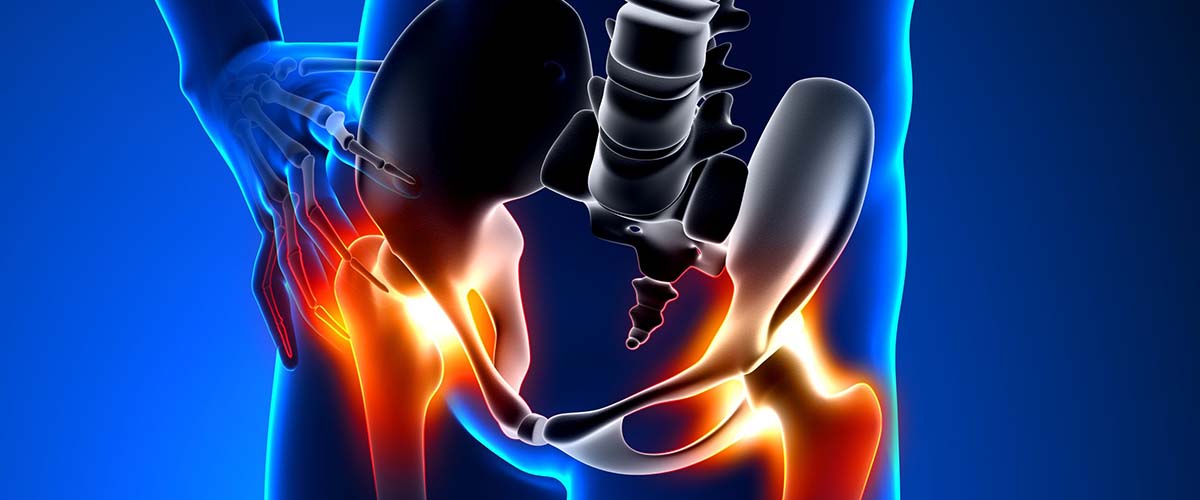
The hamstrings are three muscles along the back of the thigh. At the top, their tendons attach to the ischial tuberosity, the “sit bone” of the pelvis. A proximal hamstring tear occurs when one or more of these tendons tears or pulls off the bone (an avulsion). It’s one of the more serious hamstring injuries and is seen in athletes and in active adults of all ages.
How it happens
These injuries usually happen when the hip is forcefully bent while the knee is straight, stretching the hamstrings suddenly. Common examples are slipping into the splits, water-skiing falls, and sprinting or hurdling.
Symptoms
- A sudden pop and sharp pain at the buttock or back of the thigh
- Bruising in the back of the thigh, sometimes spreading toward the knee
- Pain when sitting on the affected side
- Difficulty walking, bending the knee or climbing stairs
- Occasionally, tingling down the leg from irritation of the nearby sciatic nerve
Diagnosis
An exam and history often suggest the diagnosis. An X-ray checks for a bone fragment (common in younger athletes), and an MRI shows how many tendons are torn and how far they have pulled away. Those two findings guide treatment.
Non-surgical treatment
Partial tears and single-tendon tears with little retraction often heal well with activity changes and a progressive physical therapy program. For persistent tendon pain at the sit bone (proximal hamstring tendinopathy), treatment may include rehab and, in selected cases, PRP injections.
Proximal hamstring repair surgery
A 2024 randomized trial in adults aged 30 to 70 found that non-surgical treatment gave results similar to surgical repair for proximal hamstring avulsions, so for many adults both options are reasonable. Repair is generally favored for young athletes, for tears with large retraction, and for patients with high strength demands or ongoing symptoms such as sciatic nerve irritation. Dr. Dold reattaches the tendons to the bone with suture anchors through an incision in the crease of the buttock. The sciatic nerve, which runs close by, is identified and protected. Chronic tears may need a more extensive procedure.
Recovery
- Crutches and protected weight bearing for about 4 to 6 weeks, with a hip brace that limits hip bending to protect the repair
- Physical therapy begins early with gentle motion and progresses to strengthening
- Return to running and sport usually takes about 4 to 6 months, based on strength testing
What the research shows
- Partial tears and tendinopathy: most heal with a progressive loading program. For persistent high hamstring tendinopathy, randomized trials support shockwave therapy, and PRP injections have shown benefit at 6 months in one trial.
- Complete avulsions in adults: a 2024 randomized trial in the New England Journal of Medicine compared surgery with non-surgical treatment in adults aged 30 to 70 and found non-surgical care was not meaningfully worse at 2 years. Many patients in both groups had some lingering discomfort years later.
- When repair is favored: older observational studies report high satisfaction and strength after repair, and elite athletes returned to sport after repair in about 95% of cases, typically within 3 to 7 months. Repair is generally recommended for young athletes, large retraction, high strength demands, or symptoms such as sciatic nerve irritation.
- Timing: when surgery is chosen, early repair, ideally within the first few weeks, gives better results and an easier operation than delayed repair.
- Rehabilitation: a randomized trial found that accelerated rehab, walking as tolerated without a brace, was safe after repair and reduced early pain.
Why see Dr. Dold
- Board certified by the American Board of Orthopaedic Surgery, with subspecialty certification in Sports Medicine
- Fellow of the American Orthopaedic Association (FAOA), the American Academy of Orthopaedic Surgeons (FAAOS), the American College of Surgeons (FACS) and the Royal College of Surgeons of Canada (FRCSC)
- Sports medicine and arthroscopy fellowship at NYU Langone / Hospital for Joint Diseases; orthopedic residency at the University of Toronto
- Member of the International Society for Hip Arthroscopy (ISHA)
- D Magazine Best Doctors (Collin County), 2019–2026 · Rated 4.9 on Google
Frequently asked questions
How do I know if I tore my hamstring off the bone?
A sudden pop, pain at the sit bone, bruising in the back of the thigh and trouble walking or sitting are warning signs. An MRI confirms the diagnosis.
Does a proximal hamstring tear need surgery?
Not always. Partial and single-tendon tears often heal with therapy. For many adults, a randomized trial found non-surgical care and repair gave similar results. Repair is generally favored for young athletes, tears with large retraction and high-demand patients.
How soon should a hamstring avulsion be repaired?
Complete tears are ideally repaired within the first few weeks. After that, the tendons retract and scar, which can make repair more difficult.
How long is recovery after proximal hamstring repair?
Crutches and a hip brace for about 4 to 6 weeks, then progressive physical therapy. Return to sport usually takes about 4 to 6 months.
Can you sit after hamstring repair surgery?
Sitting is uncomfortable at first and is usually limited early in recovery. Dr. Dold’s team will give you specific instructions.
Research cited on this page
- Bodendorfer BM, Curley AJ, Kotler JA, et al. Outcomes after operative and nonoperative treatment of proximal hamstring avulsions: a systematic review and meta-analysis. Am J Sports Med. 2018;46(11):2798-2808. PubMed
Repair led to higher satisfaction (91% vs 53%) and strength (85% vs 64%) than non-surgical care; early (acute) repairs did better than delayed repairs. - van der Made AD, Reurink G, Gouttebarge V, et al. Outcome after surgical repair of proximal hamstring avulsions: a systematic review. Am J Sports Med. 2015;43(11):2841-2851. PubMed
After repair, 76% to 100% of patients returned to sport, and the re-tear rate was about 3%. - Pihl E, Laszlo S, Rosenlund AM, et al. Operative versus Nonoperative Treatment of Proximal Hamstring Avulsions. NEJM Evid. 2024;3(8):EVIDoa2400056. PubMed
Randomized trial (NEJM) in adults aged 30 to 70: non-surgical treatment was non-inferior to surgical repair for proximal hamstring avulsions. - Rosenlund AN, Thaulow J, Kjellman KE, et al. Back in stride: patient perspectives on operative and nonoperative treatment and recovery after acute proximal hamstring avulsions – a qualitative study. BMC Musculoskelet Disord. 2026;27(1). PubMed
Trial follow-up: most patients returned to pre-injury activities, but many had lingering discomfort years after injury. - Harris JD, Griesser MJ, Best TM, et al. Treatment of proximal hamstring ruptures – a systematic review. Int J Sports Med. 2011;32(7):490-5. PubMed
Systematic review: repair gave better outcomes than non-operative care, and acute repair better outcomes than delayed repair. - Dave U, Poulson T, Rubin J, et al. Elite athletes return to sport faster and more often than non-elite athletes with low complication rates following proximal hamstring repair: A systematic review. Knee Surg Sports Traumatol Arthrosc. 2025;33(9):3389-3404. PubMed
Systematic review: elite athletes returned to sport after repair in 95.6% of cases, at 3 to 7 months; non-elite athletes returned less often. - Irger M, Forkel P, Imhoff AB, et al. [Clinical results after refixation of proximal hamstring tendon ruptures comparing different anchor systems]. Unfallchirurg. 2021;124(7):560-567. PubMed
Systematic review: all suture anchor systems gave good to excellent results after repair. - Aujla RS, Edwards P, Cecchi S, et al. Accelerated rehabilitation after proximal hamstring avulsion repair is safe and effective: Outcomes from randomized controlled trial of two different rehabilitation regimes. Knee Surg Sports Traumatol Arthrosc. 2025;33(12):4412-4425. PubMed
Randomized trial: accelerated rehabilitation with weight-bearing as tolerated and no brace was safe after repair. - Ebert JR, Edwards PK, Cecchi S, et al. Two-Year Outcomes of the Proximal Hamstring Avulsion Rehabilitation Regimes: Longitudinal Versus Accelerated Protocol (PHARRLAP) Study: A Randomized Controlled Trial. Am J Sports Med. 2026;54(9):2204-2212. PubMed
Two-year trial results: patients recovered strength and function with a low re-injury rate after repair; accelerated rehab reduced early pain. - Nasser AM, Vicenzino B, Grimaldi A, et al. Proximal Hamstring Tendinopathy: A Systematic Review of Interventions. Int J Sports Phys Ther. 2021;16(2):288-305. PubMed
Systematic review of proximal hamstring tendinopathy: no single treatment has been shown to work better than others; approaches successful in other tendinopathies are a reasonable start. - Cacchio A, Rompe JD, Furia JP, et al. Shockwave therapy for the treatment of chronic proximal hamstring tendinopathy in professional athletes. Am J Sports Med. 2011;39(1):146-53. PubMed
Randomized trial: shockwave therapy reduced pain in chronic proximal hamstring tendinopathy more than traditional conservative treatment. - Rich A, Ford J, Cook J, et al. Physiotherapy Compared With Shockwave Therapy for the Treatment of Proximal Hamstring Tendinopathy: A Randomized Controlled Trial. Am J Sports Med. 2025;53(14):3396-3407. PubMed
Randomized trial: individualized physiotherapy and shockwave therapy were similarly effective for proximal hamstring tendinopathy. - Davenport KL, Campos JS, Nguyen J, et al. Ultrasound-Guided Intratendinous Injections With Platelet-Rich Plasma or Autologous Whole Blood for Treatment of Proximal Hamstring Tendinopathy: A Double-Blind Randomized Controlled Trial. J Ultrasound Med. 2015;34(8):1455-63. PubMed
Randomized trial: PRP and whole-blood injections both improved symptoms of proximal hamstring tendinopathy, with PRP showing gains at 6 months. - Rhim HC, Shin J, Kang J, et al. Use of extracorporeal shockwave therapies for athletes and physically active individuals: a systematic review. Br J Sports Med. 2024;58(3):154-163. PubMed
Systematic review: shockwave may help selected sports injuries, alone or with exercise.
Same-day appointments available. Dr. Dold accepts most major insurance plans, including Medicare and Tricare. Please call 469-850-0680 to confirm your coverage.
Medically reviewed by Andrew P. Dold, MD, FAOA, FAAOS, FACS, FRCSC. Last reviewed October 2026. This page is general information, not medical advice.