









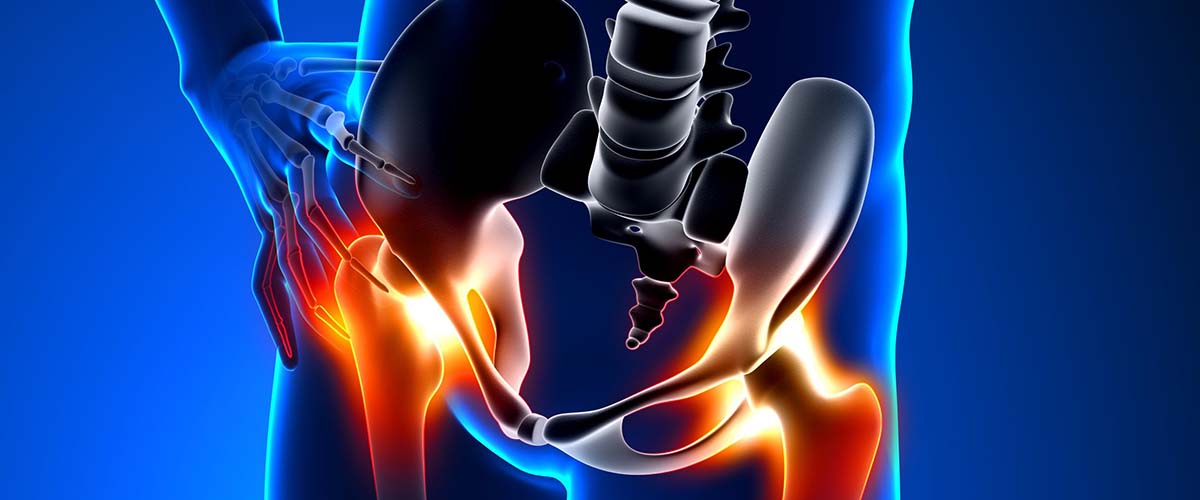
Transient osteoporosis of the hip is an uncommon condition in which the top of the thigh bone (the femoral head) temporarily loses bone density and fills with fluid, called bone marrow edema. It causes hip or groin pain that comes on without an injury. It is usually self-limiting, meaning it resolves on its own over several months, but the weakened bone needs protecting while it heals.1,2
- Hip or groin pain that starts without an injury and is worse with walking
- Seen most often in middle-aged adults and in women late in pregnancy
- MRI shows bone marrow edema; early X-rays may look normal
- Treated with protected weight bearing and pain control
- Usually resolves over several months
Symptoms
- Hip, groin or front-of-thigh pain that builds over days to weeks
- Pain worse with standing and walking, and often a limp
- Hip motion is usually preserved, unlike in arthritis
Diagnosis
An MRI is the key test: it shows bone marrow edema in the femoral head and neck.1 X-rays may be normal at first. Because several conditions can look similar on MRI, the diagnosis is made by ruling out others, including avascular necrosis, a stress fracture, infection and arthritis.1,2 Dr. Dold may also check bone health and vitamin D.
Treatment
Treatment is usually conservative:2
- Protected weight bearing with crutches, to reduce stress on the weakened bone and the risk of fracture
- Pain relief
- A gradual return to walking and activity as pain settles and follow-up imaging improves
Some small, open-label studies suggest bisphosphonate medicines may help pain and imaging findings resolve sooner, but the evidence is limited.2 Surgery is rarely needed. During pregnancy, treatment is planned together with your obstetrician.
Recovery
Symptoms usually improve gradually over a number of months.2 Follow-up visits, and sometimes a repeat MRI, confirm that the bone is recovering and rule out conditions that need different treatment.
What the research shows
- Who gets it: transient osteoporosis of the hip most often affects women in late pregnancy or just after delivery, and otherwise healthy middle-aged men. It causes sudden hip or groin pain that worsens with standing and walking.
- MRI makes the diagnosis: X-rays are often normal early, while MRI shows bone marrow swelling in the femoral head and neck. MRI also helps rule out conditions that need different treatment, such as osteonecrosis or a stress fracture.
- It usually resolves on its own: most patients recover over several months with protected weight-bearing on crutches and pain control, and bone density returns to normal.
- Protecting the bone matters: the weakened bone can fracture, particularly in pregnancy, so limiting weight-bearing until symptoms and imaging improve is important.
- Medicines that may speed recovery: case series report faster resolution with bisphosphonates (such as neridronate), and iloprost infusions have also been studied. These are options to discuss, especially for severe pain, and are not used during pregnancy.
- Migratory form: occasionally the condition moves to another joint later (regional migratory osteoporosis), so new pain elsewhere should be evaluated.
Frequently asked questions
Is transient osteoporosis the same as osteoporosis?
No. Osteoporosis is a long-term loss of bone density throughout the skeleton. Transient osteoporosis of the hip is a temporary, localized loss of bone density with bone marrow edema that usually resolves.
Do I need surgery?
Rarely. Most people recover with protected weight bearing and pain control.
Why do I need crutches?
The affected bone is temporarily weaker. Taking weight off the hip lowers the risk of a fracture while it recovers.
Can it happen during pregnancy?
Yes. It is seen in women in late pregnancy, and treatment is coordinated with the obstetric team.
Research cited on this page
- Maisi N, Patoulias D, Tsagkaris C, et al. Transient hip osteoporosis: etiopathogenetic, clinical, and imaging approach. Mediterr J Rheumatol. 2022;33(2):196-200. PubMed
A relatively rare, benign and usually self-limiting condition caused by bone marrow edema seen on MRI; careful differential diagnosis is needed. - Patel S. Primary bone marrow oedema syndromes. Rheumatology (Oxford). 2014;53(5):785-792. PubMed
A diagnosis of exclusion; treatment is usually analgesics and staying off the limb, symptoms resolve over months, and open-label studies suggest bisphosphonates may help. - Korompilias AV, Karantanas AH, Lykissas MG, et al. Transient osteoporosis. J Am Acad Orthop Surg. 2008;16(8):480-9. PubMed
Review: MRI is used for early diagnosis and monitoring; X-rays may show regional bone thinning; the condition is self-limiting. - Schapira D. Transient osteoporosis of the hip. Semin Arthritis Rheum. 1992;22(2):98-105. PubMed
Review: sudden hip pain and limp, with bone thinning on X-ray that gradually resolves as symptoms recover spontaneously. - Wilson AJ, Murphy WA, Hardy DC, et al. Transient osteoporosis: transient bone marrow edema?. Radiology. 1988;167(3):757-60. PubMed
MRI study: symptoms resolved spontaneously in all 10 patients without recurrence over 1 to 3 years. - Balakrishnan A, Schemitsch EH, Pearce D, et al. Distinguishing transient osteoporosis of the hip from avascular necrosis. Can J Surg. 2003;46(3):187-92. PubMed
Study: transient osteoporosis of the hip in young men is often overlooked; symptoms resolve over time with reduced weight-bearing. - Szwedowski D, Nitek Z, Walecki J. Evaluation of transient osteoporosis of the hip in magnetic resonance imaging. Pol J Radiol. 2014;79:36-8. PubMed
Review: sudden hip pain that worsens with weight-bearing; early X-rays are often normal. - Morton A, Savard-Heppel J. Transient osteoporosis of the hip in pregnancy. Obstet Med. 2024;17(4):188-193. PubMed
Review: affects previously healthy pregnant women and young to middle-aged men; the risk of fracture is higher in pregnancy. - Steib-Furno S, Luc M, Pham T, et al. Pregnancy-related hip diseases: incidence and diagnoses. Joint Bone Spine. 2007;74(4):373-8. PubMed
Study: transient osteoporosis and occult stress fractures are the main causes of hip pain in pregnancy and early postpartum. - Funk JL, Shoback DM, Genant HK. Transient osteoporosis of the hip in pregnancy: natural history of changes in bone mineral density. Clin Endocrinol (Oxf). 1995;43(3):373-82. PubMed
Case study: bone density at other sites (spine) was also reduced in pregnancy-associated transient osteoporosis. - Kim JW, Yoo JJ, Min BW, et al. Subchondral fracture of the femoral head in healthy adults. Clin Orthop Relat Res. 2007;464:196-204. PubMed
Study: the key imaging difference from a subchondral fracture is a visible fracture line on MRI. - Vassalou EE, Spanakis K, Tsifountoudis IP, et al. MR Imaging of the Hip: An Update on Bone Marrow Edema. Semin Musculoskelet Radiol. 2019;23(3):276-288. PubMed
MRI review: bone marrow edema patterns help distinguish transient osteoporosis from osteonecrosis and fractures. - Roth A, Beckmann J, Bohndorf K, et al. S3-Guideline non-traumatic adult femoral head necrosis. Arch Orthop Trauma Surg. 2016;136(2):165-74. PubMed
Clinical guideline on osteonecrosis: transient osteoporosis is a key differential diagnosis; MRI is recommended when X-rays are normal. - Cahir JG, Toms AP. Regional migratory osteoporosis. Eur J Radiol. 2008;67(1):2-10. PubMed
Review: regional migratory osteoporosis, in which bone marrow edema moves to other joints, is probably under-diagnosed. - Asadipooya K, Graves L, Greene LW. Transient osteoporosis of the hip: review of the literature. Osteoporos Int. 2017;28(6):1805-1816. PubMed
Review: a shorter course is reported with bisphosphonates, calcitonin or teriparatide; core decompression was not shown to be better. - D’Alessandro R, Falsetti P, Conticini E, et al. Efficacy of intravenous neridronate in transient osteoporosis of the hip. Clin Exp Rheumatol. 2022;40(9):1681-1685. PubMed
Study: intravenous neridronate was effective and safe and may speed resolution. - Puma Pagliarello C, Pavone V, Kory A, et al. Transient Osteoporosis of the Hip: Clinical and Radiological Outcomes After Combined Pharmacologic and Biophysical Therapy. J Clin Med. 2025;14(21). PubMed
Study: after treatment, bone marrow edema resolved on MRI in all patients, though one developed osteonecrosis. - Aigner N, Meizer R, Meraner D, et al. Bone marrow edema syndrome in postpartal women: treatment with iloprost. Orthop Clin North Am. 2009;40(2):241-7. PubMed
Study: iloprost infusion as an approach for painful bone marrow edema of the hip in postpartum women. - Beckmann J, Schmidt T, Schaumburger J, et al. Infusion, core decompression, or infusion following core decompression in the treatment of bone edema syndrome and early avascular osteonecrosis of the femoral head. Rheumatol Int. 2013;33(6):1561-5. PubMed
Study: iloprost infusion, core decompression or both reduced bone marrow edema; combined treatment gave the greatest improvement in that series. - Wright EV, Naqvi AZ, Syed S, et al. Transient osteoporosis of the hip in pregnancy: the orthopaedic management of bilateral neck of femur fractures in the third trimester. BMJ Case Rep. 2021;14(3). PubMed
Case report: bilateral hip fractures from transient osteoporosis during pregnancy.
Medically reviewed by Andrew P. Dold, MD, FAOA, FAAOS, FACS, FRCSC. Last reviewed October 2026. This page is general information, not medical advice. Your own diagnosis and treatment plan depend on your exam and imaging.