







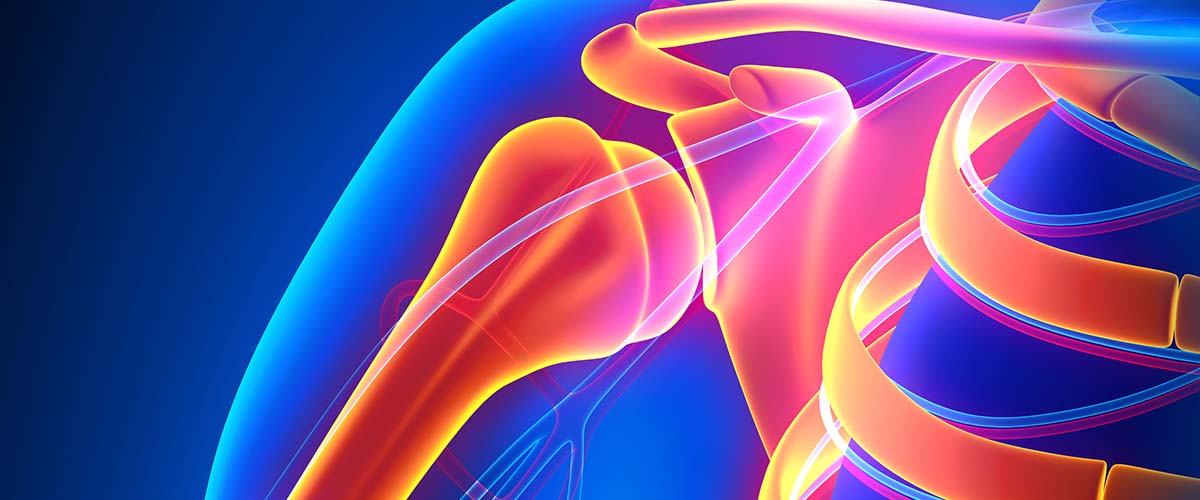
Calcific tendinitis of the shoulder is a condition in which calcium deposits (made of calcium hydroxyapatite crystals) form inside a rotator cuff tendon, most often the supraspinatus at the top of the shoulder. It can cause sudden, severe shoulder pain, or a longer-lasting ache with overhead activity. It is different from the age-related wear seen in rotator cuff tendinitis and from arthritis. Dr. Andrew Dold, a board-certified, fellowship-trained sports medicine surgeon in Frisco, Texas, treats calcific tendinitis with non-surgical care first and arthroscopic removal of the deposit when needed.
- Calcium deposits form in a rotator cuff tendon, often in middle-aged adults
- In most people, the deposit eventually breaks down and the symptoms settle
- The most painful phase is often when the body is reabsorbing the calcium
- Treatment starts with pain control, therapy and injections; needling (barbotage) and shock wave therapy are options for persistent deposits
- Arthroscopic removal is reserved for symptoms that do not improve
How calcific tendinitis develops
Calcific tendinitis typically passes through stages: a formative stage, when calcium is deposited and the tendon may be only mildly painful; a resting stage; and a resorptive stage, when the body breaks down and removes the calcium. The resorptive stage usually causes the most pain, because the calcium becomes soft and can leak into the bursa, causing intense inflammation.1 Although the condition settles on its own in most cases, some people continue to have pain and the deposit does not resolve.2
Symptoms
- Sudden, severe shoulder pain, sometimes without an injury, that may make it hard to move the arm (often in the resorptive stage)
- A longer-lasting ache with overhead activity and at night
- Pain lying on the shoulder
- Stiffness or catching when lifting the arm
Diagnosis
X-rays show the calcium deposit, its size and location, and whether it looks dense and well defined or soft and cloudy, which helps tell the stage. Ultrasound shows the deposit within the tendon and can guide treatment. An MRI may be used to check the rotator cuff, the biceps tendon and the bursa, or to rule out other problems.1 Dr. Dold also checks for a stiff (frozen) shoulder, which can develop alongside calcific tendinitis.
Treatment without surgery
- Pain control: rest from aggravating activity, ice and anti-inflammatory medicine if safe for you
- Physical therapy to restore motion and strengthen the rotator cuff and shoulder-blade muscles
- Cortisone injection into the bursa to calm severe pain
- Ultrasound-guided needling and lavage (barbotage): a needle is used under ultrasound to break up and rinse out the calcium, usually with a cortisone injection into the bursa. In a randomized trial, barbotage plus a bursal cortisone injection gave better results at 1 year than the cortisone injection alone. At 5 years, both groups were doing well and no longer differed, but far fewer patients in the barbotage group needed further treatment (4 compared with 16).3
- Extracorporeal shock wave therapy (ESWT): sound waves applied through the skin. A 2024 meta-analysis of 16 randomized trials in rotator cuff tendinopathy (with and without calcium) found improvements in pain and function compared with control treatments.4
Surgery
When pain persists despite several months of non-surgical care and the deposit remains, Dr. Dold may recommend arthroscopic removal of the calcium deposit, often with removal of the inflamed bursa. If removing the deposit leaves a significant defect in the tendon, it can be repaired at the same time. In a series of 54 patients treated arthroscopically without a tendon repair, pain and shoulder scores improved substantially, most of the improvement occurred in the first 3 months, and no patient needed another operation.5
Recovery
After arthroscopic removal alone, most patients start moving the shoulder right away and progress with therapy over several weeks. If the tendon is repaired, recovery is similar to a rotator cuff repair, with a sling for several weeks. Dr. Dold will give you a specific plan.
What the research shows
Calcific tendinitis has been studied in many trials, and the results are more mixed than many patients expect. Here is an honest summary.
Most cases settle without surgery
The deposit often resorbs on its own over time, and most patients improve with non-surgical care. In the largest sham-controlled trial, patients improved substantially even in the sham group, which is a reminder that time and the natural course of the condition do much of the work.
Needling (barbotage) and shock wave therapy
Studies of ultrasound-guided needling report good results and few complications, and some trials found it relieved pain more than shock wave therapy. However, a large 2023 sham-controlled trial found that lavage with a cortisone injection was no better than sham treatment at 4 months or 2 years. Shock wave therapy, especially at higher energy, has improved pain and function compared with sham in several trials, though a Cochrane review judged the overall benefit to be small. Physical therapy-based programs ranked well in a recent network meta-analysis. Dr. Dold will talk through the trade-offs of each option for your shoulder.
Arthroscopic removal
For pain that persists despite non-surgical care, arthroscopic removal of the deposit has produced larger gains in function scores than non-surgical treatments in pooled studies. Removing the deposit gave faster early pain relief than shaving the acromion alone, and acromioplasty does not appear to add benefit unless there are signs of impingement.
Why see Dr. Dold
- Board certified by the American Board of Orthopaedic Surgery, with subspecialty certification in Sports Medicine
- Sports medicine and arthroscopy fellowship at NYU Langone / Hospital for Joint Diseases; orthopedic residency at the University of Toronto
- Fellow of the American College of Surgeons (FACS), the American Academy of Orthopaedic Surgeons (FAAOS), the American Orthopaedic Association (FAOA) and the Royal College of Surgeons of Canada (FRCSC)
- Author of a SLAP repair book chapter (Springer, 2017) and research on shoulder suture anchors (KSSTA, 2013)
- Team physician and surgical consultant to Rugby Canada; has cared for professional athletes from the NFL, NBA, NHL, MLS, PGA Tour and Major League Rugby
- D Magazine Best Doctors (Collin County), 2019–2026 · Rated 4.9 on Google
Frequently asked questions
Will calcific tendinitis go away on its own?
Often yes. In most people the calcium is eventually reabsorbed and symptoms settle, although some people have persistent pain.2
Why is the pain so severe?
The most painful stage is often when the body is breaking down the calcium, which can leak into the bursa and cause intense inflammation.1
What is barbotage?
An ultrasound-guided procedure that uses a needle to break up and rinse out the calcium, usually combined with a cortisone injection. In a randomized trial, it led to fewer additional treatments over 5 years than cortisone alone.3
Does shock wave therapy work?
A 2024 meta-analysis found improvements in pain and function with shock wave therapy for rotator cuff tendinopathy, including calcific tendinitis.4
When is surgery needed?
When pain persists after several months of non-surgical treatment. Arthroscopic removal of the deposit has shown good results.5
Do you accept my insurance?
Dr. Dold accepts most major insurance plans, including Medicare and Tricare. Please call 469-850-0680 to confirm your coverage.
Considering surgery? Read about shoulder arthroscopy in Frisco, the minimally invasive procedure Dr. Dold uses for rotator cuff, labral and biceps problems.
Research cited on this page
- Saran S, Babhulkar JA, Gupta H, et al. Imaging of calcific tendinopathy: natural history, migration patterns, pitfalls, and management: a review. Br J Radiol. 2024;97(1158):1099-1111. PubMed
- Merolla G, Singh S, Paladini P, et al. Calcific tendinitis of the rotator cuff: state of the art in diagnosis and treatment. J Orthop Traumatol. 2016;17(1):7-14. PubMed
- de Witte PB, Kolk A, Overes F, et al. Rotator Cuff Calcific Tendinitis: Ultrasound-Guided Needling and Lavage Versus Subacromial Corticosteroids: Five-Year Outcomes of a Randomized Controlled Trial. Am J Sports Med. 2017;45(14):3305-3314. PubMed
- Xue X, Song Q, Yang X, et al. Effect of extracorporeal shockwave therapy for rotator cuff tendinopathy: a systematic review and meta-analysis. BMC Musculoskelet Disord. 2024;25(1):357. PubMed
- Philips T, Dejonghe M, Petre D, et al. Arthroscopic treatment of calcific tendinitis without rotator cuff repair using prospectively collected results. Acta Orthop Belg. 2023;89(2):195-200. PubMed
- Moosmayer S, Ekeberg OM, Hallgren HB, et al. Ultrasound guided lavage with corticosteroid injection versus sham lavage with and without corticosteroid injection for calcific tendinopathy of shoulder: randomised double blinded multi-arm study. BMJ. 2023;383:e076447. PubMed
A large sham-controlled randomized trial (218 patients) found ultrasound-guided lavage with cortisone was no better than sham treatment at 4 or 24 months; patients in all groups improved over time. - Gatt DL, Charalambous CP. Ultrasound-guided barbotage for calcific tendonitis of the shoulder: a systematic review including 908 patients. Arthroscopy. 2014;30(9):1166-72. PubMed
A review of 13 studies (908 patients) reported good outcomes and low complication rates after ultrasound-guided barbotage, but without comparison groups. - Sconza C, Palloni V, Lorusso D, et al. Ultrasound-guided percutaneous lavage for the treatment of rotator cuff calcific tendinopathy: a systematic review with meta-analysis of randomized controlled trials. Eur J Phys Rehabil Med. 2024;60(6):995-1008. PubMed
A 2024 review found ultrasound-guided lavage safe, but results compared with other minimally invasive treatments were uncertain and evidence certainty was low. - Krasny C, Enenkel M, Aigner N, et al. Ultrasound-guided needling combined with shock-wave therapy for the treatment of calcifying tendonitis of the shoulder. J Bone Joint Surg Br. 2005;87(4):501-7. PubMed
In a randomized trial, needling combined with high-energy shock wave therapy cleared more deposits and gave better results than shock wave therapy alone. - Kuo YC, Hsu WC, Lin YJ, et al. Comparison of the effects of ultrasound- guided needle puncture, radial shock wave therapy, and combined treatments on calcific tendinitis of the shoulder: A single-blind randomized controlled trial. J Back Musculoskelet Rehabil. 2022;35(5):1065-1074. PubMed
A small randomized trial found similar 3-month pain and function after needle puncture, radial shock wave therapy or both. - Surace SJ, Deitch J, Johnston RV, et al. Shock wave therapy for rotator cuff disease with or without calcification. Cochrane Database Syst Rev. 2020;3(3):CD008962. PubMed
A Cochrane review of 32 trials found shock wave therapy gave few clinically important benefits over placebo, with low- to moderate-certainty evidence. - Bannuru RR, Flavin NE, Vaysbrot E, et al. High-energy extracorporeal shock-wave therapy for treating chronic calcific tendinitis of the shoulder: a systematic review. Ann Intern Med. 2014;160(8):542-9. PubMed
A meta-analysis found high-energy shock wave therapy improved pain and function in chronic calcific tendinitis and could clear the deposit. - Brindisino F, Marruganti S, Lorusso D, et al. The effectiveness of extracorporeal shock wave therapy for rotator cuff calcific tendinopathy. A systematic review with meta-analysis. Physiother Res Int. 2024;29(3):e2106. PubMed
Across 21 randomized trials, shock wave therapy improved pain and function compared with sham, and ultrasound-guided needling relieved pain more than shock wave therapy. - Yao Y, Yang G, Jiang S, et al. Treatments for rotator cuff calcific tendinitis: a systematic review and network meta-analysis of randomized-controlled trials. EFORT Open Rev. 2025;10(7):520-533. PubMed
A network meta-analysis of 33 trials found physical therapy-based programs, alone or with shock wave therapy, ranked highly for function and pain; arthroscopic deposit removal without acromioplasty gave results similar to removal with acromioplasty. - Moggio L, Marotta N, de Sire A, et al. Efficacy of Conservative Approaches on Pain Relief and Function in Patients With Rotator Cuff Calcific Tendinopathy: Which Is the Best Option? A Systematic Review and Network Meta-Analysis. Orthop Surg. 2025;17(11):3048-3066. PubMed
A 2025 network meta-analysis of conservative treatments found several injection, aspiration and shock wave options improved pain and function, with low certainty in the rankings. - Angileri HS, Gohal C, Comeau-Gauthier M, et al. Chronic calcific tendonitis of the rotator cuff: a systematic review and meta-analysis of randomized controlled trials comparing operative and nonoperative interventions. J Shoulder Elbow Surg. 2023;32(8):1746-1760. PubMed
A review of 27 studies found surgery for chronic calcific tendinitis gave larger gains in function scores and similar pain relief compared with non-surgical treatments such as needling. - Verstraelen F, Schotanus M, Klemann-Harings S, et al. Comparison of clinical and radiological outcomes after three different surgical treatments for resistant calcifying tendinitis of the shoulder: a short-term randomized controlled trial. J Orthop Surg Res. 2022;17(1):480. PubMed
In a randomized trial, removing the deposit gave faster early pain relief than acromioplasty alone, with similar results by 6 months. - Sabeti M, Schmidt M, Ziai P, et al. The intraoperative use of ultrasound facilitates significantly the arthroscopic debridement of calcific rotator cuff tendinitis. Arch Orthop Trauma Surg. 2014;134(5):651-6. PubMed
Intraoperative ultrasound helped surgeons find the calcium deposit faster during arthroscopy, with good results in both groups. - Hurt G, Baker CL. Calcific tendinitis of the shoulder. Orthop Clin North Am. 2003;34(4):567-75. PubMed
A review noted that non-surgical treatment succeeds in most patients and that acromioplasty is not needed unless there are signs of impingement. - Bechay J, Lawrence C, Namdari S. Calcific tendinopathy of the rotator cuff: a review of operative versus nonoperative management. Phys Sportsmed. 2020;48(3):241-246. PubMed
A review of operative and non-operative treatment summarized outcomes after therapy, shock wave therapy, ultrasound-guided irrigation and surgery. - Darrieutort-Laffite C, Blanchard F, Le Goff B. Calcific tendonitis of the rotator cuff: From formation to resorption. Joint Bone Spine. 2018;85(6):687-692. PubMed
A review of how deposits form described spontaneous resorption, when crystals can move into the bursa and cause intense pain. - Suzuki K, Potts A, Anakwenze O, et al. Calcific tendinitis of the rotator cuff: management options. J Am Acad Orthop Surg. 2014;22(11):707-17. PubMed
A review described shock wave therapy, ultrasound-guided lavage and surgical removal as options when initial treatment fails. - Bureau NJ. Calcific tendinopathy of the shoulder. Semin Musculoskelet Radiol. 2013;17(1):80-4. PubMed
A review related the symptoms of calcific tendinopathy to the stage of the disease.
Medically reviewed by Andrew P. Dold, MD, FAOA, FAAOS, FACS, FRCSC. Last reviewed October 2026. This page is general information, not medical advice. Individual results vary.