








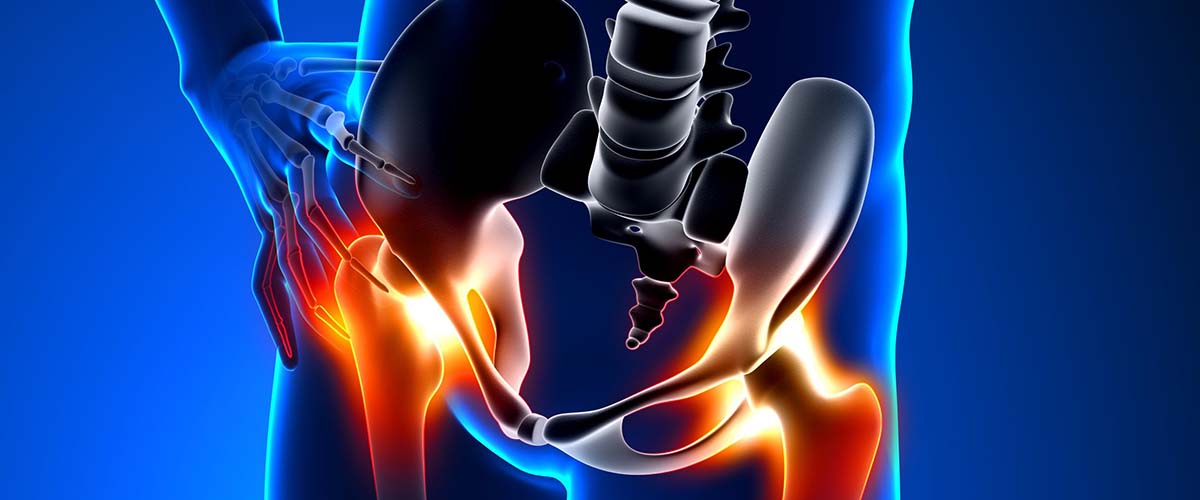
The labrum is a ring of tough cartilage around the rim of the hip socket. It deepens the socket and seals the joint. A labral tear can cause deep groin pain, clicking and catching, and it’s one of the most common hip problems in active people.
- Common symptoms: groin or front-of-hip pain, clicking, catching or locking, pain with sitting or pivoting
- Often caused by hip impingement (FAI), dysplasia, injury or wear
- Many patients improve with physical therapy and injections
- If pain persists, arthroscopic repair can restore the labrum through small incisions
What causes a hip labral tear?
- Hip impingement (FAI): extra bone on the ball or socket pinches the labrum with bending and rotation. This is the most common cause in young, active patients.
- Hip dysplasia: a shallow socket overloads the labrum.
- Injury: twisting, a fall or a sudden pivot.
- Wear: degenerative tears with age and early arthritis.
Symptoms
Typical symptoms are a deep, sharp or aching pain in the groin or front of the hip. Many patients also describe clicking, catching or locking, and stiffness. Sitting for a long time, getting out of a car, twisting and deep squats often make it worse. Some tears cause few symptoms.
Labral tear or hip flexor strain?
A hip flexor strain usually follows a specific injury, such as a sprint or kick, and steadily improves over a few weeks. Labral tear pain tends to linger or come and go for months, and often comes with clicking or catching. If groin pain has lasted longer than about 6 weeks, it’s worth an evaluation.
Diagnosis
Dr. Dold examines the hip with specific impingement tests and reviews X-rays to look for FAI, dysplasia and arthritis. An MRI, often an MR arthrogram, shows the labrum in detail. A numbing injection into the joint can confirm the joint is the source of pain.
Can a labral tear heal without surgery?
The labrum has a limited blood supply, so the tear itself usually doesn’t heal on its own. But symptoms often do improve. Many patients do well with:
- Physical therapy focused on hip and core strength and movement patterns
- Activity changes that avoid deep flexion and pinching positions
- Anti-inflammatory medicine
- An image-guided injection into the joint to calm inflammation and confirm the diagnosis
Surgery is considered when pain and mechanical symptoms persist despite several months of good non-surgical care.
Arthroscopic labral repair and reconstruction
Dr. Dold performs hip arthroscopy through a few small incisions using a camera and specialized instruments.
- Labral repair: the torn labrum is reattached to the rim of the socket with small suture anchors, restoring the hip’s seal. This is preferred when the tissue is healthy enough.
- Labral reconstruction: when the labrum is too damaged to repair, it can be rebuilt with a donor tissue graft (allograft).
- Treating the cause: any impingement bone (cam or pincer) is reshaped at the same time, so the new repair isn’t pinched again.
Dr. Dold has a research background in hip arthroscopy. It includes a published review of post-operative considerations after hip arthroscopy (JBJS Reviews, 2017) and studies of pain control for hip arthroscopy in The American Journal of Sports Medicine. He also lectured on the advanced treatment of acetabular labral tears at the 2019 DFW Sports Medicine Symposium.
Recovery after labral repair
| When | What to expect |
|---|---|
| Day of surgery | Outpatient surgery; home the same day |
| First weeks | Crutches with protected weight bearing for about 2 to 4 weeks, and a hip brace in the early weeks |
| 6 to 12 weeks | Normal walking, progressive strengthening in physical therapy |
| 3 to 6 months | Gradual return to running and sport, guided by strength testing |
Recovery timelines vary with the type of repair and any additional procedures.
“It had been about nine years and I had been dealing with pain coming from the hip. I was 42 years of age and had given up on ever running again… Dr. Dold diagnosed the problem with my hip… I had a labrum tear and a couple other issues… I was able to return to the training I desired. Actually, even harder training than ever. I am now 43 years old, going on 44, and have some competitions in line for road races, CrossFit, and Hyrox… Dr. Dold made this possible.”
— Sally I., Hip labral tear repair (Google review). Individual results vary.
Why see Dr. Dold
- Lectured on the advanced treatment of acetabular labral tears at the 2019 DFW Sports Medicine Symposium; hip arthroscopy research in AJSM and JBJS Reviews
- Board certified by the American Board of Orthopaedic Surgery, with subspecialty certification in Sports Medicine
- Fellow of the American Orthopaedic Association (FAOA), the American Academy of Orthopaedic Surgeons (FAAOS), the American College of Surgeons (FACS) and the Royal College of Surgeons of Canada (FRCSC)
- Sports medicine and arthroscopy fellowship at NYU Langone / Hospital for Joint Diseases; orthopedic residency at the University of Toronto
- Member of the International Society for Hip Arthroscopy (ISHA)
- D Magazine Best Doctors (Collin County), 2019–2026 · Rated 4.9 on Google
Frequently asked questions
Can a hip labral tear heal on its own?
The torn tissue usually doesn’t heal on its own because the labrum has a limited blood supply. Many people’s symptoms improve with physical therapy, activity changes and injections.
How do I know if I have a labral tear?
Deep groin pain with clicking, catching or locking, especially with sitting, pivoting or deep bending, suggests a labral tear. An exam and an MRI or MR arthrogram confirm it.
Is hip labral repair surgery worth it?
For patients whose pain persists despite good non-surgical care, arthroscopic repair, including correction of any impingement, can relieve pain and restore function. Results are generally best when significant arthritis is not present.
How long is recovery from hip labral repair?
Most patients use crutches for about 2 to 4 weeks, walk normally by 6 to 12 weeks, and return to sport around 3 to 6 months, depending on the procedure.
What is the difference between labral repair and reconstruction?
A repair reattaches your own labrum with suture anchors. A reconstruction replaces a labrum that is too damaged to repair with a donor tissue graft (allograft).
Medically reviewed by Andrew P. Dold, MD, FAOA, FAAOS, FACS, FRCSC. Last reviewed September 30, 2026. This page is general information, not medical advice.