







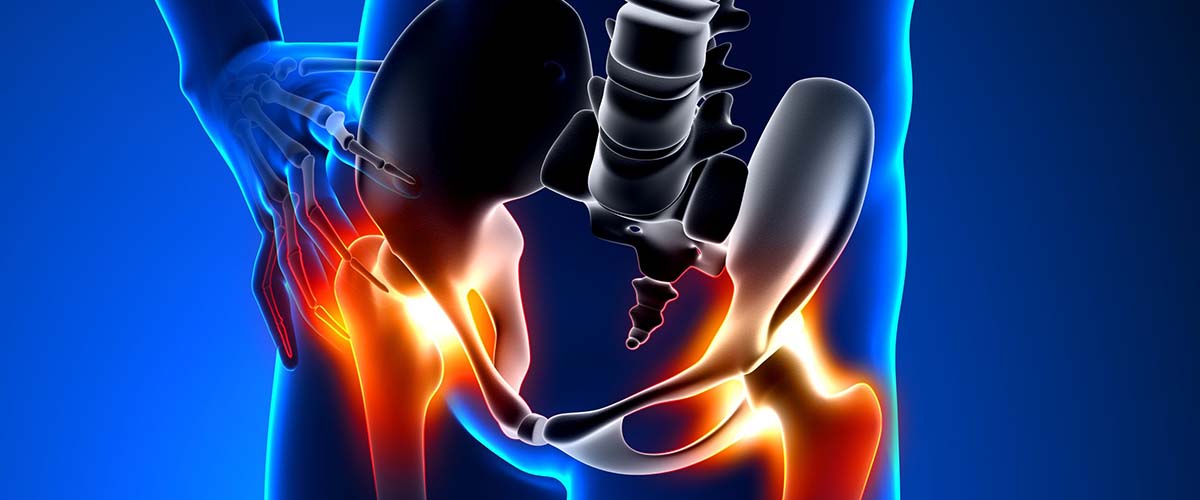
A “sports hernia” is one of the most common reasons athletes see Dr. Dold for groin pain. Doctors also call it athletic pubalgia, core muscle injury or inguinal-related groin pain. It is an injury where the lower abdominal muscles and the inner-thigh (adductor) muscles attach to the pubic bone. Despite the name, it usually is not a true hernia: there is no hole and no bulge.
Groin pain in athletes is hard to sort out because several problems can feel the same, and the hip joint itself is one of the most common hidden causes. Dr. Dold is a hip and sports medicine surgeon, so every evaluation looks at both the core muscles and the hip. The goal is a clear diagnosis, a plan that works, and a safe return to sport.
- Deep lower-abdominal or inner-groin pain with sprinting, cutting, kicking, skating or sit-ups
- Pain eases with rest and comes back as soon as you play again
- Common in hockey, soccer, football, rugby, baseball and other sports with twisting and kicking
- Hip impingement (FAI) or a labral tear is often present at the same time and must be checked
- Most athletes start with a focused rehab program; surgery is considered when rehab doesn’t work
- Same-day appointments available in Frisco
On this page
- What is a sports hernia?
- Who gets it
- Symptoms
- Is it my hip? FAI and labral tears
- Other causes of groin pain
- How Dr. Dold makes the diagnosis
- Treatment
- When surgery is considered
- Recovery and return to sport
- Prevention
- For trainers, therapists and physicians
- FAQ
- Research cited
What is a sports hernia?
Low in the front of the pelvis, the rectus abdominis (“six-pack” muscle) attaches to the top of the pubic bone, and the adductor longus (the main inner-thigh muscle) attaches just below it. Their tendons blend into a shared sheet of tissue over the pubic bone, sometimes called the rectus abdominis–adductor longus aponeurotic plate. Hard sprinting, cutting, kicking and skating pull the abdomen and thigh in opposite directions, with the pubic bone as the pivot point. Over time, or with one forceful movement, that attachment can strain, tear or weaken. The back wall of the groin canal (the inguinal canal) can also become weak or irritated.
Because no true hernia is usually found, specialists have moved away from the term “sports hernia.” A 2014 British Hernia Society consensus preferred “inguinal disruption.” The international Doha agreement and a 2026 European consensus group athletic groin pain into adductor-, iliopsoas-, inguinal-, pubic- and hip-related groin pain. You may see all of these names; they describe overlapping parts of the same region.
Who gets it
- Athletes in kicking, cutting and skating sports: soccer, ice hockey, football, rugby, lacrosse and baseball are the most common. In one long-term study of European professional soccer, hip and groin injuries made up 12–16% of all injuries each season.
- Mostly men, though it also occurs in women.
- Athletes with weak or tight hips: in professional hockey players, those whose adduction (inner-thigh) strength was less than 80% of their abduction strength were 17 times more likely to strain an adductor.
- Athletes with hip impingement (FAI): a stiff hip that can’t rotate fully may shift extra force onto the pubic bone and groin muscles.
Symptoms
- Deep, aching pain in the lower abdomen or inner groin, usually on one side, sometimes moving across to the other side
- Pain with sprinting, cutting, kicking, skating strides, sit-ups or getting out of bed
- Pain that may spread to the inner thigh, the pubic bone or, in men, the scrotum
- Sometimes pain with coughing or sneezing
- Pain that improves after days off and returns as soon as you play again
- No visible or touchable bulge (a bulge suggests a true inguinal hernia)
Is it my hip? Why hip impingement and labral tears matter
This is the most important question in an athlete with groin pain. Problems inside the hip joint, such as hip impingement (FAI) and labral tears, cause groin pain that can feel just like a sports hernia. Often both are present at once.
- In athletes who had sports hernia surgery, 86% had X-ray signs of hip impingement in at least one hip.
- In professional athletes having hip arthroscopy for FAI, 32% had already had sports hernia surgery, and none of them returned to their previous level after the sports hernia surgery alone. In another 39%, sports-hernia-type symptoms went away after the hip alone was treated.
- In athletes with both problems, treating only one often failed. Only 25% of hips treated first with sports hernia surgery returned to sport without limits, and 69% went on to need hip arthroscopy.
- In a review of 4,655 athletes having groin surgery, the most common diagnoses were hip impingement (32%) and athletic pubalgia (24%).
That is why Dr. Dold examines the hip in every athlete with groin pain, orders the right hip X-rays, and uses the MRI and, when needed, a diagnostic hip injection to sort out how much pain comes from the joint and how much from the core muscles. When the hip is part of the problem, he treats it, including hip arthroscopy when appropriate.
Other causes of groin pain
Several other problems can cause pain in the same area, alone or together with a sports hernia:
| Condition | Typical clues |
|---|---|
| Adductor (inner-thigh) strain or tendinopathy | Pain lower and more on the inner thigh; pain with squeezing the knees together |
| Osteitis pubis (pubic bone stress) | Pain right over the center of the pubic bone, often on both sides |
| Iliopsoas (hip flexor) strain or tendinopathy, snapping hip | Pain lifting the knee, kicking or getting into a car; sometimes a clunk |
| True inguinal or femoral hernia | A bulge, especially when standing, coughing or straining |
| Hip impingement (FAI), labral tear, hip dysplasia | Deep groin pain with sitting, deep squats or pivoting; clicking, catching or stiffness |
| Stress fracture of the femoral neck or pubic bone | Pain that builds with running, pain with hopping, pain at night; common in runners (see stress fractures) |
| Avulsion injuries in teens (for example the AIIS) | Sudden pain during a kick or sprint in a growing athlete |
| Pinched nerves (ilioinguinal, genitofemoral, obturator) or low back problems | Burning, numbness or tingling; pain that follows a nerve path |
| Urologic, gynecologic or abdominal problems | Pain not tied to activity, urinary symptoms, menstrual pattern, fever |
How Dr. Dold makes the diagnosis
There is no single test for a sports hernia. The diagnosis comes from putting together your story, a careful exam and imaging.
- History: where the pain is, what movements trigger it, how it started, your sport and position, prior treatment, and any symptoms that point elsewhere.
- Exam: the lower abdomen and groin canal, the pubic bone, the adductor and hip flexor tendons, resisted sit-up and squeeze tests, and a full hip exam, including hip rotation and impingement tests. The back and nerves are checked too.
- X-rays of the pelvis and hip, usually done the same day, to look at the shape of the hip (impingement or dysplasia), the pubic joint, arthritis, and bone injuries.
- MRI with a dedicated athletic pubalgia (core muscle) protocol. This specialized MRI looks closely at the pubic bone and the tendon attachments, and also images the hip joints. Ordering the right protocol matters: a routine pelvis MRI can miss these injuries.
- Diagnostic injection when needed. A numbing injection into the hip joint, the pubic joint or the adductor tendon, done with image guidance, shows which spot is causing the pain.
Treatment
Most athletes start with non-surgical care, and many improve. Dr. Dold works with your physical therapist and athletic trainer on a plan built around your sport.
- Relative rest: a short break from sprinting, cutting, kicking and sit-ups, while staying fit with activities that don’t hurt.
- Structured physical therapy, usually 6–12 weeks: progressive adductor and core strengthening (including the Copenhagen adduction exercise), hip mobility and pelvic control, then a graded return to running, cutting and sport drills. In a randomized trial, 23 athletes in an active strengthening program returned to sport without groin pain, compared with 4 in a passive treatment group, and the benefit was still present 8–12 years later.
- Medicine: a short course of anti-inflammatory medicine may help with pain during rehab.
- Image-guided injections: a targeted injection into the pubic joint or the adductor tendon attachment can calm pain so rehab can progress, and also helps confirm the source of pain.
- Treating the hip: if hip impingement or a labral tear is contributing, it is addressed as part of the plan, from targeted hip therapy and injections to hip arthroscopy.
When surgery is considered
Surgery is considered when a core muscle injury is confirmed and symptoms continue despite a full course of rehab, typically at least 6–12 weeks. Several procedures are used, such as repairing and reinforcing the rectus abdominis–adductor attachment, releasing or lengthening a tight adductor tendon, and laparoscopic or open reinforcement of the groin canal with mesh or sutures. Dr. Dold reviews the options with you and coordinates your surgical care.
- In a randomized trial of 60 athletes, 90% returned to sport 3 months after laparoscopic surgery, compared with 27% after non-surgical treatment.
- A randomized trial found laparoscopic and open repair similarly effective, with less early pain after the laparoscopic approach.
- When the hip is also involved, treating both problems gives athletes a much higher chance of returning to full sport.
Recovery and return to sport
- Non-surgical care: many athletes return within 6–12 weeks once they can sprint, cut and kick without pain. Long-standing cases can take longer.
- After core muscle surgery: return typically takes about 3–4 months in published series. In one series of 100 athletes, 96% of those reached returned to play at an average of 4.1 months.
- After hip arthroscopy for FAI: professional athletes in one study returned at an average of 5.9 months.
Dr. Dold uses objective milestones, not just time: no pain on the squeeze test, inner-thigh strength close to the other side, and a full sport-specific progression.
Prevention
Strong adductors protect the groin. In a cluster-randomized trial of 652 soccer players, a simple Copenhagen adduction program done 3 times a week in preseason and once a week in season lowered the risk of groin problems by 41%. Preseason screening of inner-thigh strength can also identify athletes at higher risk.
Clinician section
Workup and treatment algorithm for athletic groin pain
This section is for athletic trainers, physical therapists, team physicians and referring doctors. It summarizes the approach Dr. Dold uses and the evidence behind it. Patients are welcome to read it too.
1. Classify the groin pain
Use the Doha classification, reaffirmed by the 2026 ESSKA-EHPA-ESMA consensus: adductor-related, iliopsoas-related, inguinal-related, pubic-related and hip joint-related groin pain, plus “other.” Expect more than one entity: in 207 consecutive athletes, a third had multiple clinical entities at once. Rectus abdominis-related pain was found in 10%, almost always together with adductor-related pain.
2. History: points that change the workup
- Onset (acute vs insidious), mechanism (kick, cut, skate stride, sit-up), sport and position
- Location: above the inguinal ligament and lateral to the pubic tubercle (inguinal/core), on the pubic body (pubic/symphyseal), along the adductor origin, or deep anterior groin with sitting and flexion (hip joint)
- Mechanical hip symptoms (catching, clicking, painful deep flexion, pain with prolonged sitting or getting out of a car)
- Cough/sneeze pain, a bulge, scrotal or testicular radiation
- Red flags: night or rest pain, constitutional symptoms, inability to hop, neurologic symptoms, urinary or gynecologic symptoms
- Patient-reported outcome at baseline: the Copenhagen Hip and Groin Outcome Score (HAGOS)
3. Physical examination
The 2026 consensus recommends gait, Trendelenburg, palpation and resistance testing of the relevant muscle groups, hip range of motion, and the FADIR test.
| Test | How | Points toward |
|---|---|---|
| Inguinal canal palpation / scrotal invagination with cough or Valsalva | Palpate the superficial ring and posterior wall | Inguinal-related pain. Recognizable pain on invagination with Valsalva was the most common positive test (79%) in defined inguinal-related groin pain; posterior wall “softness” has very poor inter-examiner reliability (κ 0.01) |
| Rectus abdominis insertion palpation; resisted sit-up / resisted trunk flexion and oblique curl | Palpate just above and lateral to the pubic tubercle; resist trunk flexion | Core muscle (rectus abdominis) injury. Resistance tests were positive in 21–49% of inguinal-related cases |
| Adductor longus origin palpation; resisted adduction; adductor squeeze test at 0°, 45° and 90° hip flexion | Hand-held dynamometer or sphygmomanometer cuff between the knees | Adductor-related pain. Pain and lower strength on the squeeze test reliably separate athletes with and without groin pain; with a blood-pressure cuff the test is highly reproducible (ICC 0.89–0.92), and squeeze values are highest at 45° |
| Pubic symphysis palpation, springing | Direct pressure over the symphysis and pubic bodies | Pubic-related pain / osteitis pubis |
| Iliopsoas palpation, resisted hip flexion, modified Thomas test | Palpate below the inguinal ligament, lateral to the femoral artery | Iliopsoas-related pain |
| FADIR, FABER, internal rotation at 90° flexion, log roll | Compare sides; note pain reproduction and loss of rotation | Hip joint-related pain. FADIR is sensitive (pooled sensitivity 0.94–0.99) but not specific: a good screening test, not a diagnosis |
| Standing hernia exam; lumbar and neurologic screen | Cough impulse; dermatomes, nerve tension | True hernia; spine or nerve entrapment |
4. Imaging: what to order
| Study | Order as | What to look for |
|---|---|---|
| Radiographs (first line) | Standing AP pelvis; Dunn 45° or frog-leg lateral; false-profile view. Single-leg stance (flamingo) views if pubic instability is suspected | Cam morphology (alpha angle; values above roughly 50–55° are commonly used to define a cam), pincer signs (crossover, posterior wall and ischial spine signs, lateral center-edge angle), dysplasia (low center-edge angle), Tönnis grade and joint space, symphyseal sclerosis, erosions, widening or step-off, avulsion fragments, stress reaction |
| MRI, athletic pubalgia (core muscle) protocol | “MRI pelvis without contrast, athletic pubalgia / sports hernia protocol.” 1.5T or 3T. Large field-of-view coronal and axial fluid-sensitive sequences of the whole pelvis (both hips, sacroiliac joints), plus small field-of-view high-resolution oblique axial and sagittal images centered on the pubic symphysis | Rectus abdominis–adductor longus aponeurotic plate tear or detachment; the secondary (superior) cleft sign; asymmetric pubic bone marrow edema; adductor longus enthesopathy or tear; symphyseal degenerative change; true hernia; and, at the hips, labral tears, effusion, cam morphology, cartilage injury, stress fracture |
| Dedicated hip MRI or MR arthrogram | When hip joint-related pain is suspected and pubalgia-protocol images of the hip are not enough | Labral tear, chondral injury, cam/pincer morphology, ligamentum teres. In an older series, MR arthrography had an 8% false-negative rate versus 42% for conventional MRI of that era |
| Dynamic ultrasound | Operator-dependent; useful with an experienced musculoskeletal sonographer | Posterior inguinal wall deficiency/bulging with Valsalva, adductor and rectus tendon injury, true hernia. Posterior wall deficiency is also common in asymptomatic athletes |
| CT (low-dose, 3D) | Second line, typically for surgical planning | Three-dimensional mapping of cam and pincer morphology before hip arthroscopy |
Interpreting the MRI: compared with surgery, MRI was 68% sensitive and 100% specific for rectus abdominis injury and 86% sensitive and 89% specific for adductor tendon injury. The secondary cleft sign corresponded to the symptomatic side and was confirmed at symphyseal cleft injection. But findings are common without symptoms: up to 71% of asymptomatic soccer players had positive MRI findings, and bone marrow edema and adductor tendinopathy were much more frequent in soccer players than non-soccer athletes. Treat the athlete, not the scan: imaging must match the history and exam.
5. Diagnostic and therapeutic injections
- Intra-articular hip injection (image-guided, local anesthetic, with or without corticosteroid): relief was 90% accurate for intra-articular pathology confirmed at arthroscopy. Useful when hip and core findings coexist.
- Symphyseal cleft injection: diagnostic and therapeutic for pubic-related pain/osteitis pubis; may allow earlier return to competition.
- Adductor enthesis (entheseal pubic cleft) injection: relieves adductor origin pain and helps confirm the source. A single injection gave at least a year of relief when MRI showed no enthesopathy, but symptoms returned within weeks in 16 of 17 athletes with MRI enthesopathy, so it is a diagnostic or short-term tool in that group.
6. Treatment algorithm
- Hip joint-dominant (FAI/labral tear, positive intra-articular injection): hip arthroscopy discussion with Dr. Dold.
- Core muscle injury confirmed on exam and MRI: surgical repair referral (aponeurotic plate repair ± adductor release, or laparoscopic/open inguinal reinforcement).
- Both present: plan to address both, staged or together. Treating only one often fails.
7. Outcomes to discuss with athletes
- Rehab: active strengthening returned 23 vs 4 athletes to sport pain-free in a randomized trial, and the effect lasted 8–12 years.
- Surgery after failed rehab: 90% vs 27% return at 3 months (randomized trial); 96% return at a mean of 4.1 months in a series of aponeurotic plate repairs; in another series of 104 athletes, 80% returned to their pre-injury sport (90% of those who tried) at a mean 4.4-year follow-up, and only 4 needed another sports hernia procedure. Results are less predictable in non-athletes.
- Combined hip and core pathology: concurrent or eventual treatment of both was associated with an 89% unrestricted return to sport.
Why see Dr. Dold
- Board certified by the American Board of Orthopaedic Surgery, with subspecialty certification in Sports Medicine
- Fellow of the American Orthopaedic Association (FAOA), the American Academy of Orthopaedic Surgeons (FAAOS), the American College of Surgeons (FACS) and the Royal College of Surgeons of Canada (FRCSC)
- Sports medicine and arthroscopy fellowship at NYU Langone / Hospital for Joint Diseases; orthopedic residency at the University of Toronto
- Member of the International Society for Hip Arthroscopy (ISHA)
- D Magazine Best Doctors (Collin County), 2019–2026 · Rated 4.9 on Google
Frequently asked questions
What does a sports hernia feel like?
Deep pain in the lower abdomen or inner groin during sprinting, cutting, kicking, skating or sit-ups that eases with rest and returns with sport. There is usually no bulge.
Is a sports hernia a real hernia?
Usually not. It is an injury to the core muscles and tendons where they attach to the pubic bone, sometimes with weakness of the back wall of the groin canal, not a hole with a bulge.
Is my groin pain from my hip or a sports hernia?
It can be either, or both. Hip impingement (FAI) and labral tears are common in athletes with sports hernia symptoms, and treating only one problem often fails. Dr. Dold examines both the hip and the core and uses X-rays, MRI and, if needed, a diagnostic injection to tell them apart.
What MRI should I get for a sports hernia?
An MRI of the pelvis done with a dedicated athletic pubalgia (core muscle) protocol. It uses high-resolution images centered on the pubic bone and also images both hips. A routine pelvis or abdominal MRI can miss these injuries.
Can a sports hernia heal without surgery?
Many athletes improve with a short period of relative rest and a structured 6 to 12 week strengthening program, sometimes with an image-guided injection. Surgery is considered when a core muscle injury is confirmed and symptoms continue despite a full course of rehab.
How long until I can play again?
Many athletes return within 6 to 12 weeks with non-surgical care. After core muscle surgery, published series report return at about 3 to 4 months. Return is based on milestones such as a pain-free squeeze test and near-equal inner-thigh strength, not time alone.
Can a sports hernia be prevented?
Strengthening the inner-thigh muscles helps. A Copenhagen adduction exercise program lowered the risk of groin problems by 41% in a randomized trial of soccer players.
Do you see athletes with groin pain the same day?
Yes. Same-day appointments are available at our Frisco office. Call 469-850-0680 or request an appointment online.
Hurt playing sports? See how Dr. Dold, a sports medicine doctor in Frisco, treats athletes of every age and level.
Research cited on this page
- Weir A, Brukner P, Delahunt E, et al. Doha agreement meeting on terminology and definitions in groin pain in athletes. Br J Sports Med. 2015;49(12):768-774. PubMed
International agreement classifying groin pain in athletes as adductor-, iliopsoas-, inguinal- or pubic-related, hip-related, or other causes. - Paajanen H, Brinck T, Hermunen H, Airo I. Laparoscopic surgery for chronic groin pain in athletes is more effective than nonoperative treatment: a randomized clinical trial with magnetic resonance imaging of 60 patients with sportsman’s hernia (athletic pubalgia). Surgery. 2011;150(1):99-107. PubMed
In a randomized trial of 60 athletes, 90% returned to sport 3 months after surgery, compared with 27% after non-surgical treatment. - Larson CM, Pierce BR, Giveans MR. Treatment of athletes with symptomatic intra-articular hip pathology and athletic pubalgia/sports hernia: a case series. Arthroscopy. 2011;27(6):768-775. PubMed
In athletes with both a hip joint problem and athletic pubalgia, treating only one often failed; treating both allowed an unrestricted return to sport in 89% of hips. - Serafim TT, Oliveira ES, Migliorini F, et al. Return to sport after conservative versus surgical treatment for pubalgia in athletes: a systematic review. J Orthop Surg Res. 2022;17(1):484. PubMed
Surgery may allow an earlier return to sport, but conservative treatment should be tried before surgery. - Forlizzi JM, Ward MB, Whalen J, et al. Core Muscle Injury: Evaluation and Treatment in the Athlete. Am J Sports Med. 2023;51(4):1087-1095. PubMed
Review: pain just above the inguinal ligament with tenderness at the rectus abdominis insertion suggests a core muscle injury. - Kraeutler MJ, Mei-Dan O, Belk JW, et al. A Systematic Review Shows High Variation in Terminology, Surgical Techniques, Preoperative Diagnostic Measures, and Geographic Differences in the Treatment of Athletic Pubalgia/Sports Hernia/Core Muscle Injury/Inguinal Disruption. Arthroscopy. 2021;37(7):2377-2390.e2. PubMed
Systematic review: many diagnostic methods and surgical procedures are used for core muscle injury across surgical specialties. - Economopoulos KJ, Milewski MD, Hanks JB, et al. Radiographic evidence of femoroacetabular impingement in athletes with athletic pubalgia. Sports Health. 2014;6(2):171-7. PubMed
Study: 86% of patients having athletic pubalgia surgery had X-ray signs of hip impingement. - de Sa D, Hölmich P, Phillips M, et al. Athletic groin pain: a systematic review of surgical diagnoses, investigations and treatment. Br J Sports Med. 2016;50(19):1181-6. PubMed
Systematic review: intra- and extra-articular causes often overlap in athletes having groin surgery. - Coleman SH, Mayer SW, Tyson JJ, et al. The Epidemiology of Hip and Groin Injuries in Professional Baseball Players. Am J Orthop (Belle Mead NJ). 2016;45(3):168-75. PubMed
Professional baseball study: athletic pubalgia and intra-articular hip problems were usually treated surgically, while most other hip injuries were treated without surgery. - Hölmich P, Uhrskou P, Ulnits L, et al. Effectiveness of active physical training as treatment for long-standing adductor-related groin pain in athletes: randomised trial. Lancet. 1999;353(9151):439-43. PubMed
Randomized trial of 68 athletes: 23 in the active strengthening group returned to sport without groin pain, compared with 4 in the passive physiotherapy group. - Hölmich P, Nyvold P, Larsen K. Continued significant effect of physical training as treatment for overuse injury: 8- to 12-year outcome of a randomized clinical trial. Am J Sports Med. 2011;39(11):2447-51. PubMed
Long-term follow-up: the benefit of the exercise program for adductor-related groin pain lasted 8 to 12 years. - Hölmich P, Thorborg K, Nyvold P, et al. Does bony hip morphology affect the outcome of treatment for patients with adductor-related groin pain? Outcome 10 years after baseline assessment. Br J Sports Med. 2014;48(16):1240-4. PubMed
Randomized trial follow-up: hip shape related to impingement or dysplasia did not prevent success of the exercise program. - Jansen JA, Mens JM, Backx FJ, et al. Treatment of longstanding groin pain in athletes: a systematic review. Scand J Med Sci Sports. 2008;18(3):263-74. PubMed
Systematic review: active strengthening outperforms passive therapy for long-standing groin pain; surgery may help inguinal-related cases. - Almeida MO, Silva BN, Andriolo RB, et al. Conservative interventions for treating exercise-related musculotendinous, ligamentous and osseous groin pain. Cochrane Database Syst Rev. 2013;2013(6):CD009565. PubMed
Cochrane review: evidence is insufficient to recommend a specific conservative treatment; active exercise has the strongest support. - Weir A, Jansen JA, van de Port IG, et al. Manual or exercise therapy for long-standing adductor-related groin pain: a randomised controlled clinical trial. Man Ther. 2011;16(2):148-54. PubMed
Randomized trial: a multimodal program allowed quicker return to sport than exercise alone. - Jørgensen SG, Öberg S, Rosenberg J. Treatment of longstanding groin pain: a systematic review. Hernia. 2019;23(6):1035-1044. PubMed
Systematic review: surgery returned patients to activity, reduced pain and satisfied patients more than conservative care for longstanding inguinal-related groin pain. - Paajanen H, Montgomery A, Simon T, et al. Systematic review: laparoscopic treatment of long-standing groin pain in athletes. Br J Sports Med. 2015;49(12):814-8. PubMed
Systematic review: laparoscopic surgery for athlete groin pain is increasingly common, with no technique clearly favored. - Sheen AJ, Montgomery A, Simon T, et al. Randomized clinical trial of open suture repair versus totally extraperitoneal repair for treatment of sportsman’s hernia. Br J Surg. 2019;106(7):837-844. PubMed
Randomized trial: laparoscopic (TEP) and open repair were similarly effective, with less early pain after TEP. - Caudill P, Nyland J, Smith C, et al. Sports hernias: a systematic literature review. Br J Sports Med. 2008;42(12):954-64. PubMed
Systematic review: laparoscopic repair allowed faster recovery than open repair. - Harøy J, Clarsen B, Wiger EG, et al. The Adductor Strengthening Programme prevents groin problems among male football players: a cluster-randomised controlled trial. Br J Sports Med. 2019;53(3):150-157. PubMed
Cluster randomized trial: the Adductor Strengthening Programme (Copenhagen adduction) reduced the risk of groin problems by 41% in soccer players. - Alsirhani AA, Muaidi QI, Nuhmani S, et al. The effectiveness of the Copenhagen adduction exercise on improving eccentric hip adduction strength among soccer players with groin injury: a randomized controlled trial. Phys Sportsmed. 2024;52(5):497-506. PubMed
Randomized trial: adding the Copenhagen adduction exercise to rehabilitation improved adductor strength and reduced pain. - Farrell SG, Hatem M, Bharam S. Acute Adductor Muscle Injury: A Systematic Review on Diagnostic Imaging, Treatment, and Prevention. Am J Sports Med. 2023;51(13):3591-3603. PubMed
Systematic review: partial adductor injuries returned to play in 1 to 7 weeks with physical therapy. - Schöberl M, Prantl L, Loose O, et al. Non-surgical treatment of pubic overload and groin pain in amateur football players: a prospective double-blinded randomised controlled study. Knee Surg Sports Traumatol Arthrosc. 2017;25(6):1958-1966. PubMed
Randomized trial: non-surgical care with shockwave therapy helped athletes with pubic overload return to football within 3 months. - Hölmich P, Weir A, Papadopoulou T, et al. Hip and groin pain in physically active adults with a focus on terminology, clinical examination and imaging: A formal ESSKA-EHPA-ESMA Consensus. Knee Surg Sports Traumatol Arthrosc. 2026;34(10):3844-3855. PubMed
2026 European consensus (57 specialists, 22 countries): recommended terms are adductor-, iliopsoas-, inguinal-, pubic- and hip joint-related groin pain; exam should include gait, Trendelenburg, palpation and resistance tests, hip motion and FADIR; X-rays or ultrasound first, with MRI, CT and diagnostic hip injections second line. - Sheen AJ, Stephenson BM, Lloyd DM, et al. ‘Treatment of the sportsman’s groin’: British Hernia Society’s 2014 position statement based on the Manchester Consensus Conference. Br J Sports Med. 2014;48(14):1079-87. PubMed
British Hernia Society consensus: “inguinal disruption” preferred over “sportsman's hernia” because no true hernia exists; tailored physiotherapy first, with a multidisciplinary approach. - Hölmich P. Long-standing groin pain in sportspeople falls into three primary patterns, a “clinical entity” approach: a prospective study of 207 patients. Br J Sports Med. 2007;41(4):247-52; discussion 252. PubMed
In 207 athletes, adductor-related pain was the main pattern in 58%, iliopsoas in 36%, and rectus abdominis in 10% (nearly always with adductor pain); a third had more than one pattern. - Meyers WC, Foley DP, Garrett WE, et al. Management of severe lower abdominal or inguinal pain in high-performance athletes. PAIN (Performing Athletes with Abdominal or Inguinal Neuromuscular Pain Study Group). Am J Sports Med. 2000;28(1):2-8. PubMed
Of 157 athletes with no prior surgery, 97% returned to their previous level after pelvic floor repair; 38 other problems, including severe hip problems, were found during evaluation; results were less predictable in non-athletes. - Meyers WC, McKechnie A, Philippon MJ, et al. Experience with “sports hernia” spanning two decades. Ann Surg. 2008;248(4):656-65. PubMed
Two decades of experience with 8,490 patients: injuries involve the abdominal and adductor attachments on both sides of the pubic symphysis, and MRI improved diagnosis of both hip and non-hip causes. - Werner J, Hägglund M, Waldén M, et al. UEFA injury study: a prospective study of hip and groin injuries in professional football over seven consecutive seasons. Br J Sports Med. 2009;43(13):1036-40. PubMed
European professional soccer, 7 seasons: hip and groin injuries made up 12-16% of all injuries; adductor-related injuries were the most common. - Tyler TF, Nicholas SJ, Campbell RJ, et al. The association of hip strength and flexibility with the incidence of adductor muscle strains in professional ice hockey players. Am J Sports Med. 2001;29(2):124-8. PubMed
NHL players: those with adduction strength below 80% of abduction strength were 17 times more likely to sustain an adductor strain. - Hammoud S, Bedi A, Magennis E, et al. High incidence of athletic pubalgia symptoms in professional athletes with symptomatic femoroacetabular impingement. Arthroscopy. 2012;28(10):1388-95. PubMed
Professional athletes having arthroscopy for FAI: 32% had prior sports hernia surgery and none returned to their previous level after that surgery alone; 39% had sports hernia symptoms resolve with FAI surgery alone. - Thorborg K, Hölmich P, Christensen R, et al. The Copenhagen Hip and Groin Outcome Score (HAGOS): development and validation according to the COSMIN checklist. Br J Sports Med. 2011;45(6):478-91. PubMed
Development and validation of the Copenhagen Hip and Groin Outcome Score (HAGOS), a patient questionnaire for hip and groin problems. - Thorborg K, Reiman MP, Weir A, et al. Clinical Examination, Diagnostic Imaging, and Testing of Athletes With Groin Pain: An Evidence-Based Approach to Effective Management. J Orthop Sports Phys Ther. 2018;48(4):239-249. PubMed
Clinical commentary: an evidence-based approach to history, examination, imaging, testing and management of athletes with groin pain. - Heijboer WMP, Vuckovic Z, Weir A, et al. Clinical examination for athletes with inguinal-related groin pain: interexaminer reliability and prevalence of positive tests. BMJ Open Sport Exerc Med. 2023;9(1):e001498. PubMed
In inguinal-related groin pain, recognisable pain on scrotal invagination with Valsalva was positive in 79%; reliability of palpating posterior wall softness was very poor (kappa 0.01). - Delahunt E, McEntee BL, Kennelly C, et al. Intrarater reliability of the adductor squeeze test in gaelic games athletes. J Athl Train. 2011;46(3):241-5. PubMed
The adductor squeeze test with a blood-pressure cuff was highly reproducible (ICC 0.89-0.92); values were highest at 45 degrees of hip flexion. - Mosler AB, Agricola R, Weir A, et al. Which factors differentiate athletes with hip/groin pain from those without? A systematic review with meta-analysis. Br J Sports Med. 2015;49(12):810. PubMed
Meta-analysis: athletes with hip/groin pain have pain and lower strength on the adductor squeeze test, less hip internal rotation, and lower patient-reported scores. - Reiman MP, Goode AP, Cook CE, et al. Diagnostic accuracy of clinical tests for the diagnosis of hip femoroacetabular impingement/labral tear: a systematic review with meta-analysis. Br J Sports Med. 2015;49(12):811. PubMed
Meta-analysis: the FADIR test is highly sensitive (0.94-0.99) for FAI/labral tear but useful only for screening. - Nötzli HP, Wyss TF, Stoecklin CH, et al. The contour of the femoral head-neck junction as a predictor for the risk of anterior impingement. J Bone Joint Surg Br. 2002;84(4):556-60. PubMed
Introduced the alpha angle to measure the femoral head-neck shape; it averaged 74 degrees in impingement hips vs 42 degrees in controls. - Clohisy JC, Carlisle JC, Beaulé PE, et al. A systematic approach to the plain radiographic evaluation of the young adult hip. J Bone Joint Surg Am. 2008;90 Suppl 4(Suppl 4):47-66. PubMed
A systematic approach to X-ray evaluation of the young adult hip, including views and measurements for impingement and dysplasia. - Omar IM, Zoga AC, Kavanagh EC, et al. Athletic pubalgia and “sports hernia”: optimal MR imaging technique and findings. Radiographics. 2008;28(5):1415-38. PubMed
Describes the optimal MRI technique for athletic pubalgia, including large and small field-of-view sequences centered on the pubic symphysis. - Zoga AC, Kavanagh EC, Omar IM, et al. Athletic pubalgia and the “sports hernia”: MR imaging findings. Radiology. 2008;247(3):797-807. PubMed
Compared with surgery, MRI was 68% sensitive and 100% specific for rectus abdominis injury and 86% sensitive and 89% specific for adductor tendon injury; true hernias were rare. - Brennan D, O’Connell MJ, Ryan M, et al. Secondary cleft sign as a marker of injury in athletes with groin pain: MR image appearance and interpretation. Radiology. 2005;235(1):162-7. PubMed
The secondary cleft sign on MRI was confirmed at symphyseal cleft injection and matched the side of symptoms. - Branci S, Thorborg K, Nielsen MB, et al. Radiological findings in symphyseal and adductor-related groin pain in athletes: a critical review of the literature. Br J Sports Med. 2013;47(10):611-9. PubMed
Review: the four most consistent imaging findings are symphyseal degenerative change, adductor insertion pathology, pubic bone marrow edema and the secondary cleft sign. - Branci S, Thorborg K, Bech BH, et al. MRI findings in soccer players with long-standing adductor-related groin pain and asymptomatic controls. Br J Sports Med. 2015;49(10):681-91. PubMed
Up to 71% of asymptomatic soccer players had positive MRI findings; findings must be matched to the clinical exam. - Orchard JW, Read JW, Neophyton J, et al. Groin pain associated with ultrasound finding of inguinal canal posterior wall deficiency in Australian Rules footballers. Br J Sports Med. 1998;32(2):134-9. PubMed
Dynamic ultrasound found posterior inguinal wall deficiency in footballers with groin pain, but the finding was also present in some without symptoms. - Byrd JW, Jones KS. Diagnostic accuracy of clinical assessment, magnetic resonance imaging, magnetic resonance arthrography, and intra-articular injection in hip arthroscopy patients. Am J Sports Med. 2004;32(7):1668-74. PubMed
In hip arthroscopy patients, relief from an intra-articular anesthetic injection was 90% accurate for intra-articular pathology; MR arthrography had an 8% false-negative rate. - O’Connell MJ, Powell T, McCaffrey NM, et al. Symphyseal cleft injection in the diagnosis and treatment of osteitis pubis in athletes. AJR Am J Roentgenol. 2002;179(4):955-9. PubMed
Symphyseal cleft injection is useful for diagnosing and treating osteitis pubis in athletes and may allow earlier return to competition. - Schilders E, Bismil Q, Robinson P, et al. Adductor-related groin pain in competitive athletes. Role of adductor enthesis, magnetic resonance imaging, and entheseal pubic cleft injections. J Bone Joint Surg Am. 2007;89(10):2173-8. PubMed
A single adductor enthesis injection gave at least 1 year of relief when MRI showed no enthesopathy; 16 of 17 athletes with enthesopathy had symptoms return at a mean of 5 weeks. - Emblom BA, Mathis T, Aune K. Athletic Pubalgia Secondary to Rectus Abdominis-Adductor Longus Aponeurotic Plate Injury: Diagnosis, Management, and Operative Treatment of 100 Competitive Athletes. Orthop J Sports Med. 2018;6(9):2325967118798333. PubMed
100 athletes after rectus abdominis-adductor longus aponeurotic plate repair (after failing 6-12 weeks of conservative care): 96% of those reached returned to play at a mean of 4.1 months. - Rezaie N, Ithurburn MP, Powell MT, et al. Outcomes and Proportions of Subsequent Contralateral Sports Hernia Repair Following Primary Unilateral Repair. Am J Sports Med. 2024;52(3):653-659. PubMed
104 athletes after unilateral sports hernia repair: 80% returned to their pre-injury sport (90% of those who tried); only 4 needed a further sports hernia procedure.
Same-day appointments available. Dr. Dold accepts most major insurance plans, including Medicare and Tricare. Please call 469-850-0680 to confirm your coverage.
Medically reviewed by Andrew P. Dold, MD, FAOA, FAAOS, FACS, FRCSC. Last reviewed October 2026. This page is general information, not medical advice.