








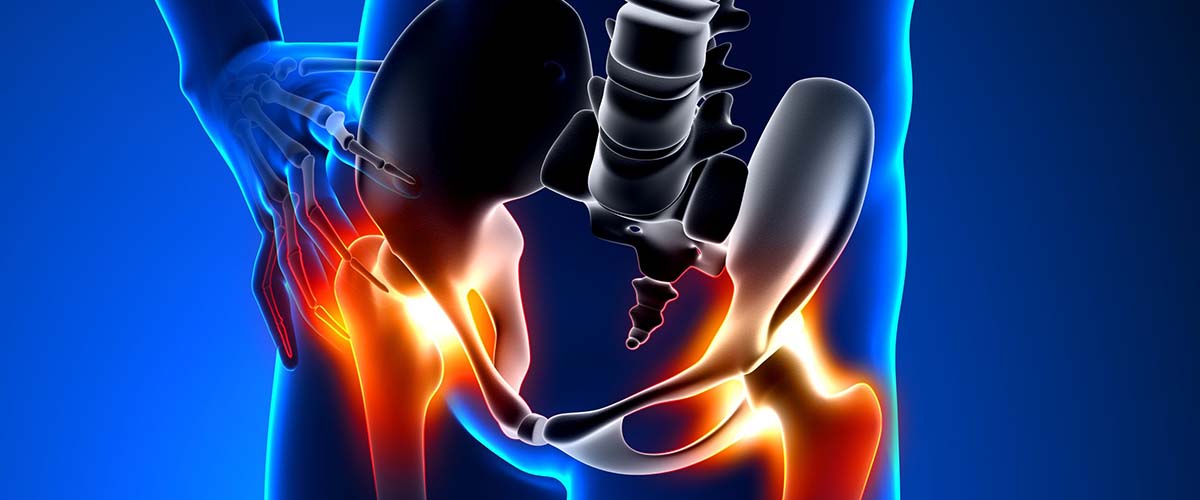
An anterior superior iliac spine (ASIS) avulsion is an injury in which a muscle pulls a small piece of bone off the front of the pelvis. The ASIS is the bony point you can feel at the front of your hip, near your belt line. It is mainly an injury of teenage athletes, whose growth plates are weaker than their muscles and tendons. Dr. Andrew Dold, a board-certified sports medicine surgeon in Frisco, Texas with subspecialty training in the hip, evaluates and treats hip and pelvic injuries in young athletes.
- Most common in adolescent athletes, especially boys, during sprinting, kicking and jumping
- Caused by a sudden, forceful pull of the sartorius (and tensor fasciae latae) muscle
- Often a sudden “pop” or sharp pain at the front of the hip
- Usually diagnosed with an X-ray
- Most heal with rest, crutches and gradual rehab; surgery is considered when the fragment is pulled far out of place
How does an ASIS avulsion happen?
Two muscles attach at or near the ASIS: the sartorius, a long muscle that crosses the front of the thigh, and the tensor fasciae latae. During a sudden, powerful movement, such as the start of a sprint, a hard kick, a jump or a quick change of direction, these muscles contract forcefully while the hip is stretched. In teenagers the growth plate (apophysis) at the ASIS has not yet fused and is the weakest link, so the bone pulls away instead of the muscle tearing. ASIS avulsions are seen in soccer, track and field (especially sprinting and hurdles), football, ice hockey and other sports with explosive running and kicking.
Symptoms
- A sudden “pop,” “crack” or sharp pain at the front of the hip during activity
- Pain and tenderness right over the bony point at the front of the pelvis
- Swelling or bruising in the area
- Pain when lifting the leg, walking or running; a limp
- Pain that improves with rest and worsens with exercise
How is it diagnosed?
A history of a sudden injury during sprinting or kicking, plus tenderness over the ASIS, strongly suggests the diagnosis. An X-ray of the pelvis usually confirms it and shows how far the bone fragment has moved. A CT or MRI scan is sometimes used to measure displacement more precisely, rule out other injuries, or plan surgery. Other causes of front-of-hip pain in young athletes, such as a hip muscle strain, an AIIS (rectus femoris) avulsion, a labral tear or athletic pubalgia, are considered as well.
Treatment
Non-surgical treatment (most patients)
Most ASIS avulsions, especially those with little displacement, heal well without surgery:
- Rest and crutches for a short period, weight bearing as comfortable
- Ice and pain control
- Positioning that relaxes the sartorius (for example, a slightly bent hip) early on
- Gradual physical therapy: restoring motion first, then strengthening, then running and sport-specific drills once pain-free and healing is seen
Surgery
Surgery may be recommended when the bone fragment is pulled far from its normal position (studies often use a threshold of about 1.5 to 2 cm), when there is ongoing pain or a painful nonunion, or for some high-level athletes after discussing pros and cons. The fragment is put back in place and held with one or more screws. Dr. Dold will explain whether surgery is worth considering for your child’s injury.
When can my child return to sports?
Return to sport depends on healing, pain and strength rather than a fixed date. In published studies, athletes commonly return in roughly 2 to 4 months. Returning too early risks re-injury, so the last phase of rehab focuses on sprinting, kicking and cutting under supervision.
What the research shows
- Who gets it: pelvic avulsion fractures occur in teenagers, usually between about 13 and 17, when the growth centers are weaker than the muscles pulling on them. In a cohort of over 700 fractures, sprinting and kicking were the most common mechanisms, with soccer, football and baseball the most common sports.
- Diagnosis: an X-ray usually shows the fragment, though these injuries are easily missed or mistaken for a muscle strain. Comparing both sides, and sometimes ultrasound or MRI, helps.
- Most heal without surgery: rest, crutches for comfort, positioning to relax the muscle involved, and a staged return to activity over several weeks to a few months lead to good outcomes in most ASIS and AIIS avulsions.
- When surgery helps: a meta-analysis of nearly 600 patients found higher return to sport with surgery (92% vs 80%) and recommended considering fixation when the fragment is displaced more than about 1.5 cm in athletes with high demands. Surgery may also be needed for a painful non-union, irritation of the nerve to the outer thigh, or bone overgrowth causing hip impingement.
Why see Dr. Dold
- Board certified by the American Board of Orthopaedic Surgery, with subspecialty certification in Sports Medicine
- Sports medicine and arthroscopy fellowship at NYU Langone / Hospital for Joint Diseases; orthopedic residency at the University of Toronto
- Fellow of the American College of Surgeons (FACS), the American Academy of Orthopaedic Surgeons (FAAOS), the American Orthopaedic Association (FAOA) and the Royal College of Surgeons of Canada (FRCSC)
- Published research on hip arthroscopy, including Post-operative Considerations Following Hip Arthroscopy (JBJS Reviews, 2017) and studies in the American Journal of Sports Medicine; member of the International Society for Hip Arthroscopy (ISHA)
- Team physician and surgical consultant to Rugby Canada; has cared for professional and Olympic athletes from the NFL, NBA, NHL, MLS, PGA Tour, Major League Rugby and USA Gymnastics
- D Magazine Best Doctors (Collin County), 2019–2026 · Rated 4.9 on Google
Frequently asked questions
What is an ASIS avulsion fracture?
It is an injury in which the sartorius muscle pulls a small piece of bone off the anterior superior iliac spine, the bony point at the front of the pelvis. It mainly happens in teenage athletes.
How long does an ASIS avulsion take to heal?
Most heal without surgery. Athletes commonly return to sport in roughly 2 to 4 months, depending on healing, pain and strength.
Does an ASIS avulsion need surgery?
Usually not. Surgery may be considered when the fragment is pulled far out of place, often more than about 1.5 to 2 cm, or when it does not heal and remains painful.
Can you walk with an ASIS avulsion?
Many patients can walk with a limp, and crutches are often used for a short period for comfort while the bone begins to heal.
Why do teenagers get avulsion fractures?
In teenagers the growth plates where muscles attach to the pelvis are not yet fused and are weaker than the muscle and tendon, so a forceful pull can separate the bone at the growth plate.
Which sports cause ASIS avulsions?
They are most common in sports with sprinting, kicking and jumping, such as soccer, track and field, football and ice hockey.
Research cited on this page
- Eberbach H, Hohloch L, Feucht MJ, et al. Operative versus conservative treatment of apophyseal avulsion fractures of the pelvis in the adolescents: a systematical review with meta-analysis of clinical outcome and return to sports. BMC Musculoskelet Disord. 2017;18(1):162. PubMed
In 596 adolescents, most were treated without surgery. Return to sport was 80% after non-surgical care and 92% after surgery; surgery was suggested mainly for fragments displaced more than 15 mm in high-demand athletes. - Molina LL, Block AM, Carsen S, et al. Outcomes of conservative versus surgical treatment of adolescent pelvic and hip avulsion fractures: a systematic review and meta-analysis. J Pediatr Orthop. 2026 (published online ahead of print). PubMed
In 852 avulsion fractures, 87% were treated without surgery. ASIS fractures displaced more than 15 mm did well either way, with a faster return to sport after surgery. - Ferraro SL, Batty M, Heyworth BE, et al. Acute Pelvic and Hip Apophyseal Avulsion Fractures in Adolescents: A Summary of 719 Cases. J Pediatr Orthop. 2023;43(4):204-210. PubMed
Large cohort of 719 fractures: the AIIS (33%), ASIS (31%) and ischial tuberosity (19%) were most common; running and kicking were the usual mechanisms, mostly in soccer. - Di Maria F, Testa G, Sammartino F, et al. Treatment of avulsion fractures of the pelvis in adolescent athletes: A scoping literature review. Front Pediatr. 2022;10:947463. PubMed
Scoping review: the ASIS was the most common site; surgery had fewer complications and better return to prior activity for major displacement. - Anduaga I, Seijas R, Pérez-Bellmunt A, et al. Anterior Iliac Spine Avulsion Fracture Treatment Options in Young Athletes. J Invest Surg. 2020;33(2):159-163. PubMed
Systematic review: anterior iliac spine avulsions are rare and most (93%) are treated without surgery. - Nauta HJA, van der Made AD, Tol JL, et al. Satisfactory clinical outcome of operative and non-operative treatment of avulsion fracture of the hamstring origin with treatment selection based on extent of displacement: a systematic review. Knee Surg Sports Traumatol Arthrosc. 2021;29(6):1813-1821. PubMed
Systematic review: both operative and non-operative treatment of anterior iliac spine avulsions gave satisfactory outcomes and high return to sport. - Yeager KC, Silva SR, Richter DL. Pelvic Avulsion Injuries in the Adolescent Athlete. Clin Sports Med. 2021;40(2):375-384. PubMed
Review of pelvic avulsion injuries in adolescent athletes: presentation, imaging and management. - McKinney BI, Nelson C, Carrion W. Apophyseal avulsion fractures of the hip and pelvis. Orthopedics. 2009;32(1):42. PubMed
Review: apophyseal avulsion fractures can be easily missed; most heal with conservative care. - Moeller JL. Pelvic and hip apophyseal avulsion injuries in young athletes. Curr Sports Med Rep. 2003;2(2):110-5. PubMed
Review: hip apophyseal injuries are often unrecognized, can be very painful and may take months to heal. - White KK, Williams SK, Mubarak SJ. Definition of two types of anterior superior iliac spine avulsion fractures. J Pediatr Orthop. 2002;22(5):578-82. PubMed
Study: two types of ASIS avulsion, from the sartorius or the tensor fascia lata origin. - Hayashi S, Nishiyama T, Fujishiro T, et al. Avulsion-fracture of the anterior superior iliac spine with meralgia paresthetica: a case report. J Orthop Surg (Hong Kong). 2011;19(3):384-5. PubMed
Case report: ASIS avulsion with irritation of the lateral femoral cutaneous nerve treated with fixation. - Ali E, Khanduja V. Adolescent avulsion injuries of the pelvis: a case study and review of the literature. Orthop Nurs. 2015;34(1):21-6, quiz 27-8. PubMed
Review: adolescent avulsion injuries of the pelvis and their management. - Vasiliadis AV, Tsioulas P, Alvanos D, et al. Avulsion fracture of the ischial tuberosity: A surgical dilemma. Clin Case Rep. 2021;9(3):1814-1815. PubMed
Study: surgical treatment can achieve lasting results and a rapid return to sport. - Nakano N, Lisenda L, Khanduja V. Arthroscopic excision of heterotopic ossification in the rectus femoris muscle causing extra-articular anterior hip impingement. SICOT J. 2018;4:41. PubMed
Case report: heterotopic bone after AIIS avulsion causing subspine impingement treated arthroscopically. - Vadhera AS, Knapik DM, Gursoy S, et al. Avulsion fractures of the ischial tuberosity in the pediatric athlete: a systematic review and return to sport analysis. J Pediatr Orthop B. 2022;31(5):508-516. PubMed
Systematic review (ischial tuberosity): misdiagnosis was common (39%), and complications occurred in 16% treated surgically vs 33% conservatively. - Materne O, Chamari K, Farooq A, et al. Shedding light on incidence and burden of physeal injuries in a youth elite football academy: A 4-season prospective study. Scand J Med Sci Sports. 2022;32(1):165-176. PubMed
Football academy study: growth plate and apophyseal injuries caused a quarter of all time lost, mostly in the lower limb.
Medically reviewed by Andrew P. Dold, MD, FAOA, FAAOS, FACS, FRCSC. Last reviewed October 2026. This page is general information, not medical advice. Individual results vary.