








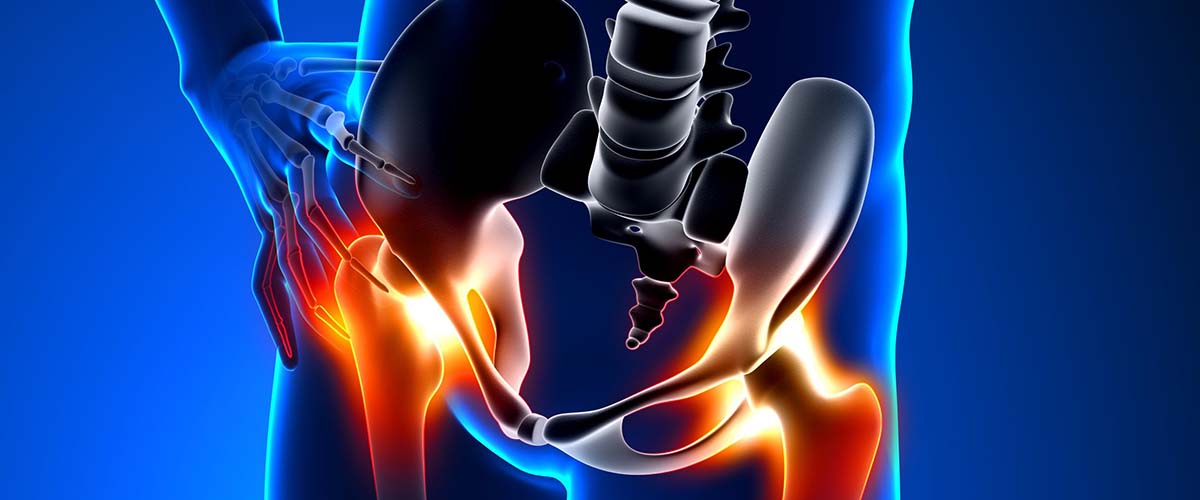
Osteitis pubis is painful stress and inflammation of the pubic symphysis, the joint where the two pubic bones meet at the front of the pelvis. In athletes it is a form of pubic-related groin pain,1 usually from repeated kicking, sprinting, cutting and twisting that pull the adductor and abdominal muscles in opposite directions across the joint. It is more common in men,3 and can also follow pregnancy, childbirth or pelvic surgery.6 Recovery is usually good, but it can take time.3
- Pain over the pubic bone and inner groin, worse with running, kicking, sit-ups and changing direction
- Common in soccer, football, hockey and other kicking and cutting sports
- MRI often shows pubic bone edema, but so do many athletes without pain13,15
- Active strengthening and load management are the foundation5,18,21
- Most athletes return to sport without surgery22
Causes and risk factors
- Repetitive loading of the pubic symphysis from kicking, sprinting and cutting
- Muscle imbalance between the adductors and the abdominal wall
- Reduced hip rotation, which was found in athletes with pubic bone stress injury11 and can relate to hip impingement
- Pregnancy, childbirth or pelvic surgery6
- Rarely, infection of the symphysis, which can mimic osteitis pubis8
Preseason groin pain and pubic tenderness were associated with groin pain that limited training in Australian football players.10
Symptoms
- Pain over the front of the pubic bone, often spreading into the inner thighs or lower abdomen
- Pain with running, kicking, sit-ups, getting out of a car or rolling over in bed
- Tenderness directly over the pubic symphysis
- Pain that builds gradually over weeks
Diagnosis
Groin pain in athletes has several overlapping causes. Using the Doha agreement, Dr. Dold classifies it as adductor-, iliopsoas-, inguinal- or pubic-related, hip-related, or other,1 because the treatment differs. He also checks for athletic pubalgia (sports hernia) and hip problems.
- Examination: tenderness over the symphysis and pain provocation tests, such as squeezing the knees together against resistance.12
- X-rays may show irregularity or widening of the joint in long-standing cases.
- MRI: pubic bone marrow edema was found in 77% of footballers with groin pain and pubic tenderness.9 However, it is also common in athletes without symptoms: 47% of symptom-free players had it,13 and pubic findings appeared in 75% to 85% of hips regardless of symptoms.14,15 MRI findings must be matched to the exam;16 imaging also helps rule out other causes.4
Rehabilitation
Conservative, individualized, multimodal rehabilitation is the first-line treatment and works for most athletes.5 High-quality trials specific to osteitis pubis are lacking,17 but research on related groin pain supports active rehab:
- In a randomized trial of adductor-related groin pain, an active strengthening program returned 23 athletes to sport pain-free, compared with 4 with passive therapy.18
- A multimodal program with manual therapy returned athletes to sport faster than exercise alone (12.8 vs 17.3 weeks).19,20
- For pubic-related groin pain, rehabilitation returned athletes to play faster than surgery (10.5 vs 23.1 weeks).21
- The Copenhagen adduction exercise increased hip adductor strength by 35.7%.30
A typical program progresses from relative rest and pain control to adductor and core strengthening, hip mobility, running, then sport-specific cutting and kicking. With conservative management of pubic bone stress injury, 89% returned to sport the next season and all by the second season.22
Injections and other treatments
- Corticosteroid injection into the symphysis helped most college athletes return to sport quickly,24 and after image-guided injection, 89% improved, with relief lasting at least 6 months in 58%.25
- Shockwave therapy: in a randomized trial of football players with osteitis pubis, adding shockwave led to earlier pain relief and return to play.23
- Anti-inflammatory medicines help many minor cases.7
Evidence for these treatments in athletes comes mostly from case series.17
Surgery
Surgery is reserved for the few patients who don’t improve after a long, well-run program.5,28 Options include curettage of the joint, wedge resection, mesh reinforcement and fusion.28 After surgery to the pubic symphysis, 84% returned to play at or above their pre-injury level, though study quality was low.26 In a series of long-standing cases, all improved but only 6 of 10 were satisfied.27 In non-athletes, surgery is rarely needed.29
Prevention and recovery
Adductor and core strengthening, gradual training increases and attention to hip mobility may lower risk; a groin injury prevention program reduced injuries by 31%, though this was not statistically significant.31 Recovery is usually measured in weeks to months, and long-standing cases can take longer.3,22 Dr. Dold reviews your expected timeline based on your sport and symptoms.
Frequently asked questions
Is osteitis pubis the same as a sports hernia?
No. Osteitis pubis involves the pubic symphysis joint and bone; a sports hernia (athletic pubalgia) involves the abdominal wall and its attachments. They can occur together, and the treatment differs.
Will an MRI confirm osteitis pubis?
MRI often shows bone edema at the pubis, but many athletes without pain show the same finding, so the diagnosis depends on matching the MRI with your symptoms and exam.
Do I need to stop playing?
Usually you need a period of reduced load and a structured rehab program. Playing through worsening pain tends to prolong recovery.
How long does osteitis pubis take to heal?
Many athletes return within a few months with active rehab; long-standing cases can take longer. Most return without surgery.
Can an injection help?
A cortisone injection into the symphysis can speed return to sport in some athletes, usually alongside rehab rather than instead of it.
Research cited on this page
- Weir A, Brukner P, Delahunt E, et al. Doha agreement meeting on terminology and definitions in groin pain in athletes. Br J Sports Med. 2015;49(12):768-74. PubMed
The Doha agreement classifies groin pain in athletes as adductor-, iliopsoas-, inguinal- or pubic-related, hip-related, or other. - Hiti CJ, Stevens KJ, Jamati MK, et al. Athletic osteitis pubis. Sports Med. 2011;41(5):361-76. PubMed
Athletic osteitis pubis is usually treated conservatively first; injections and surgery have been reported with varying effectiveness. - Johnson R. Osteitis pubis. Curr Sports Med Rep. 2003;2(2):98-102. PubMed
Osteitis pubis appears more common in men; the prognosis for full recovery is good, although recovery is lengthy. - Beatty T. Osteitis pubis in athletes. Curr Sports Med Rep. 2012;11(2):96-8. PubMed
Imaging helps rule out other causes of groin pain and confirm osteitis pubis; treatment is usually rest, rehab and medication. - Via AG, Frizziero A, Finotti P, et al. Management of osteitis pubis in athletes: rehabilitation and return to training – a review of the most recent literature. Open Access J Sports Med. 2019;10:1-10. PubMed
Conservative, individualized multimodal rehabilitation is first-line and works for most athletes; surgery is reserved for resistant cases. - Vincent C. Osteitis pubis. J Am Board Fam Pract. 1993;6(5):492-6. PubMed
Osteitis pubis can follow pelvic surgery, childbirth or athletics; it causes pubic tenderness and pain with hip movement. - Lentz SS. Osteitis pubis: a review. Obstet Gynecol Surv. 1995;50(4):310-5. PubMed
Most minor cases respond to anti-inflammatory treatment and rest; surgery is rarely needed. - Michiels E, Knockaert DC, Vanneste SB. Infectious osteitis pubis. Neth J Med. 1990;36(5-6):297-300. PubMed
Infection of the pubic symphysis can mimic osteitis pubis and was confirmed by biopsy in a case that failed to improve. - Verrall GM, Slavotinek JP, Fon GT. Incidence of pubic bone marrow oedema in Australian rules football players: relation to groin pain. Br J Sports Med. 2001;35(1):28-33. PubMed
In Australian football players with groin pain and pubic tenderness, 77% had pubic bone marrow edema on MRI. - Slavotinek JP, Verrall GM, Fon GT, et al. Groin pain in footballers: the association between preseason clinical and pubic bone magnetic resonance imaging findings and athlete outcome. Am J Sports Med. 2005;33(6):894-9. PubMed
Preseason groin pain and pubic bone tenderness were associated with groin pain that limited training. - Verrall GM, Hamilton IA, Slavotinek JP, et al. Hip joint range of motion reduction in sports-related chronic groin injury diagnosed as pubic bone stress injury. J Sci Med Sport. 2005;8(1):77-84. PubMed
Reduced hip rotation was found in athletes with pubic bone stress injury. - Verrall GM, Slavotinek JP, Barnes PG, et al. Description of pain provocation tests used for the diagnosis of sports-related chronic groin pain: relationship of tests to defined clinical (pain and tenderness) and MRI (pubic bone marrow oedema) criteria. Scand J Med Sci Sports. 2005;15(1):36-42. PubMed
Three pain provocation tests, including the bilateral adductor test, help assess chronic groin pain in athletes. - Paajanen H, Hermunen H, Ristolainen L, et al. Long-standing groin pain in contact sports: a prospective case-control and MRI study. BMJ Open Sport Exerc Med. 2019;5(1):e000507. PubMed
Pubic bone marrow edema was about as common in symptom-free players (47%) as in players with groin pain (53%). - Robinson P, Grainger AJ, Hensor EM, et al. Do MRI and ultrasound of the anterior pelvis correlate with, or predict, young football players’ clinical findings? A 4-year prospective study of elite academy soccer players. Br J Sports Med. 2015;49(3):176-82. PubMed
MRI findings at the pubis did not differ between athletes with and without a history of groin injury. - Buckthorpe E, Heerey JJ, Entwistle T, et al. What is the prevalence of extra-articular and intra-articular magnetic resonance imaging findings in football players with and without hip and/or groin pain? A cross-sectional study of 166 football players. Hip Int. 2026;36(3):486-492. PubMed
Pubic findings on MRI were seen in 75% to 85% of hips regardless of symptoms. - Ooi MWX, Marzetti M, Rowbotham E, et al. MRI findings in athletic groin pain: correlation of imaging with history and examination in symptomatic and asymptomatic athletes. Skeletal Radiol. 2025;54(4):841-850. PubMed
Pubic subchondral bone edema and capsule tears were more common in athletes with groin pain. - Choi H, McCartney M, Best TM. Treatment of osteitis pubis and osteomyelitis of the pubic symphysis in athletes: a systematic review. Br J Sports Med. 2011;45(1):57-64. PubMed
Evidence for osteitis pubis treatment in athletes is limited to case reports and series; no randomized trials exist. - Hölmich P, Uhrskou P, Ulnits L, et al. Effectiveness of active physical training as treatment for long-standing adductor-related groin pain in athletes: randomised trial. Lancet. 1999;353(9151):439-43. PubMed
In a randomized trial of adductor-related groin pain, active strengthening returned 23 athletes to sport pain-free vs 4 with passive therapy. - Weir A, Jansen JA, van de Port IG, et al. Manual or exercise therapy for long-standing adductor-related groin pain: a randomised controlled clinical trial. Man Ther. 2011;16(2):148-54. PubMed
A multimodal program with manual therapy returned athletes to sport faster than exercise therapy alone (12.8 vs 17.3 weeks). - Serner A, van Eijck CH, Beumer BR, et al. Study quality on groin injury management remains low: a systematic review on treatment of groin pain in athletes. Br J Sports Med. 2015;49(12):813. PubMed
Active exercise improves success over passive treatment for adductor-related groin pain, though study quality is limited. - King E, Ward J, Small L, et al. Athletic groin pain: a systematic review and meta-analysis of surgical versus physical therapy rehabilitation outcomes. Br J Sports Med. 2015;49(22):1447-51. PubMed
For pubic-related groin pain, rehabilitation returned athletes to play faster than surgery (10.5 vs 23.1 weeks). - Verrall GM, Slavotinek JP, Fon GT, et al. Outcome of conservative management of athletic chronic groin injury diagnosed as pubic bone stress injury. Am J Sports Med. 2007;35(3):467-74. PubMed
With conservative management of pubic bone stress injury, 89% returned to sport the next season and all by the second season. - Schöberl M, Prantl L, Loose O, et al. Non-surgical treatment of pubic overload and groin pain in amateur football players: a prospective double-blinded randomised controlled study. Knee Surg Sports Traumatol Arthrosc. 2017;25(6):1958-1966. PubMed
In a randomized trial of football players with osteitis pubis, adding shockwave therapy led to earlier pain relief and return to play. - Holt MA, Keene JS, Graf BK, et al. Treatment of osteitis pubis in athletes. Results of corticosteroid injections. Am J Sports Med. 1995;23(5):601-6. PubMed
Corticosteroid injection into the symphysis helped most college athletes return to sport quickly. - Byrne CA, Bowden DJ, Alkhayat A, et al. Sports-Related Groin Pain Secondary to Symphysis Pubis Disorders: Correlation Between MRI Findings and Outcome After Fluoroscopy-Guided Injection of Steroid and Local Anesthetic. AJR Am J Roentgenol. 2017;209(2):380-388. PubMed
After image-guided symphysis injection, 89% improved and the response lasted at least 6 months in 58%. - Hatem M, Martin RL, Bharam S. Surgical Outcomes of Inguinal-, Pubic-, and Adductor-Related Chronic Pain in Athletes: A Systematic Review Based on Surgical Technique. Orthop J Sports Med. 2021;9(9):23259671211023116. PubMed
After surgery to the pubic symphysis, 84% returned to play at or above their pre-injury level, but study quality was low. - Mehin R, Meek R, O’Brien P, et al. Surgery for osteitis pubis. Can J Surg. 2006;49(3):170-6. PubMed
After wedge resection or fusion of the symphysis for long-standing osteitis pubis, all improved but only 6 of 10 were satisfied. - Angoules AG. Osteitis pubis in elite athletes: Diagnostic and therapeutic approach. World J Orthop. 2015;6(9):672-9. PubMed
Surgical options for refractory cases include curettage, wedge or total resection, mesh placement and fusion. - Kavroudakis E, Karampinas PK, Evangelopoulos DS, et al. Treatment of osteitis pubis in non-athlete female patients. Open Orthop J. 2011;5:331-4. PubMed
In non-athletic women with osteitis pubis, most improved with conservative care; surgery was rarely needed. - Ishøi L, Sørensen CN, Kaae NM, et al. Large eccentric strength increase using the Copenhagen Adduction exercise in football: A randomized controlled trial. Scand J Med Sci Sports. 2016;26(11):1334-1342. PubMed
The Copenhagen adduction exercise increased eccentric hip adduction strength by 35.7%. - Hölmich P, Larsen K, Krogsgaard K, et al. Exercise program for prevention of groin pain in football players: a cluster-randomized trial. Scand J Med Sci Sports. 2010;20(6):814-21. PubMed
A groin injury prevention program reduced groin injury risk by 31%, though this was not statistically significant.
Medically reviewed by Andrew P. Dold, MD, FAOA, FAAOS, FACS, FRCSC. Last reviewed October 2026. This page is general information, not medical advice. Your own diagnosis and treatment plan depend on your exam and imaging.