









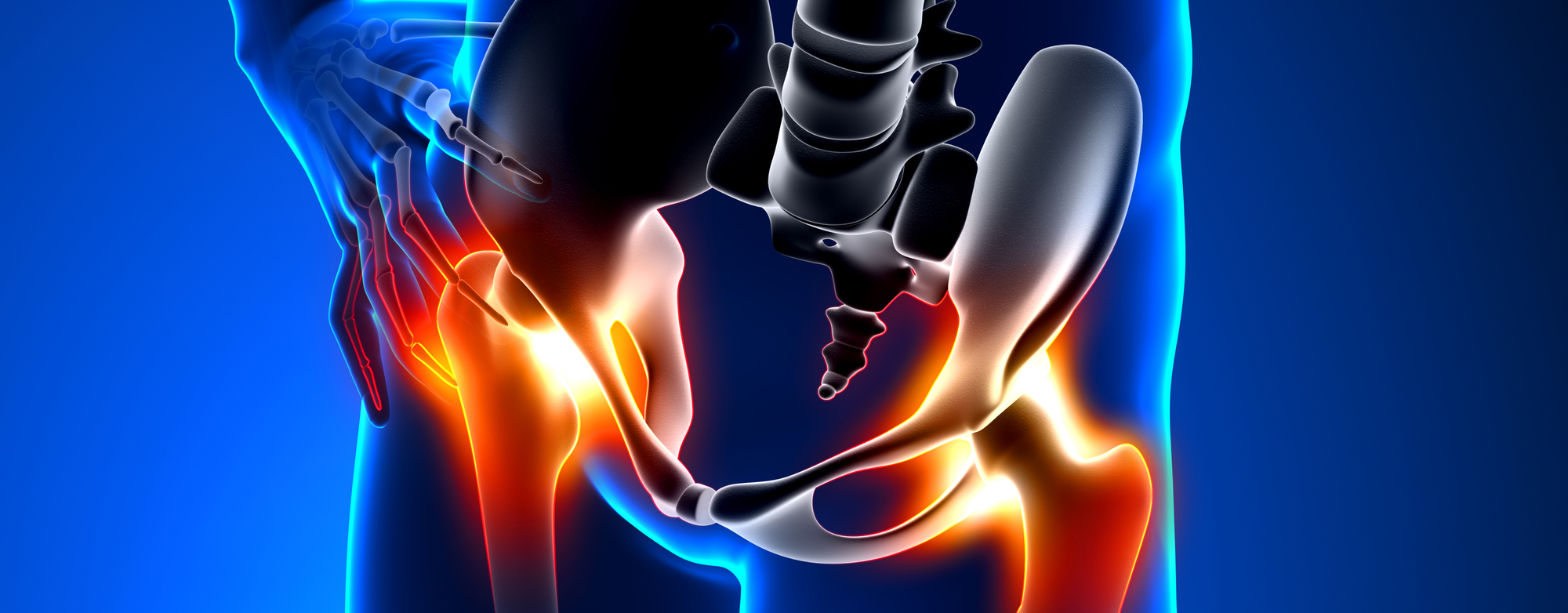
Hip replacement is one of the most successful operations in orthopedic surgery for relieving pain from advanced hip arthritis. Dr. Dold performs total hip replacement using the direct anterior approach (DAA). He reaches the hip joint through the natural interval between muscles at the front of the hip, rather than cutting through them.
- Muscle-sparing approach through the front of the hip
- Performed on a specialized anterior-approach surgical table, with live X-ray (fluoroscopy) during surgery
- OrthoGrid Hip AI® software measures implant position, offset and leg length in real time during the operation
- Many patients go home the same day
- Most patients have no formal hip precautions after surgery
What is the direct anterior approach?
In a total hip replacement, the worn ball (femoral head) and socket (acetabulum) are replaced with implants. The approach is the path the surgeon takes to reach the joint. The direct anterior approach works between the tensor fasciae latae and sartorius muscles at the front of the hip. That lets the surgeon reach the joint without detaching the muscles and tendons that surround it.
Other approaches, such as the posterior approach, are also well established and give excellent results. In a randomized trial, patients who had the anterior approach stopped using all walking aids about 6 days sooner on average (22 vs. 28 days), with little other difference between the groups.1 In a large single-institution study of more than 8,800 hip replacements, dislocation was less common after the anterior approach (0.5%) than after the posterior approach (3.3%).2 The right approach depends on your anatomy, your health and your surgeon’s experience. Dr. Dold will talk through whether the anterior approach is right for you.
Who is a candidate?
Anterior hip replacement may be an option if you have:
- Hip arthritis (osteoarthritis, post-traumatic arthritis or inflammatory arthritis) that limits walking, sleep or daily activity
- Avascular necrosis (osteonecrosis) of the femoral head
- Hip pain that has not improved with non-surgical treatment such as activity changes, physical therapy, medication or injections
For younger, active patients with hip pain but a well-preserved joint, hip arthroscopy may be an alternative. Dr. Dold performs both procedures and can help you weigh them. Learn about hip arthroscopy.
What happens during surgery
- You are positioned on your back on a specialized anterior-approach table.
- A single incision, typically about 3 to 4 inches long, is made at the front of the hip.
- The muscles are gently moved aside, and the arthritic femoral head is removed.
- The socket is prepared and a new cup and liner are placed.
- A stem is placed in the thigh bone with a new ball on top. Dr. Dold usually uses cementless (press-fit) implants that the bone grows onto. A cemented stem may be used when needed, for example in patients with weaker bone.
- Live X-ray is used during surgery to check cup position and leg length before the incision is closed.
AI-assisted implant positioning
During surgery, Dr. Dold uses OrthoGrid Hip AI®, an AI-powered platform built for direct anterior (DA) hip replacement. Images from the intraoperative fluoroscope (live X-ray) are sent to the system automatically. The software corrects for image distortion and tracks the patient’s functional pelvic plane. It then displays smart grid overlays and real-time measurements of:
- Cup positioning: the angle and placement of the new hip socket
- Leg length: identifying and correcting leg length discrepancy (LLD)
- Offset: the distance that affects hip muscle tension, stability and a natural gait
Because these measurements are available while Dr. Dold is still operating, he can fine-tune implant position before the incision is closed.
The goals are precise implant placement, well-matched leg lengths, a stable hip and a smooth recovery. Accurate positioning is linked in research to better hip stability and implant wear. Final results still depend on each patient’s anatomy, bone quality and recovery.
Anesthesia and where surgery is done
Most patients have spinal anesthesia with sedation. The final plan is made with your anesthesiologist. Dr. Dold performs anterior hip replacement at Baylor Surgicare at The Star, Medical City Frisco and other facilities in the area. The location can depend on your health needs and on your insurance plan and coverage, and our team will help you with this.
Watch Dr. Dold explain anterior hip replacement
Recovery timeline
Everyone recovers differently. This is a general guide, and Dr. Dold’s team will give you a personal plan.
| When | What to expect |
|---|---|
| Day of surgery | Walking with a walker or cane with the physical therapy team. Many patients go home the same day; research suggests outpatient hip replacement does not increase complications or readmissions in appropriately selected patients.3 |
| First 2 weeks | Most patients move from a walker to a cane, or to no support, within about 1 to 2 weeks. Walking at home, home exercises, wound care and pain control. First follow-up visit with Dr. Dold’s team at about 10 to 14 days. |
| 2 to 6 weeks | Most patients return to driving and desk work at about 2 to 4 weeks, once off narcotic pain medication. Physical therapy progresses. |
| 6 to 12 weeks | Most daily activities. Physical jobs usually take longer to return to, and Dr. Dold clears each patient individually. In a review of 48 studies, about 88% of people who were working before surgery returned to work.4 |
| 3 months and beyond | Continued strength gains. Discuss low-impact sports such as golf, cycling and swimming with Dr. Dold. |
Most of Dr. Dold’s anterior hip patients do not need formal hip precautions (for example, restrictions on bending past 90 degrees or crossing the legs). He will tell you if your case is different.
Risks
All surgery has risks. For hip replacement these include infection, blood clots, dislocation, a difference in leg length, fracture around the implant, wear or loosening over time, and anesthesia-related risks. Some risks are more specific to the anterior approach. Temporary or permanent numbness on the outer thigh can occur from irritation of the lateral femoral cutaneous nerve; in studies that looked for it specifically, this was common (about 31% on average), and because this nerve carries only sensation, it causes numbness or tingling, not weakness.5 Wound-healing problems can also occur in some patients. Dr. Dold will review your individual risks at your consultation.
What the research shows
Here is a balanced summary of the research on anterior hip replacement and the choices that go with it.
Anterior compared with posterior
Meta-analyses consistently find faster early recovery and less early pain with the anterior approach, and similar overall complication and dislocation rates. Long-term results are similar between approaches. The trade-offs are a higher chance of numbness on the outer thigh from irritation of a skin nerve, and a learning curve: complication rates fall substantially once a surgeon has done roughly 100 cases.
Implant positioning technology
Studies of fluoroscopy and image-based software show that their main benefit is reducing outliers, so fewer implants land outside the target range. In a randomized trial, fluoroscopy-based software placed more cups within the target angle. These tools support, but do not replace, surgical judgment.
Recovery choices
Research does not support routine hip precautions for most patients, and more liberal activity rules have led to faster recovery and higher satisfaction. Same-day discharge has been safe in selected, healthier patients. Blood-clot prevention is tailored to each patient: a large trial found more clots with aspirin than with enoxaparin, while other analyses support low-dose aspirin as an option.
Durability
Registry data suggest most modern hip replacements last 20 years or more.
What patients say
Beyond being an excellent orthopedic surgeon, Dr. Dold is incredibly likable, approachable, and compassionate. His warm personality made me feel comfortable and confident in his care. Having two major joint replacements is a significant experience, and knowing I had a surgeon who truly cared about my recovery made all the difference.
His care continued well beyond the surgeries. He closely monitored my progress and consistently made sure I was comfortable throughout my recovery. I always felt supported and cared for, and I appreciated the attention he gave to how I was healing. That level of dedication means so much when you are working to regain your strength and mobility.
I wholeheartedly recommend Dr. Dold to anyone considering joint replacement. He brings together surgical expertise, genuine kindness, and thoughtful follow-up care. I am thrilled with my recovery and deeply thankful to have had him as my surgeon. Thank you, Dr. Dold, for helping me reach such a wonderful outcome!”
Patient reviews in their own words. Individual results vary. Read more patient reviews.
Why see Dr. Dold for hip replacement
- Board certified by the American Board of Orthopaedic Surgery, with subspecialty certification in Sports Medicine
- Fellow of the American Orthopaedic Association (FAOA), the American Academy of Orthopaedic Surgeons (FAAOS), the American College of Surgeons (FACS) and the Royal College of Surgeons of Canada (FRCSC)
- Orthopedic surgery residency at the University of Toronto; sports medicine and arthroscopy fellowship at NYU Langone / Hospital for Joint Diseases
- Performs both hip arthroscopy (hip preservation) and hip replacement, so your options are weighed together
- D Magazine Best Doctors (Collin County), 2019–2026
- Rated 4.9 on Google
Frequently asked questions
Is anterior hip replacement better than posterior hip replacement?
Both approaches are well established, and long-term results are similar. Some studies suggest the anterior approach may allow a slightly faster early recovery, but the difference tends to narrow over the following months. The right approach depends on your anatomy and your surgeon’s experience.
Will I go home the same day?
Many of Dr. Dold’s patients go home the same day. Whether that is right for you depends on your health, your home support and how you do with physical therapy after surgery.
Will I have hip precautions after surgery?
Most anterior hip patients have no formal hip precautions. Dr. Dold will let you know if your situation calls for any.
How does AI help during hip replacement?
Dr. Dold uses OrthoGrid Hip AI®, AI-powered software that analyzes intraoperative fluoroscopic (live X-ray) images in real time. It measures cup positioning, hip offset and leg length discrepancy (LLD). That gives Dr. Dold precise measurements to guide adjustments before the operation is finished. The aim is accurate implant placement and equal leg lengths. It supports the surgeon’s judgment and doesn’t replace it.
How long does a hip replacement last?
Modern hip replacements are designed to last many years. Based on national registry data, about 58% of hip replacements are still in place after 25 years.6 Longevity depends on factors such as activity level, body weight and bone quality.
When can I drive after anterior hip replacement?
That depends on which hip was replaced, whether you still need prescription pain medicine, and how quickly your strength and reaction time return. Dr. Dold will clear you at a follow-up visit.
Does insurance cover hip replacement?
Hip replacement is generally covered when it is medically necessary. Dr. Dold accepts most major insurance plans, including Medicare and Tricare. Please call 469-850-0680 to confirm your coverage.
Research cited on this page
- Taunton MJ, Mason JB, Odum SM, Springer BD. Direct anterior total hip arthroplasty yields more rapid voluntary cessation of all walking aids: a prospective, randomized clinical trial. J Arthroplasty. 2014;29(9 Suppl):169-172. PubMed
- Haynes JA, Hopper RH Jr, Ho H, et al. Direct anterior approach for primary total hip arthroplasty lowers the risk of dislocation compared to the posterior approach: a single institution experience. J Arthroplasty. 2022;37(3):495-500. PubMed
- Bordoni V, Marelli N, Previtali D, et al. Outpatient total hip arthroplasty does not increase complications and readmissions: a meta-analysis. Hip Int. 2022;32(3):326-333. PubMed
- Soleimani M, Babagoli M, Baghdadi S, et al. Return to work following primary total hip arthroplasty: a systematic review and meta-analysis. J Orthop Surg Res. 2023;18(1):95. PubMed
- Dahm F, Aichmair A, Dominkus M, Hofstaetter JG. Incidence of lateral femoral cutaneous nerve lesions after direct anterior approach primary total hip arthroplasty: a literature review. Orthop Traumatol Surg Res. 2021;107(8):102956. PubMed
- Evans JT, Evans JP, Walker RW, et al. How long does a hip replacement last? A systematic review and meta-analysis of case series and national registry reports with more than 15 years of follow-up. Lancet. 2019;393(10172):647-654. PubMed
- Ang JJM, Onggo JR, Stokes CM, et al. Comparing direct anterior approach versus posterior approach or lateral approach in total hip arthroplasty: a systematic review and meta-analysis. Eur J Orthop Surg Traumatol. 2023;33(7):2773-2792. PubMed
A meta-analysis of 24 studies found the anterior approach gave better early function and a shorter hospital stay than the posterior approach, with similar dislocation and complication rates. - Jin Z, Wang L, Qin J, et al. Direct anterior approach versus posterolateral approach for total hip arthroplasty in the treatment of femoral neck fractures in elderly patients: a meta-analysis and systematic review. Ann Med. 2023;55(1):1378-1392. PubMed
In older patients, the anterior approach gave quicker functional recovery than the posterior approach but more thigh numbness from lateral femoral cutaneous nerve irritation. - Yang XT, Huang HF, Sun L, et al. Direct Anterior Approach Versus Posterolateral Approach in Total Hip Arthroplasty: A Systematic Review and Meta-analysis of Randomized Controlled Studies. Orthop Surg. 2020;12(4):1065-1073. PubMed
Anterior and posterior approaches had comparable overall results, with earlier recovery and less pain after the anterior approach. - Huang XT, Liu DG, Jia B, et al. Comparisons between Direct Anterior Approach and Lateral Approach for Primary Total Hip Arthroplasty in Postoperative Orthopaedic Complications: A Systematic Review and Meta-Analysis. Orthop Surg. 2021;13(6):1707-1720. PubMed
A large meta-analysis found some complications, including nerve injury, were more frequent after the anterior approach, although rates were low. - Yan L, Ge L, Dong S, et al. Evaluation of Comparative Efficacy and Safety of Surgical Approaches for Total Hip Arthroplasty: A Systematic Review and Network Meta-analysis. JAMA Netw Open. 2023;6(1):e2253942. PubMed
A network meta-analysis of surgical approaches found similar improvements in hip scores across most approaches. - Meermans G, Konan S, Das R, et al. The direct anterior approach in total hip arthroplasty: a systematic review of the literature. Bone Joint J. 2017;99-B(6):732-740. PubMed
A review found little evidence of better long-term outcomes with the anterior approach and described a steep learning curve. - Nairn L, Gyemi L, Gouveia K, et al. The learning curve for the direct anterior total hip arthroplasty: a systematic review. Int Orthop. 2021;45(8):1971-1982. PubMed
Operative time with the anterior approach levels off after about 100 cases, and complication rates fall substantially with experience. - Lee GC, Marconi D. Complications Following Direct Anterior Hip Procedures: Costs to Both Patients and Surgeons. J Arthroplasty. 2015;30(9 Suppl):98-101. PubMed
The most common early complications of anterior hip replacement were nerve symptoms (2.8%) and fractures during surgery (2.3%). - De Geest T, Fennema P, Lenaerts G, et al. Adverse effects associated with the direct anterior approach for total hip arthroplasty: a Bayesian meta-analysis. Arch Orthop Trauma Surg. 2015;135(8):1183-92. PubMed
A meta-analysis noted a learning curve with the anterior approach and a risk of thigh numbness and fractures during surgery. - Sang W, Xue S, Xu Y, et al. Bikini Incision Increases the Incidence of Lateral Femoral Cutaneous Nerve Injury in Direct Anterior Approach Hip Arthroplasty: A Prospective Ultrasonic, Electrophysiological, and Clinical Study. J Arthroplasty. 2021;36(10):3463-3470. PubMed
In a randomized trial, a horizontal “bikini” incision increased the rate of lateral femoral cutaneous nerve injury. - Subramanian T, Oles A, Halayqeh S, et al. Systematic Review of Wound Complications After Direct Anterior Approach Total Hip Arthroplasty: Incidence, Risk Factors, and Management Strategies. J Am Acad Orthop Surg. 2026;34(19):e2736-e2752. PubMed
Wound complications after anterior hip replacement were uncommon and usually managed without surgery; obesity raised the risk. - Shah NV, Huddleston HP, Wolff DT, et al. Does Surgical Approach for Total Hip Arthroplasty Impact Infection Risk in the Obese Patient? A Systematic Review. Orthopedics. 2022;45(2):e67-e72. PubMed
Higher body weight increased the risk of wound complications and infection with the anterior approach, and also raised infection risk with the posterior approach. - Sun C, Lee WG, Ma Q, et al. Does intraoperative fluoroscopy improve acetabular component positioning and limb-length discrepancy during direct anterior total hip arthroplasty? A meta-analysis. J Orthop Surg Res. 2023;18(1):586. PubMed
A review found intraoperative fluoroscopy did not clearly improve average cup position or leg length, though it may help less experienced surgeons. - Hamilton WG, Parks NL, McDonald JF, et al. A Prospective, Randomized Study of Surgical Positioning Software Shows Improved Cup Placement in Total Hip Arthroplasty. Orthopedics. 2019;42(1):42-47. PubMed
In a randomized trial, fluoroscopy-based software placed more cups within 5° of the target angle (87% vs 68%). - Jha G, Malasani S, Bishnoi A. Beyond robotics: a systematic review of technology integration in direct anterior approach total hip arthroplasty. J Robot Surg. 2026;20(1). PubMed
A 2026 review of image-based navigation in anterior hip replacement found its main value is reducing outliers in implant position rather than changing the average. - Korfitsen CB, Mikkelsen LR, Mikkelsen ML, et al. Hip precautions after posterior-approach total hip arthroplasty among patients with primary hip osteoarthritis do not influence early recovery: a systematic review and meta-analysis of randomized and non-randomized studies with 8,835 patients. Acta Orthop. 2023;94:141-151. PubMed
A meta-analysis found no support for routinely prescribing hip precautions after hip replacement to prevent dislocation. - van der Weegen W, Kornuijt A, Das D. Do lifestyle restrictions and precautions prevent dislocation after total hip arthroplasty? A systematic review and meta-analysis of the literature. Clin Rehabil. 2016;30(4):329-39. PubMed
More liberal activity rules after hip replacement did not increase dislocation and led to faster return to activities and higher satisfaction. - French JMR, Woods A, Sayers A, et al. Day-case knee and hip replacement. Bone Joint J. 2024;106-B(12):1385-1392. PubMed
Outcomes after day-case hip and knee replacement appeared no worse than after an inpatient stay in selected patients. - Jaibaji M, Volpin A, Haddad FS, et al. Is Outpatient Arthroplasty Safe? A Systematic Review. J Arthroplasty. 2020;35(7):1941-1949. PubMed
Patients chosen for outpatient joint replacement were generally younger, more active and healthier. - Li Z, Xu X, Zhuang Z, et al. Impact of spinal Anaesthesia versus general Anaesthesia on the incidence of surgical site infections after knee or hip arthroplasty: A meta-analysis. Int Wound J. 2024;21(1):e14369. PubMed
Spinal anesthesia was associated with fewer surgical site infections than general anesthesia in joint replacement. - Xu Y, Sun S, Feng Q, et al. The efficiency and safety of oral tranexamic acid in total hip arthroplasty: A meta-analysis. Medicine (Baltimore). 2019;98(46):e17796. PubMed
Oral tranexamic acid reduced blood loss after hip replacement without increasing complications. - CRISTAL Study Group, Sidhu VS, Kelly TL, et al. Effect of Aspirin vs Enoxaparin on Symptomatic Venous Thromboembolism in Patients Undergoing Hip or Knee Arthroplasty: The CRISTAL Randomized Trial. JAMA. 2022;328(8):719-727. PubMed
The CRISTAL trial found a higher rate of symptomatic blood clots with aspirin than with enoxaparin after hip or knee replacement. - Cheok T, Beveridge A, Berman M, et al. Efficacy and safety of commonly used thromboprophylaxis agents following hip and knee arthroplasty. Bone Joint J. 2024;106-B(9):924-934. PubMed
A network meta-analysis recommended low-dose aspirin, enoxaparin or dabigatran as options for clot prevention after joint replacement. - Megaloikonomos PD, Nowak L, Shehata M, et al. Does Stem Design Affect the Incidence of Periprosthetic Femoral Fractures in Arthroplasty for Femoral Neck Fractures? A Secondary Analysis of the HEALTH Trial. J Arthroplasty. 2025;40(8S1):S322-S327.e3. PubMed
A randomized trial found cementless stems had a relatively high rate of fractures around the implant, regardless of stem type. - Pentland V, Thompson Z, Dayimu A, et al. Survivorship of modern total hip replacement to 30 years: systematic review, meta-analysis, and extrapolation of global joint registry data. Lancet. 2026;407(10531):855-866. PubMed
A 2026 analysis of nearly 1.9 million hip replacements estimated about 94% survival at 20 years and about 92% at 30 years.
Medically reviewed by Andrew P. Dold, MD, FAOA, FAAOS, FACS, FRCSC. Last reviewed September 30, 2026. This page is general information, not medical advice.
“The results of my total hip replacement surgery performed by Doctor Dold and Karina were excellent… The day after the surgery I had the expected muscle pain but no joint pain… I also walked one mile without a cane or walker… Five weeks after the surgery I participated in a 10K and did it without any pain and at a fast pace. Now at five months I have been doing all my activities such as workouts at the gym, gardening and other physical activities without any limitations.”
— Harry B., Total hip replacement (Google review). Individual results vary.