







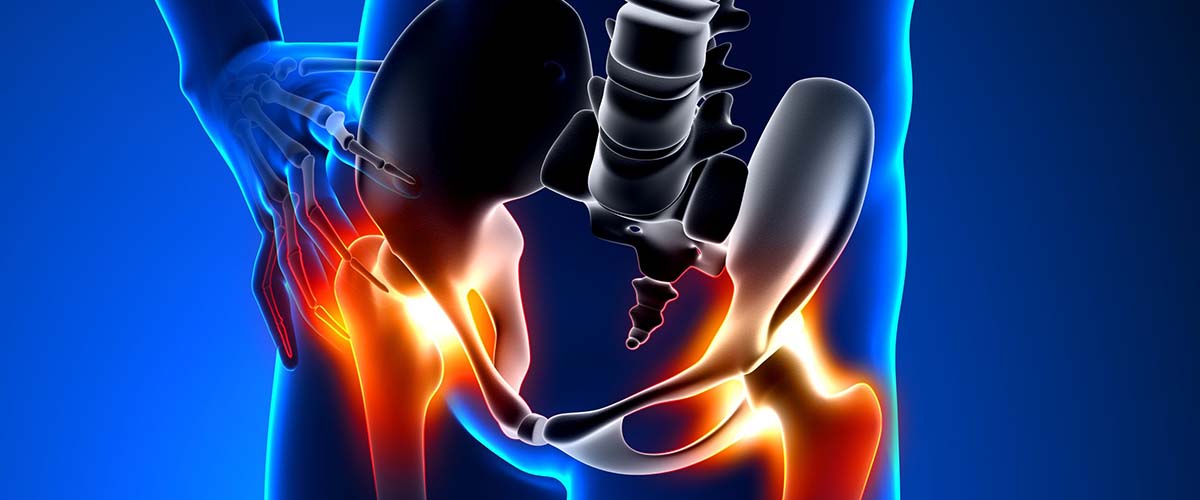
The anterior inferior iliac spine (AIIS) is a bony bump at the front of the pelvis, just above the hip joint, where the straight head of the rectus femoris (the main hip-flexing quadriceps muscle) attaches. In teenagers, this bump is still attached by a growth plate. A forceful kick or sprint start can pull the growth plate and a piece of bone off: an AIIS avulsion fracture. It is one of the two most common pelvic avulsion injuries in young athletes, along with the ASIS avulsion.1,2
- Sudden pain at the front of the hip or groin during a kick or sprint, often with a “pop”
- Most common in boys aged about 13 to 17 in soccer, football, track and sprint sports
- Diagnosed with X-ray; MRI or CT in selected cases
- Most heal without surgery, with rest, crutches and physical therapy
- Surgery is considered for widely displaced fragments, or later for painful bone overgrowth that pinches the hip (subspine impingement)
Symptoms
- Sharp pain at the front of the hip or groin during a kick, sprint or jump
- Pain lifting the leg or bending the hip against resistance
- A limp and tenderness just below the front of the pelvis
- Sometimes bruising and swelling
Diagnosis
An X-ray of the pelvis usually shows the fragment. Comparing both sides helps, because the growth plate can be hard to judge. MRI is useful when the X-ray is normal or to look for other injuries, and CT can measure displacement when surgery is being considered.
Non-surgical treatment
Most AIIS avulsions are treated without surgery.1,2
- Protection (about 1 to 2 weeks): rest, ice, crutches as needed, and avoiding stretching the front of the hip
- Restoring motion: gentle range of motion and walking without a limp
- Strengthening: progressive hip and core strengthening with a physical therapist
- Return to sport: sprinting and kicking are added last, once strength and motion are back
In a prospective study, most adolescents treated without surgery had near-complete recovery of strength by 3 months.3
When is surgery considered?
Surgery to fix the fragment may be considered when it is widely displaced in a high-level athlete. An older review found higher return-to-sport rates with surgery, especially with more than 15 mm of displacement,1 but a 2026 review of 852 fractures found good results with either approach and no proven displacement threshold for surgery.2 The decision is individualized.
Occasionally, an AIIS that healed in a raised position or grew larger causes subspine impingement years later: pinching pain at the front of the hip with deep bending. This can be treated by arthroscopically reshaping the bone, often alongside treatment of hip impingement (FAI).4 See hip arthroscopy.
Recovery
Most young athletes return to sport in about 6 to 12 weeks without surgery, depending on the size of the injury and the sport. Returning before strength is restored increases the risk of re-injury.
Frequently asked questions
Is an AIIS avulsion a broken hip?
No. It is a small piece of bone pulled off the front of the pelvis by a tendon. The hip joint itself is not broken.
Will my child need surgery?
Usually not. Most heal with rest, crutches if needed and physical therapy. Surgery is considered for widely displaced fragments or for later impingement.
How long until my child can play again?
Most return in about 6 to 12 weeks, once they have full motion and strength and can sprint and kick without pain.
Why does this happen in teenagers?
The growth plate where the tendon attaches is weaker than the tendon itself until it fuses in the late teens, so a forceful contraction pulls off bone instead of tearing the muscle.
Can it cause problems later?
Occasionally the bone heals in a raised position and pinches against the hip with deep bending (subspine impingement). This can be treated arthroscopically if it causes symptoms.
Research cited on this page
- Eberbach H, Hohloch L, Feucht MJ, et al. Operative versus conservative treatment of apophyseal avulsion fractures of the pelvis in the adolescents: a systematical review with meta-analysis of clinical outcome and return to sports. BMC Musculoskelet Disord. 2017;18(1):162. PubMed
Across 596 adolescents (mean age 14), the AIIS was the most commonly involved site (33%). Return to sport was 80% with non-surgical care and 92% with surgery; surgery was suggested for displacement over 15 mm in high-demand athletes. - Molina LL, Block AM, Carsen S, et al. Outcomes of conservative versus surgical treatment of adolescent pelvic and hip avulsion fractures: a systematic review and meta-analysis. J Pediatr Orthop. 2026 (online ahead of print). PubMed
852 fractures: ASIS (33%) and AIIS (30%) were most common. Both approaches gave favorable outcomes for most; no validated displacement threshold for surgery was established. - Ratcliff T, Ojeaga PO, Hawkins ND, et al. Strength recovery from nonsurgical treatment of apophyseal avulsions of the pelvis. J Pediatr Orthop. 2025;45(9):e797-e803. PubMed
No strength deficits remained after non-surgical treatment; most had near-complete strength recovery at 3 months. - Perets I, Rybalko D, Mu BH, et al. Hip arthroscopy: extra-articular procedures. Hip Int. 2019;29(4):346-354. PubMed
Reviews AIIS/subspine impingement among extra-articular hip problems that can be treated arthroscopically, usually after non-surgical care has failed.
Medically reviewed by Andrew P. Dold, MD, FAOA, FAAOS, FACS, FRCSC. Last reviewed October 2026. This page is general information, not medical advice. Your own diagnosis and treatment plan depend on your exam and imaging.